If you rent, you don’t get to drill holes, install shelves everywhere, or stockpile like you’re building a bunker. You do get to have a simple, calm emergency plan for UK renters that covers the stuff that actually happens here: power cuts, water issues, boiler failures, storms, travel disruption, and “everything’s closed / delayed” weeks.
This is built for real rented homes: flats, shared houses, HMOs, studios, and short-term lets. No panic. No “tactical” cringe. Just the boring systems that make day two feel normal.
If you’re brand new to home preparedness, start with our calm 72-hour framework first, then come back to this renter-specific version: Prepping for Beginners UK Calm 72-Hour Starter System
Key takeaways
- Keep it renter-sized: one box, one folder, one shelf
- Build 72 hours first, then scale up
- Save the right numbers (and keep a paper backup)
- Know your building basics: exits, alarms, shut-offs, who to call
- Make it maintainable: a 10-minute monthly check beats a “prep day”
What an emergency plan looks like in a rented home
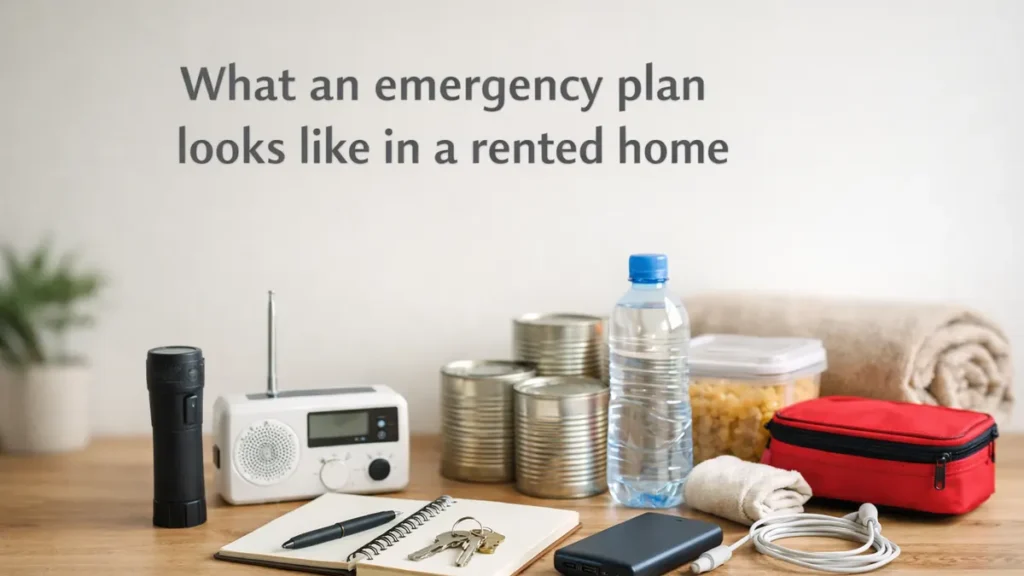
An emergency plan for UK renters is really three tiny plans you can write on half a page:
- Stay put plan: you’re safer (or it’s simply easier) staying inside for 24–72 hours
- Step-out plan: you might need to pop out to charge devices, get supplies, or check on someone
- Relocate plan: you have to leave the property (fire damage, serious leak, building issue)
You’re not trying to predict every scenario. You’re removing the “what do we do now?” moment when your phone battery is at 12% and everyone’s tired.
A good companion read here is our calm “stay at home” approach (especially relevant for flats and renters):
Shelter-in-place prepping UK: stay safe at home
The 10-minute setup for an emergency plan for UK renters
1) Save these numbers and also write them down
Save them in your phone and keep a paper copy in your “boring folder” (below). In a longer power cut, your phone can die and networks can get patchy.
| What | Why it matters | What to save |
|---|---|---|
| Emergency services | Immediate danger | 999 |
| NHS urgent help | Advice fast, not life-threatening | 111 and 111.nhs.uk |
| Power cut reporting | Connects you to your local network operator | 105 (free) |
| Gas emergency | Smell gas / suspected leak | 0800 111 999 |
| Landlord/agent | Repairs, access, building issues | Main + out-of-hours number |
| Building manager/concierge | Communal areas, alarms, shutdowns | If you have one |
Useful official guidance:
2) Choose one local meeting point and one out-of-area contact
- Local meeting point: somewhere obvious and safe near home (corner shop, café, library)
- Out-of-area contact: someone outside your area who can relay messages if local networks are busy
- Shared house tip: agree one simple rule: “If we can’t reach each other, we meet at X at Y time.”
3) Learn the shut-off basics
Renters don’t need to touch anything you’re not confident with. But you should know what’s where:
- Stopcock location (often under the kitchen sink / in a cupboard)
- Consumer unit (fuse box) location
- Gas shut-off location (if you have gas)
- Main exits + nearest alternative exit
Quick win: take a photo of each and store it in a phone album called Home basics.
4) Create a “boring folder” you can grab
A cheap A4 folder or document wallet. This is the stuff that makes hard days easier.
Include:
- Tenancy agreement and landlord/agent details
- Building info (entry instructions, spare key arrangements)
- Contents insurance details (if you have it)
- A paper list of emergency numbers
- Any medical info you’d want to hand over quickly
Want a bigger, step-by-step home setup to copy? Use the full guide and just adapt it to your home:
UK 72-hour Home Plan: Calm 7-step System
The renter-friendly 72-hour kit that fits on one shelf
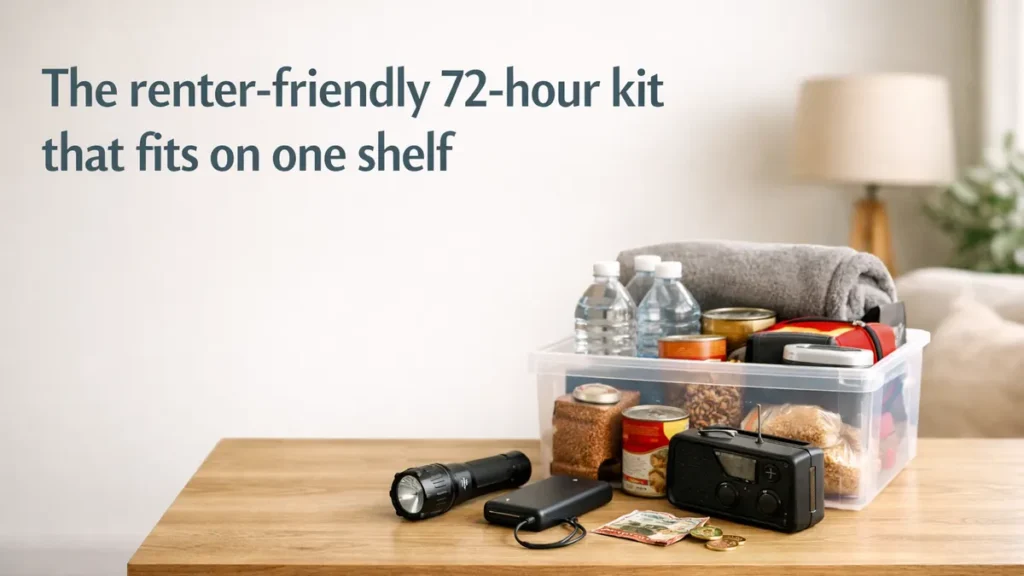
This is your emergency kit for renters UK: one plastic box, tote bag, or small suitcase that lives in the same place all year.
Renter rule: if it doesn’t fit in one box, you’re allowed to say “not yet”. Start small and build it up over a few weekly shops.
Emergency kit for renters UK checklist
| Item | Why it’s in the kit | Where to buy | Typical UK price |
|---|---|---|---|
| Torch (battery or wind-up) | Safer than candles | Tesco/Asda/Aldi, Argos, Screwfix | £5–£20 |
| Spare batteries | Keeps torch/radio going | Supermarket, B&M, Poundland | £2–£10 |
| Power bank + right cables | Phone power when sockets are off | Argos, Amazon, supermarkets | £10–£35 |
| Battery/wind-up radio | Updates if internet is patchy | Argos, Amazon | £15–£40 |
| Bottled water or clean containers | Drinking + basic hygiene | Any supermarket | £2–£8 |
| 3 days of simple food | Stress drops when you can eat normally | Any supermarket | £10–£25 per person |
| Tin opener | Quietly essential | Supermarket, IKEA, pound shops | £1–£8 |
| First aid + regular meds | Headaches/cuts/blisters happen | Boots, Superdrug, supermarkets | £5–£25 |
| Warm layer + socks | Heating failures feel rough fast | Your wardrobe | £0 |
| Hygiene bits | Day two feels normal | Supermarket | £3–£15 |
| Small cash float | Card machines can go down | ATM | What you can manage |
For a no-waste food buffer that works in normal UK kitchens (not “survival food”), link your renter kit to your cupboard plan:
Emergency Food Storage UK Food Storage for Normal UK Homes
And if you want a “timer-based” approach (great for renters and busy households), use:
UK Prepping Checklists (30 minutes, 2 hours, 1 weekend)
A simple food rule for renters
- Pick 7 meals you already eat
- Each shop, buy one extra (not bulk)
- Store it in one buffer spot and rotate as you use it
This one habit gives you calm momentum without turning your rental into a storage unit.
Fire and carbon monoxide basics for renters and flat dwellers
Most emergencies are boring and inconvenient. Fire and carbon monoxide are the exceptions, so this bit is worth doing properly.
Alarms: what to check and what to report
Rules vary across the UK, but the practical renter approach is consistent:
- Make sure you have working smoke alarms and test them regularly
- If you have gas appliances, take carbon monoxide seriously
- Report faulty alarms quickly and keep the message/email
For England-specific guidance GOV.UK
If you smell gas or suspect carbon monoxide:
- Get into fresh air
- Call the gas emergency line:
If you live in a block of flats
- Find your building’s fire safety instructions (noticeboard, hallway signage, tenant pack)
- Know two routes out if possible
- Keep keys, shoes, and a coat in the same place so you can leave quickly if needed
Power cuts and winter disruption what renters should do first
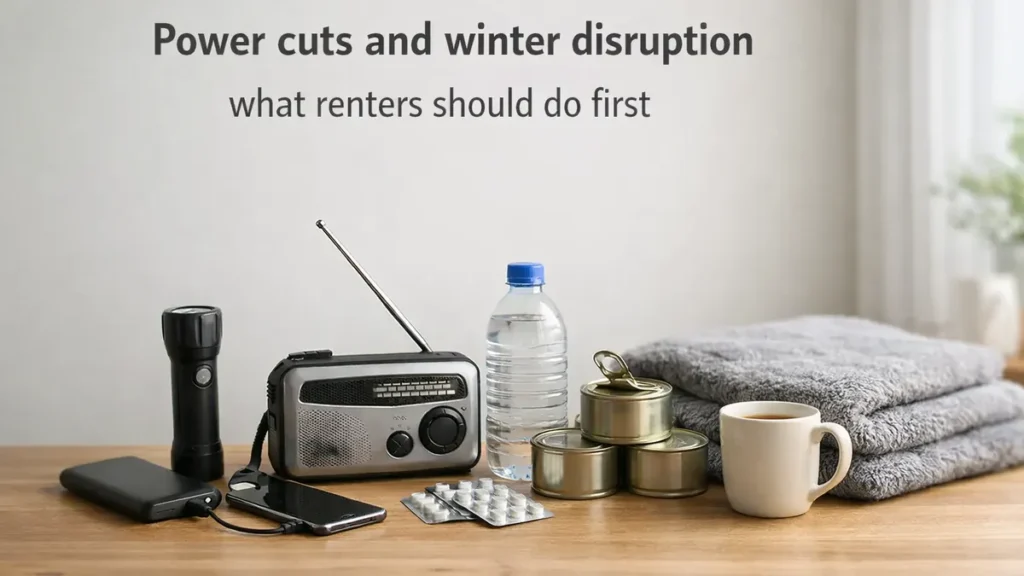
When the power goes, don’t start by shopping. Start by doing the calm basics:
- Report the outage on 105
- Unplug sensitive electronics (surges can happen when power returns)
- Keep fridge/freezer closed as much as possible
- Layer clothing and close doors to keep heat in one room
If you want a full warm-room plan that works in normal UK homes (and doesn’t involve weird gadgets), use:
Power Cuts and Home Warmth UK: Stay Warm Safely
External reference for power cuts:
National Grid
Renter realities: what not to do
This is where people accidentally make renting harder:
- Storing unsafe fuels indoors (especially in flats)
- Candles as your main lighting plan (fires happen fast)
- Buying bulky gear you can’t store or carry
- Creating a kit that’s so complicated you never maintain it
Your emergency plan should feel like a tidy household system, not a secret hobby.
Quick-start checklist emergency plan for UK renters in 30 minutes
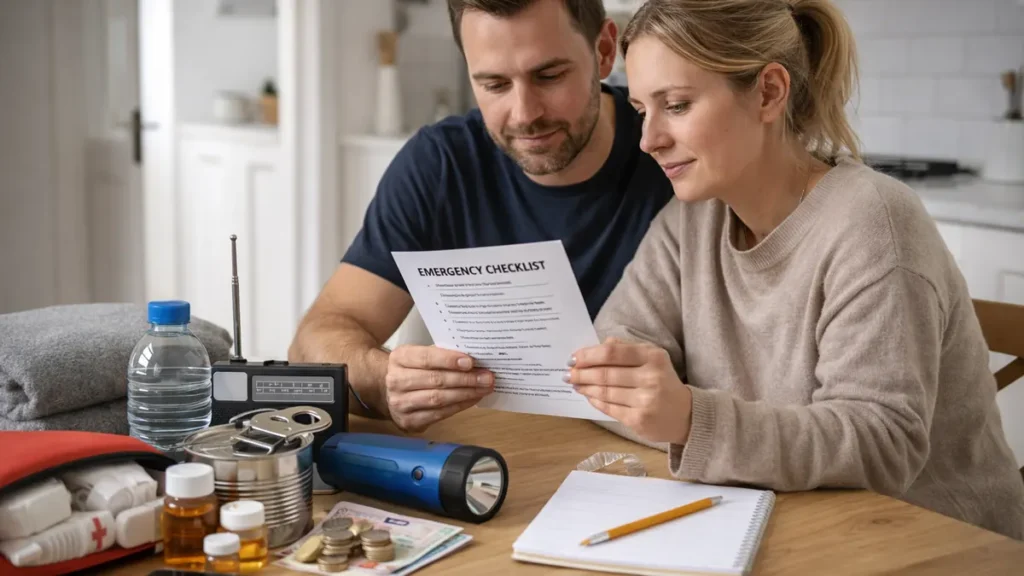
- Save + write down: 999, 111, 105, 0800 111 999, landlord/agent
- Choose a local meeting point + out-of-area contact
- Photograph: stopcock, fuse box, gas shut-off (if relevant)
- Build the “boring folder” (tenancy docs + emergency numbers)
- Start your emergency kit for renters UK (torch, batteries, power bank, water, 3 days of food, tin opener)
- Test smoke alarm (and CO alarm if you have one)
If you want the “do this in small bites” version, this pairs perfectly with renters and small flats:
Next Read:
Checklist Guide
Common mistakes that make renter emergency plans harder than they need to be
- Buying lots of gear first (plan + contacts matter more)
- No paper backup (phones die at the worst time)
- Food you don’t eat (won’t rotate, becomes clutter)
- Not knowing building basics (exits, alarms, who to call)
- All-or-nothing thinking (one box today beats “perfect someday”)
FAQs
What is the simplest emergency plan for UK renters?
Three things:
- a written contact list + meeting plan
- a one-box 72-hour kit
- knowing your building basics (exits, shut-offs, alarm testing)
That’s a complete emergency plan for UK renters without turning your flat into a storage unit.
How much should a renter emergency kit cost in the UK?
You can start under £20 if you already own warm layers and can repurpose a box/bag. Most renters build it across a few shops: torch + batteries first, then power bank, then a simple 3-day food buffer.
Do renters need bottled water?
It’s the easiest start because it’s simple and safe. If you’re tight on space, keep a couple of smaller bottles and rotate them. You can scale up later. If you want to avoid the common beginner mistakes, read: emergency water storage UK
Who is responsible for smoke alarms and carbon monoxide alarms in a rented home?
It depends on UK nation and tenancy type. The practical rule is: test what you have, report faults quickly, and follow local official guidance. For England-specific guidance, use the GOV.UK link above.
What should I do first in a power cut in a flat?
Call 105, use a torch (avoid candles), and focus on warmth (layer up, close doors) and phone power (power bank).
What if I’m in a shared house and everyone has different routines?
Agree one simple rule: if phones are down, meet at X at Y time. Keep the kit in a shared cupboard and do a 10-minute monthly check together (batteries, torch, food dates).
Your next step
Tonight, set a 10-minute timer and do the basics: save the numbers, choose a meeting point, and start your one-box kit with a torch, batteries, and a power bank. That’s your emergency plan for UK renters started — calm, realistic, and actually maintainable.
When you’re ready to expand it into a full home system, follow the step-by-step plan here: Power cuts and home warmth