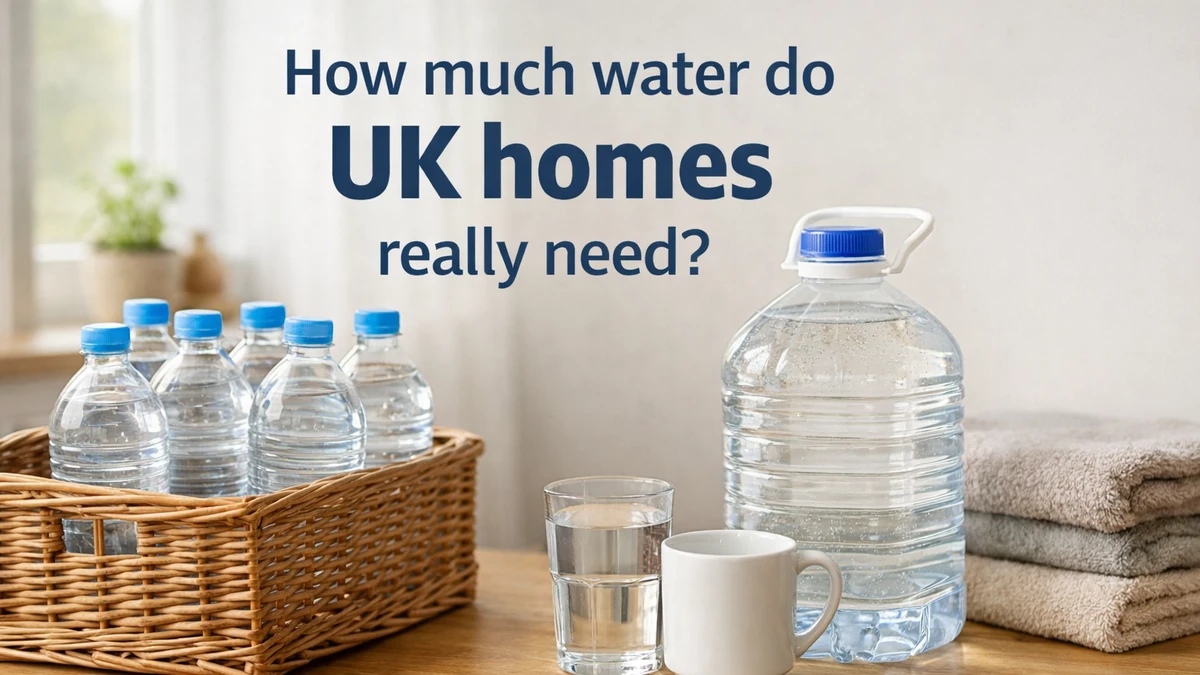
If you’ve ever wondered how much water do UK homes need, you’re not alone. Most of us don’t think about it until there’s a burst main, a local supply issue, or a notice from the water company.
The good news: you don’t need a garage full of supplies. You just need a simple number you can trust, and a realistic storage plan that fits a normal UK home.
This guide will help you work out how much water do UK homes need for 72 hours, a week, or longer, without turning your hallway into a warehouse.
If you are like me and like to start at the beginning and go step by step Prepping UK The Complete System is for you
Key takeaways
- A sensible baseline for emergencies is 2.5–3 litres of drinking water per person per day.
- For a more comfortable buffer (drinking, basic cooking, quick hygiene), aim closer to 10 litres per person per day if you can store it.
- A simple rule: people × days × litres per person per day = total litres to store
- Start with a 3-day core you can actually keep at home, then build from there
- Flats and renters can do this with 2-litre bottles under beds, in wardrobes, and low kitchen cupboards
How much water do UK homes need in an emergency?
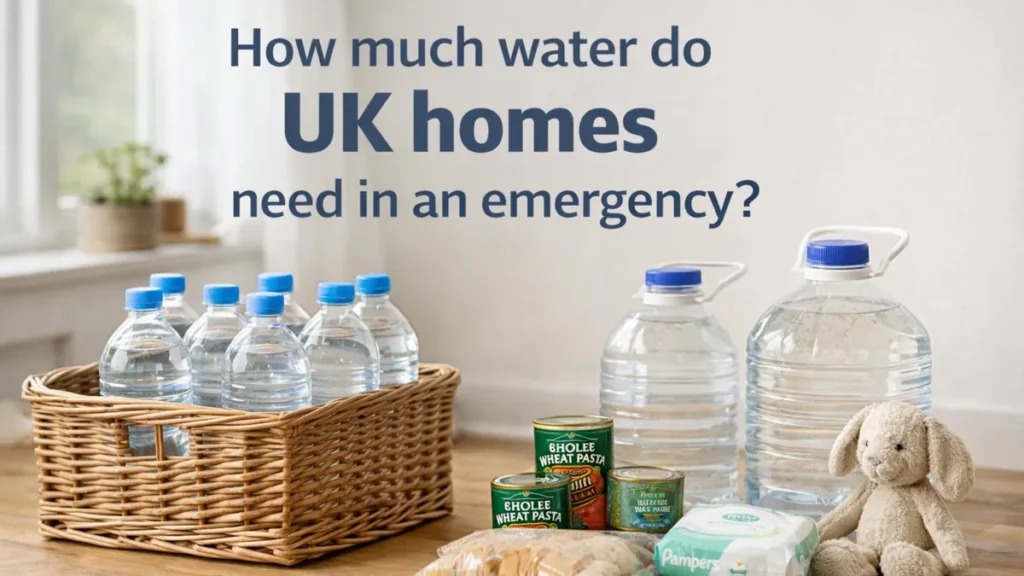
Let’s keep it plain and practical. When people ask how much water do UK homes need, they usually mean: “How much should I have at home so we’re fine for a few days?”
UK government guidance via the Prepare campaign notes there’s no single perfect number (because situations vary), but it gives two very useful benchmarks:
- Minimum for survival: 2.5–3 litres of drinking water per person per day
- More comfortable level: about 10 litres per person per day to also cover basic cooking and hygiene
British Red Cross advice for an emergency kit includes having three days’ supply of bottled water as part of a sensible household setup.
So the “right” answer depends on what you’re planning for:
- If you want a minimum buffer so nobody goes without drinks: plan around 3 litres per person per day
- If you want to feel normal-ish (tea, simple meals, quick wash): push towards 10 litres per person per day where space allows
The simple calculator for how much water do UK homes need
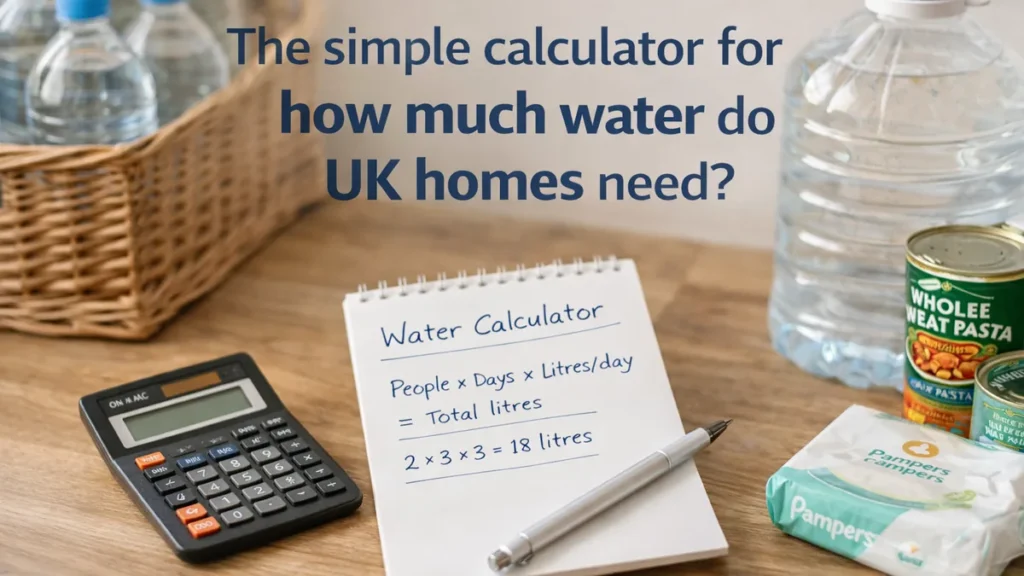
Use this every time. It’s the easiest way to stop guessing.
The formula
People × Days × Litres per person per day = Total litres
Choose your “litres per person per day” target:
- 3 litres = drinking only, bare minimum buffer
- 10 litres = drinking + basic cooking + basic hygiene
Quick examples
- 2 adults, 3 days, drinking only
2 × 3 × 3 = 18 litres - 2 adults, 3 days, more comfortable
2 × 3 × 10 = 60 litres - Family of 4, 3 days, drinking only
4 × 3 × 3 = 36 litres
That’s the core of answering how much water do UK homes need: pick a target, do the sum, store what you can.
Quick reference table
This table shows per-person totals first (so you can multiply easily).
| Days to cover | Drinking only target (3L per person per day) | Comfortable target (10L per person per day) |
|---|---|---|
| 3 days | 9L per person | 30L per person |
| 7 days | 21L per person | 70L per person |
| 14 days | 42L per person | 140L per person |
Now multiply by household size:
- 1 person, 3 days: 9L minimum or 30L comfortable
- 2 people, 3 days: 18L minimum or 60L comfortable
- 4 people, 3 days: 36L minimum or 120L comfortable
If you’re in a flat, that “comfortable” number can feel massive. Don’t stress. You can do a realistic version that still works well (I’ll show you below).
What counts as “water you need”?
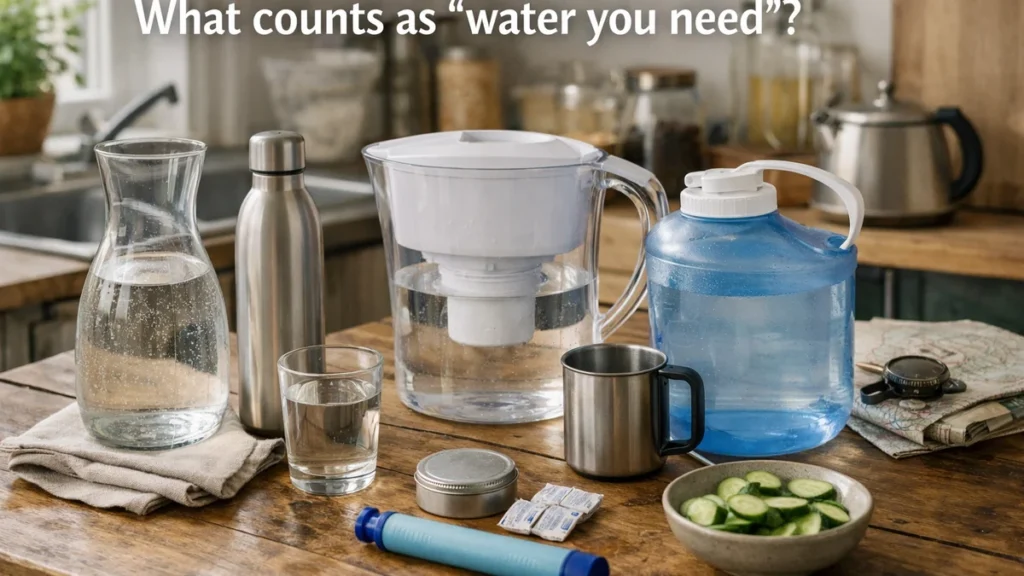
When people calculate how much water do UK homes need, they often forget the everyday stuff that quietly adds up:
Drinking and hot drinks
Water for drinking, squash, tea, coffee.
The NHS generally advises aiming for 6 to 8 cups or glasses of fluid a day (not all of it has to be plain water).
In an emergency, you’re planning for water specifically, so you’re covering your drinks in a reliable way.
Simple cooking
Think: porridge, instant mash, pasta, pot noodles, cup soups, rehydrating foods.
Basic hygiene
Hand washing, quick “strip wash”, toothbrushing, wiping down surfaces.
This is why the “comfortable” benchmark goes up to around 10 litres per person per day.
Extra needs
Prepare also flags that you may need extra water for things like baby formula, medical devices, and pets.
A realistic target for normal UK homes
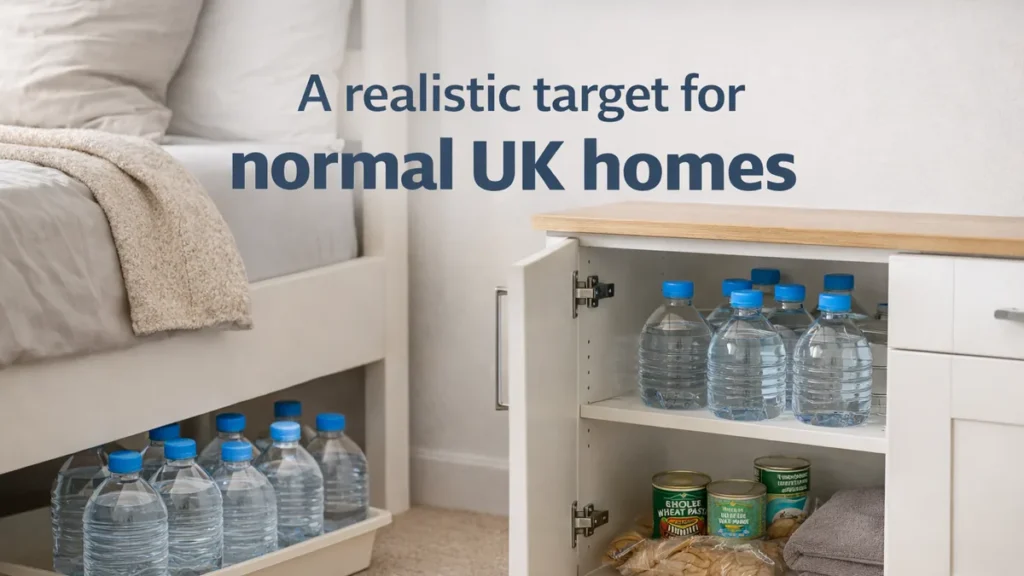
Here’s a calm, space-friendly way to decide how much water do UK homes need, without aiming for perfection on day one.
Level 1: The easy minimum (great starting point)
- Aim for 3 litres per person per day for 3 days
- That’s “drinks covered” and you can handle everything else with smart choices
Who this suits:
- Small flats, renters, limited storage, anyone starting from zero
Level 2: The practical sweet spot
- Aim for 5–7 litres per person per day for 3 days
- Enough for drinks plus basic cooking and quick hygiene without feeling deprived
Who this suits:
- Most households who can spare one cupboard floor or a few under-bed crates
Level 3: The comfortable buffer
- Aim for 10 litres per person per day for 3 days where possible
- This is the “we can keep routines going” level
Who this suits:
- Families with more storage, people with babies, higher needs, or medical considerations
If you want the simplest answer to how much water do UK homes need: start with Level 1, then build toward Level 2.
How to store water in a UK flat or rented home
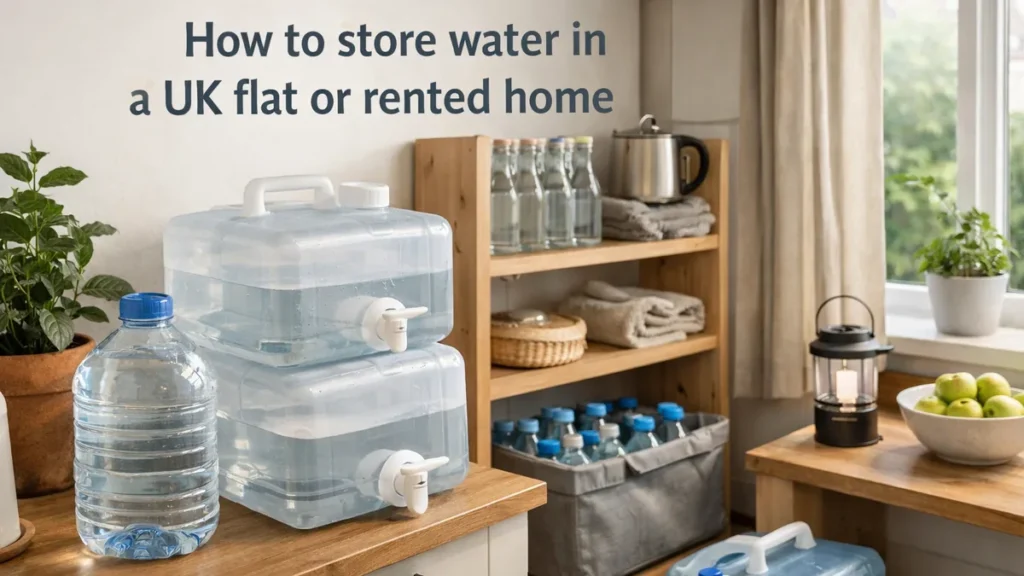
You don’t need fancy containers. You need smart placement and sensible weight.
Best storage spots in smaller homes
- Under beds (2-litre bottles in shallow crates)
- Bottom of wardrobes (kept upright, not squashing clothes)
- Low kitchen cupboards (away from cleaning chemicals)
- Utility cupboard floor
- Behind the sofa (if it’s cool and dark)
Avoid:
- Lofts (temperature swings)
- Next to radiators or boilers
- Car boots long-term (heat/cold cycles)
Bottles vs larger containers
- 2-litre bottles: easiest to buy, easiest to rotate, easiest to carry
- 5-litre bottles: fewer units, but heavier to move once opened
- 10-litre containers: efficient, but heavy and awkward in tight spaces
A simple flat-friendly setup:
- Per person: 6 to 10 x 2-litre bottles (that’s 12–20 litres per person as a starting stash)
- Store them split across two or three locations (so one leak doesn’t ruin everything)
Rotation and “water admin” that takes 2 minutes
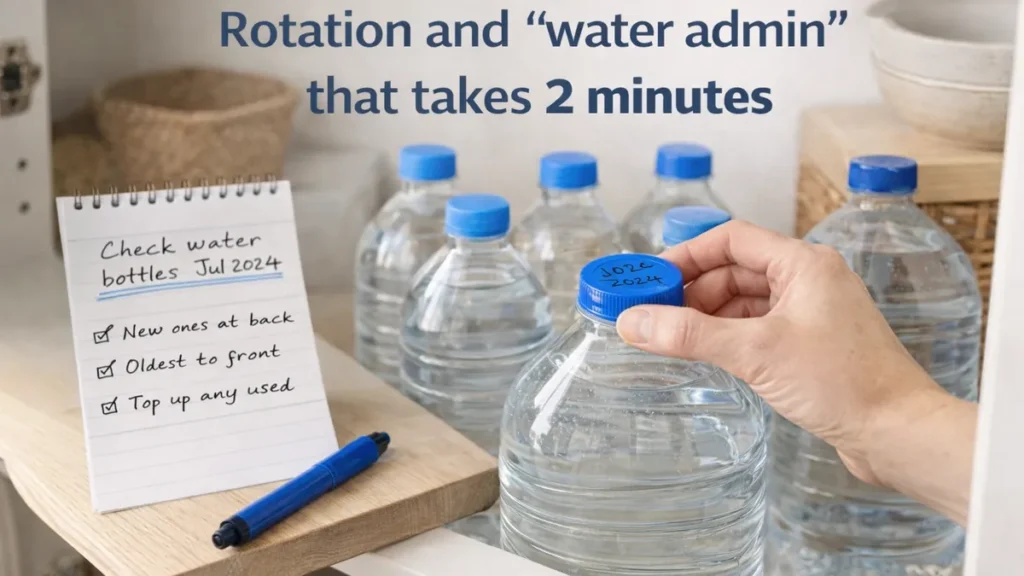
This is how you avoid wasting money and keep it effortless.
The no-fuss routine
- Write the month and year on the cap with a marker
- Put the newest bottles at the back
- Use the oldest first (top up as part of your normal shop)
A simple reminder
- Add a repeating reminder on your phone every 3 months: “Check water bottles”
- Quick check: leaks, bulging bottles, odd smells (rare with sealed bottles)
If you’re using tap water, keep it simple and safe
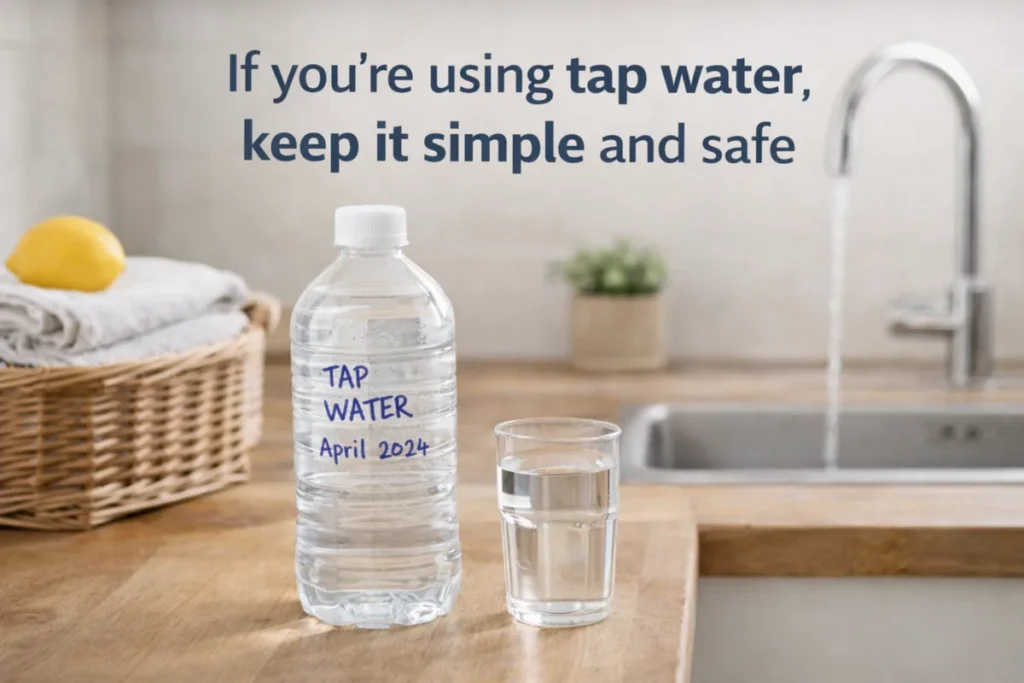
Most people find shop-bought bottled water the easiest for emergency storage.
If you do store tap water:
- Use clean, food-safe bottles with tight lids
- Store in a cool, dark place
- Keep it clearly labelled so nobody confuses it with cleaning mixes
If you want the easiest route, stick to sealed bottled water for the “core” amount and then use your normal tap water when supply is running as normal.
For a deeper dive
[Water storage and filtration for UK homes]
When you’ll need more than the basic number
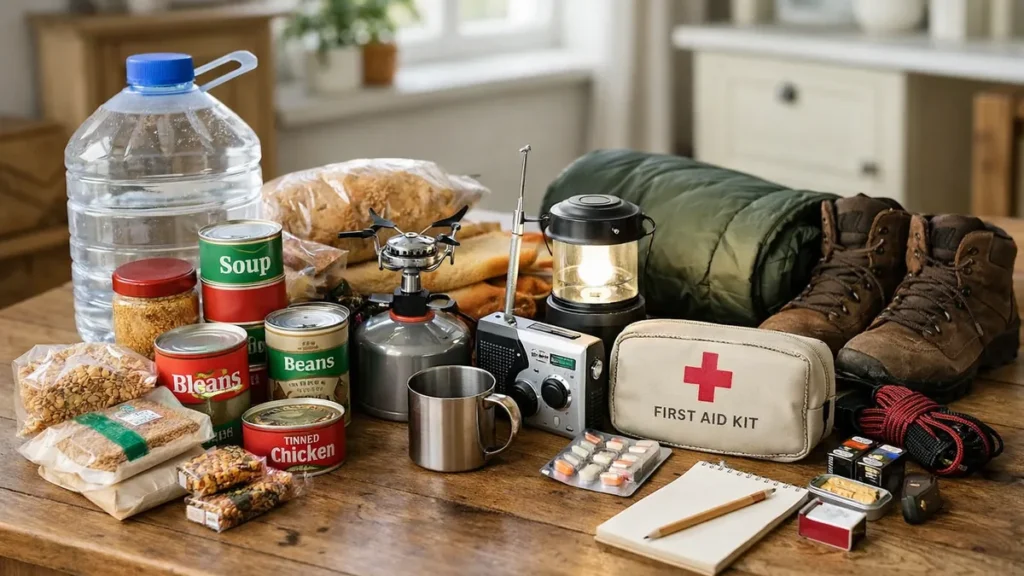
This matters when working out how much water do UK homes need, because “per person” isn’t always equal.
Babies and formula
You’ll need extra for mixing feeds and sterilising essentials. Prepare specifically notes babies as a reason you may need additional water.
Illness or hot weather
People often need more fluids when unwell or during warmer conditions. NHS guidance notes you may need more fluids if you’re ill or in a hot environment.
Pets
Pets need drinking water too, and larger dogs will obviously use more. A simple approach:
- Add a few extra litres per day for pets, then watch their normal bowl habits and adjust
Medical needs
If anyone uses medical devices, has limited mobility, or needs extra hygiene support, your “comfortable” target becomes more important.
Your 20-minute do-this-now plan
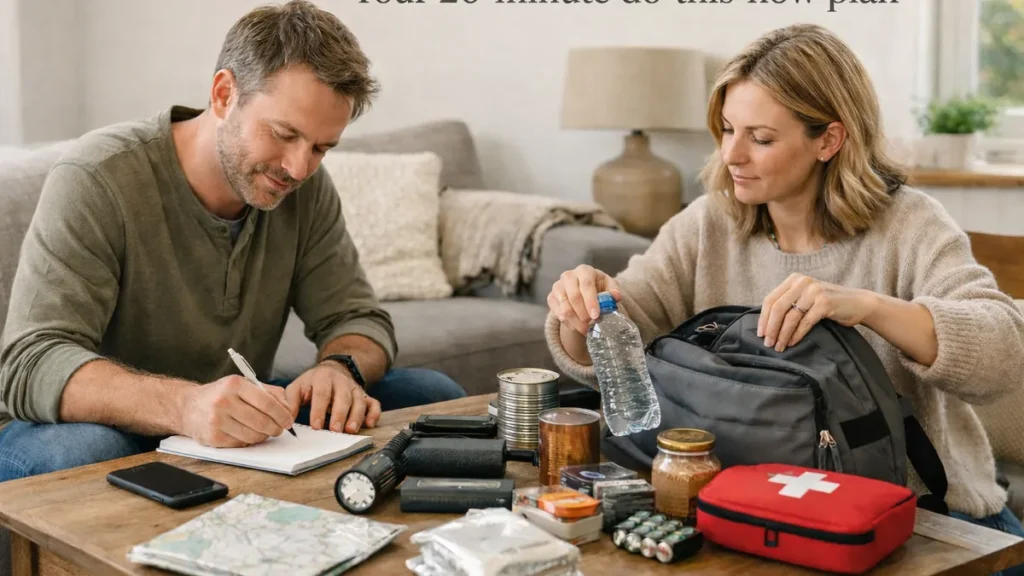
If you do nothing else, do this today.
Step 1: Pick your 3-day target
- Minimum: 3 litres per person per day (drinks covered)
- Better: 5–7 litres per person per day
- Comfortable: 10 litres per person per day
Step 2: Buy the water in the easiest format
- Most people find 2-litre bottles easiest to stack, rotate, and carry
Step 3: Choose 2 storage spots
- One “main stash” (wardrobe/kitchen cupboard floor)
- One “backup stash” (under bed)
Step 4: Label and forget about it
- Write the month and year on caps
- Set a 3-month reminder: “Check water”
Step 5: Add one small upgrade
Pick one:
- A couple of no-cook meals that don’t need water
- A small washing-up bowl for quick hygiene
- A pack of wipes for hands and surfaces
For a full household plan [UK 72-hour home plan]
FAQs
How much water do UK homes need for 72 hours?
A practical baseline is 3 litres of drinking water per person per day, so 9 litres per person for 72 hours.
If you want to cover basic cooking and hygiene too, aim closer to 30 litres per person for 72 hours (10 litres per day).
Is 2 litres per person per day enough?
For normal days, many people drink around that kind of amount in fluids, but emergency planning is different. The Prepare campaign references 2.5–3 litres per person per day as a minimum drinking-water figure for survival planning.
If you only store 2 litres, you’ll have less flexibility for hot drinks, cooking, and bad timing (like illness or warm weather).
Do I need three days of water at home?
It’s a sensible, widely recommended starting point. The British Red Cross lists three days’ supply of bottled water as part of an emergency kit.
Even if your area is usually fine, a short local outage is exactly the kind of thing that catches people out.
Can I rely on the water company to provide bottled water?
Sometimes support is provided during larger incidents, but it can depend on the situation and timing. Your best plan is to have your own small buffer at home, so you’re comfortable while you wait for updates.
How can I store water in a small flat without clutter?
Use small bottles and split them up:
- A crate under the bed
- A line of bottles at the bottom of a wardrobe
- A few bottles in a low kitchen cupboard
Start with the minimum 3-day number, then build gradually as you find space.
Do I need a water filter as well as bottled water?
Not essential for a basic 3-day buffer, but a filter can be a helpful upgrade for longer disruptions or if you want more flexibility. If you’re interested, plan it as a “phase two” after you’ve nailed your core stored water.
For more help on what Not to do read [Common UK Water Prepping Mistakes]
Next step
If you want to make this effortless, do this next:
- Calculate your 3-day total using the formula above
- Add enough bottled water to your next shop to hit that number
- Then build toward your “sweet spot” level over the next few weeks