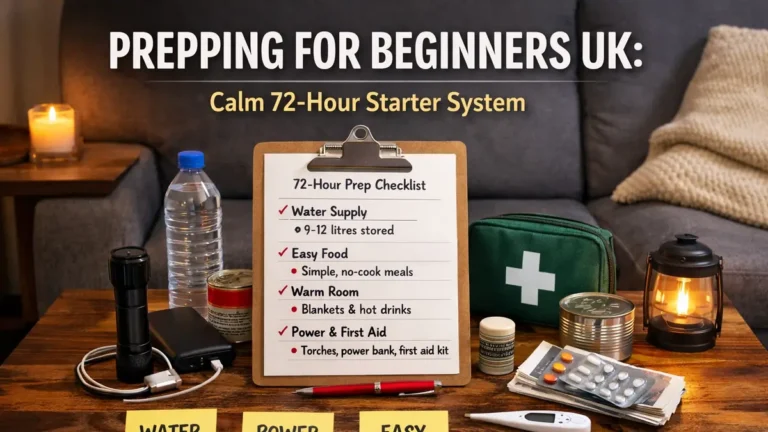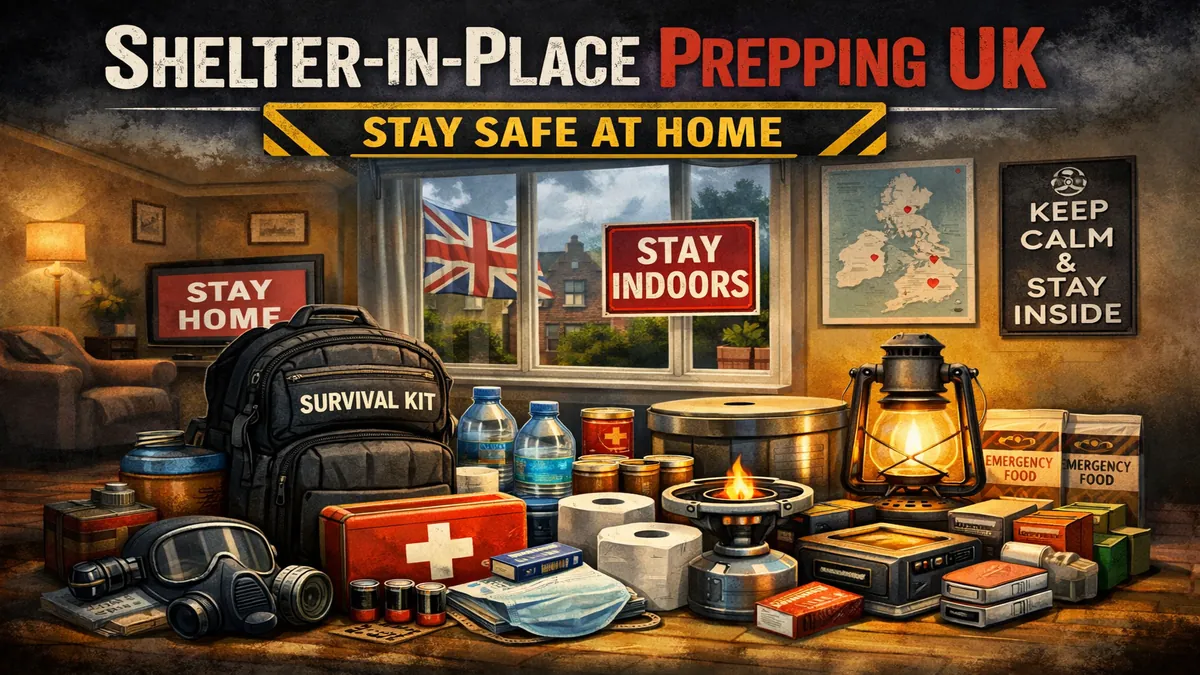
Shelter in place prepping UK is essential for protecting your family and staying safe at home during emergencies.
Power outages, severe weather, local flooding, fuel shortages, supply chain disruptions, and short-term infrastructure failures are far more common than situations requiring evacuation. In these scenarios, leaving your home often increases risk rather than reduces it.
Shelter in place prepping UK is about being ready to safely remain in your home for several days with minimal outside support. It is calm, practical, legal, and realistic—especially for UK families, flat-dwellers, and urban households.
This shelter in place prepping UK guide will walk you through exactly how to prepare your home,
For official guidance, consult the UK government’s Prepare for Emergencies resource step by step, using sensible systems rather than extreme measures.
Looking for a 1 page printable 72-hour checklist?
Alternatively Start Here for UK Prepping The Complete System
What Does “Shelter-in-Place” Mean in the UK?
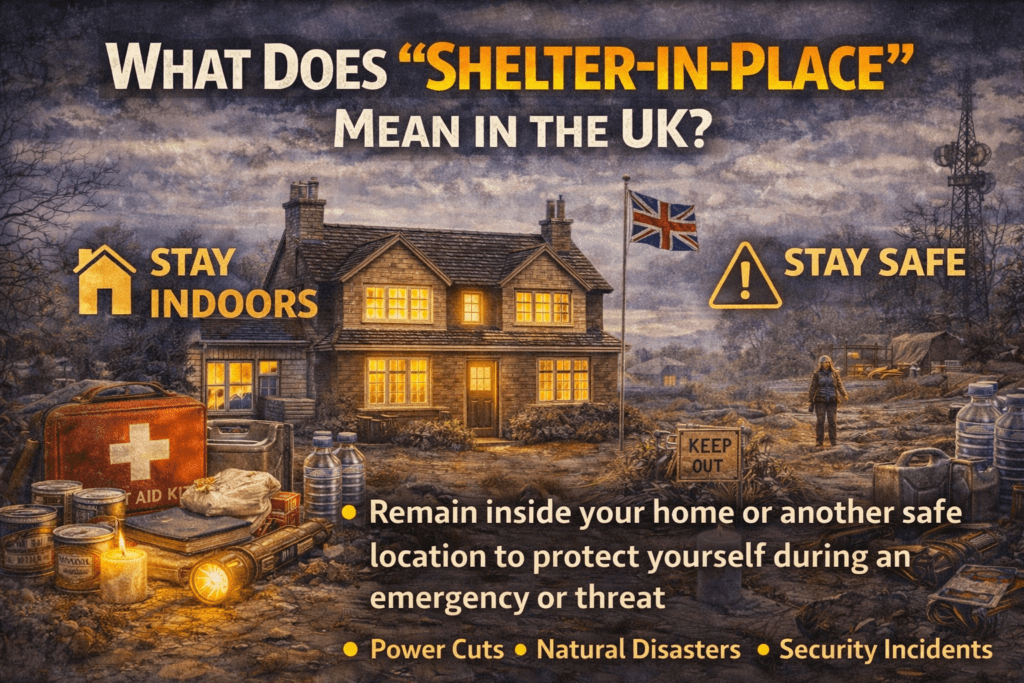
Remaining at home through a short- to medium-term disruption, until everyday services and routines click back into place.
In the UK, that’s usually what “emergency planning” looks like in real life: not bunkers, not disappearing off-grid — just a rough patch where the things you normally rely on become slower, less reliable, or temporarily unavailable.
Common examples include:
- Power cuts that last hours — sometimes days — especially after storm damage
- Severe storms and winter weather that make travel unsafe and delay deliveries
- Local flooding that blocks roads, affects shops, or knocks out power in specific areas
- Fuel shortages or disruption at distribution depots that cause queues and rationing
- Short-term food supply issues where certain basics vanish for a week or two
- Transport strikes or infrastructure failures that limit commuting, restocking, and access to services
In most of these situations:
- Emergency services are still operating, even if response times are stretched
- You’re not cut off forever — you’re riding out a delay, not a collapse
- Help may be slower, not absent — and you may need to manage without immediate support
- The biggest stressor is the ripple effect: no power means no heating, no hot water, patchy mobile signal, limited cash access, reduced opening hours, and empty shelves for the first wave of essentials
That’s why the target isn’t “survive indefinitely”. It’s stay comfortable, safe, and independent for at least 72 hours — long enough to avoid panic-buying, avoid unnecessary travel, and give services time to stabilise.
Think of it as bridging the gap: you’re building a small buffer so your household can keep functioning normally (or close to it) while the rest of the system catches up.
Why Staying at Home Is Usually Safer Than Leaving
For most UK households — especially in towns and cities — sheltering in place is usually the most sensible, lowest-risk option. It plays to the strengths you already have: a secure base, familiar routines, and access to local support.
Here’s why it works so well.
Familiar environment
Your home is your known quantity. You already understand the layout, where things are stored, what doors and windows are secure, and which rooms hold heat best in winter. You also know the little quirks — the dodgy fuse, the stiff back door, the bathroom tap that needs a firm twist.
That familiarity matters more than people realise. In a disruption, stress is the real multiplier: it makes small problems feel bigger, and it drains your decision-making. Staying in familiar surroundings reduces uncertainty, helps children and pets stay calmer, and makes it easier to stick to a simple plan.
Legal simplicity
The UK isn’t a place where it’s practical — or sensible — to move around with “prepper-looking” kit. The moment you start carrying fuel, tools, knives, or bulky equipment outside your home, you can create legal, safety, and insurance headaches, even if your intentions are completely harmless.
At home, those items are normal household things. Out on the street, they can be misunderstood quickly. Sheltering in place keeps your approach quiet, low-drama, and straightforward, without adding new risks you don’t need.
Access to neighbours and community
In real UK emergencies, your first line of support often isn’t “the authorities” — it’s the people next door. A spare torch battery, a quick lift to pick up meds, help checking on an elderly neighbour, sharing updates when mobile signal is patchy… that’s how most communities get through short-term disruptions.
Sheltering in place doesn’t mean isolating yourself. It means staying local and connected, where mutual support is easiest. A calm, prepared household is also a better neighbour — you’re not competing for the last loaf of bread, and you’re more able to help if someone nearby is struggling.
Reduced exposure
Moving around during a disruption tends to create problems rather than solve them. Roads get congested, public transport becomes unreliable, weather turns travel into a risk, and rumours spread fast — especially on social media.
Staying put reduces your exposure to:
- Accidents and travel hazards
- Queues and crowd tension
- Bad information and panic buying
- Unnecessary spending on “quick fixes”
- Weather-related risks, especially in winter or storms
In short: if your home is safe, warm enough, and stocked for a few days, staying home is usually the calmest, smartest move — and it gives you the best chance of riding things out with minimal stress.
Who Should Prioritise Shelter-in-Place Prepping?
Shelter-in-place prepping is especially relevant if you:
- Live in a flat or apartment
In most UK blocks, leaving in a hurry isn’t simple. Lifts can go down in a power cut, stairwells can be poorly lit, and you may be several floors up with kids, shopping, or pets to juggle. Staying put — with a few practical backups — is often safer, calmer, and far more realistic than trying to move everything out at short notice. - Live in a terraced or semi-detached house
These homes make up a huge chunk of the UK housing stock. They’re usually in built-up areas, close to shops, schools, and neighbours — which is an advantage in a disruption. The goal isn’t to “escape”, it’s to keep your household running when heating, power, or deliveries are temporarily unreliable. - Have children or older relatives to support
When you’re responsible for other people, the priority is stability: warmth, routine, food, hygiene, and reassurance. Travelling during disruption adds complexity fast — naps, medications, mobility issues, sensory needs, and simple comfort. A plan that keeps everyone safe at home is often the easiest way to reduce stress and avoid avoidable risks. - Have limited storage space
You don’t need a garage full of supplies to be prepared. Shelter-in-place prepping works brilliantly with small, sensible buffers: a few days of food you actually eat, a bit of extra water, basic lighting, and ways to stay warm. It’s about smart use of cupboards, under-bed space, and everyday items — not stockpiling. - Rely on local services and infrastructure
Most of us do — from supermarkets and pharmacies to public transport, mobile networks, and cash machines. Short-term disruptions usually don’t remove these services completely; they make them slower, patchier, and less predictable. Having a 72-hour buffer at home gives you breathing room while things stabilise.
In other words: this is “normal UK household” prepping. It’s built for the way most of us actually live — in ordinary homes, with ordinary responsibilities — and it focuses on staying safe and comfortable until life gets back to normal.
The Core Systems of Shelter-in-Place Prepping
Rather than focusing on individual items, effective preparedness is built around systems. Each system below addresses a core human need.
1. Water: The Most Critical System
Prepare for one thing first: water.
In most UK shelter-in-place scenarios, losing clean, usable water causes problems faster than almost anything else. You can manage a few days without electricity. You can eat simply for a short period. You can even tolerate a colder home for longer than you’d like. But when water becomes limited or uncertain, everything deteriorates quickly — your ability to stay hydrated, keep clean, prepare food, flush toilets, and think clearly.
This isn’t about “surviving drought” or living like it’s the end of the world. It’s about a very practical aim:
Never be forced into unsafe decisions because you ran out of water.
That means having enough safe water at home for:
- drinking
- basic hygiene (hands, face, teeth)
- simple food prep
- and, ideally, a plan for toilets and cleaning too
Why water fails faster than people expect in the UK
A lot of households assume water is basically guaranteed — “it’s the UK, it’ll be fine.” Most of the time, it is. But the system has pressure points, and disruption doesn’t always look like the tap suddenly running dry.
Water issues can happen because of:
- Power outages affecting pumping stations and local pressure
- Burst mains during freezing weather (or sudden ground movement)
- Flooding that contaminates supply or overwhelms treatment works
- Planned or emergency repairs that require isolation of sections of pipe
- Local pressure reductions during high demand or infrastructure problems
And even when the supply doesn’t fully stop, it can become:
- low pressure (especially in flats and on higher floors)
- temporarily unsafe to drink (for example, a boil notice)
- unreliable for flushing, washing, or filling containers quickly
That’s why stored water is the single most important preparedness “system” for UK homes. It buys you time, keeps your options open, and removes the panic factor.
Common UK Water Prepping Mistakes
How much water do you actually need?
A realistic UK baseline looks like this:
Absolute minimum (short-term)
- 2 litres per person per day
Drinking water only. This is the bare minimum, not comfortable, and leaves no slack.
Practical shelter-in-place minimum
- 3–4 litres per person per day
Drinking + hot drinks + basic food prep + minimal hygiene (hands/teeth).
Comfortable planning level
- 5 litres per person per day
Enough to stay hydrated and keep hygiene and cooking ticking over without feeling constantly rationed.
Timeframe examples
72 hours (3 days)
- 9–12 litres per person (practical minimum range)
7 days
- 21–35 litres per person (depending on whether you’re aiming for “minimum” or “comfortable”)
It sounds like a lot until you picture it in everyday terms:
- A standard 2-litre bottle is roughly one day of drinking water for one adult. That’s it — no tea, no cooking, no brushing teeth.
- Cooking and hygiene quietly eat volume: washing hands properly, cleaning a pan, rinsing a chopping board, brushing teeth, wiping a spill.
- If water pressure drops or a boil notice lands, you’ll be glad you can carry on normally while everyone else scrambles.
Water planning isn’t about panic. It’s about volume awareness — knowing what your household actually uses, and keeping a simple buffer so you can stay calm and make good decisions when things go a bit sideways.
How Much Water Do UK Homes Really Need?
Stored Water vs Filtration
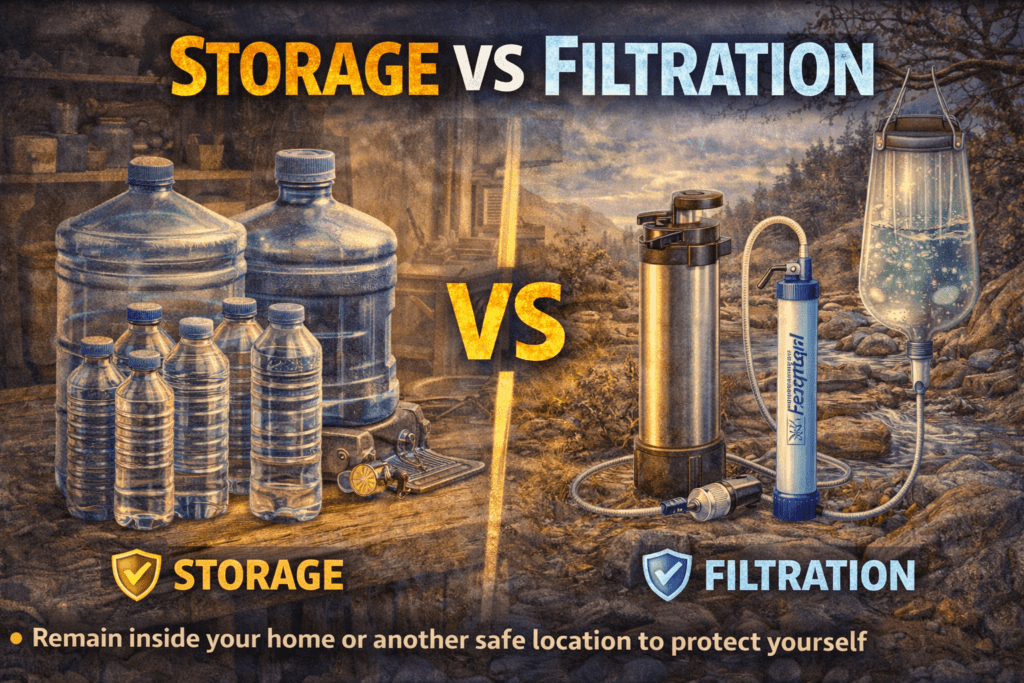
Stored water
Stored water is your “no-drama” solution. It gives you:
- Immediate access — no waiting for deliveries, no queues, no boiling kettles
- Zero effort under stress — you don’t have to think when you’re tired, cold, or juggling kids
- Predictable safety — if you store it correctly, you know exactly what you’ve got
In shelter-in-place planning, that reliability is the point. When everything else is uncertain, you want at least one system that just works.
Best storage options for UK homes
- Shop-bought bottled water
The easiest starting point. It’s already sealed, portable, easy to rotate, and simple to count in litres. - Food-grade water containers
Purpose-made containers (often 10–25L) are a great “step up” once you want more volume without filling your cupboard with bottles. - Stackable jerry cans
Ideal when you want to build a bigger buffer in a small space. They stack neatly, carry well, and are practical for decanting.
How to store it so it stays safe
Keep it boring and consistent:
- Cool and dark (heat and sunlight shorten shelf life and can affect taste)
- Away from chemicals (cleaning products, paint, fuel, garden sprays — don’t store water next to anything that could leak or taint it)
- Clearly labelled (date of purchase/fill date, and “DRINKING WATER” if it’s in containers)
A simple rule: treat stored water like food. If you wouldn’t keep pasta next to bleach, don’t keep water there either.
Rotation: keep it fresh without fuss
You don’t need a complicated system — just a routine.
- Bottled water: rotate roughly every 6–12 months
(Most bottled water has a long “best before”, but rotating keeps taste fresh and keeps you in the habit.) - Water in containers: refresh about once a year
(Drain, quick clean, refill, relabel. The point is confidence and hygiene, not perfection.)
If you want it effortless, tie it to something you already do: a seasonal reset, a school holiday, or the clocks changing.
Water filtration
Filtration isn’t a replacement for stored water — it’s insurance.
Stored water is your first line: instant, safe, predictable. Filtration is what you lean on when reality doesn’t follow the neat plan.
Filtration helps when:
- your stored water is running low
- tap water is available but unsafe (for example, a boil notice, flood contamination, or discoloured supply)
- you’re limited on storage space and need a way to extend what you have
UK-appropriate filtration options
- Gravity filters
Great for home use because they don’t rely on electricity. You fill the top, and it filters into the bottom over time — low effort, high capacity. - Pump filters
Useful if you need faster flow or you’re filtering from a container/bucket. More work, but reliable and compact. - Inline bottle filters
Handy for day-to-day backup and “grab and go” situations. Not a full household solution on their own, but excellent as a secondary layer.
What filtration can and can’t do
A good filter is extremely effective against:
- bacteria
- parasites
- sediment and grit
But filtration doesn’t remove every chemical contaminant. That matters in certain scenarios (industrial spills, some floodwater contamination). The practical takeaway is simple:
Use stored water first. Use filtration to stretch supplies or improve safety when supply is uncertain.
If you remember one line, make it this:
Stored water first. Filtration second.
Flat vs House Water Planning
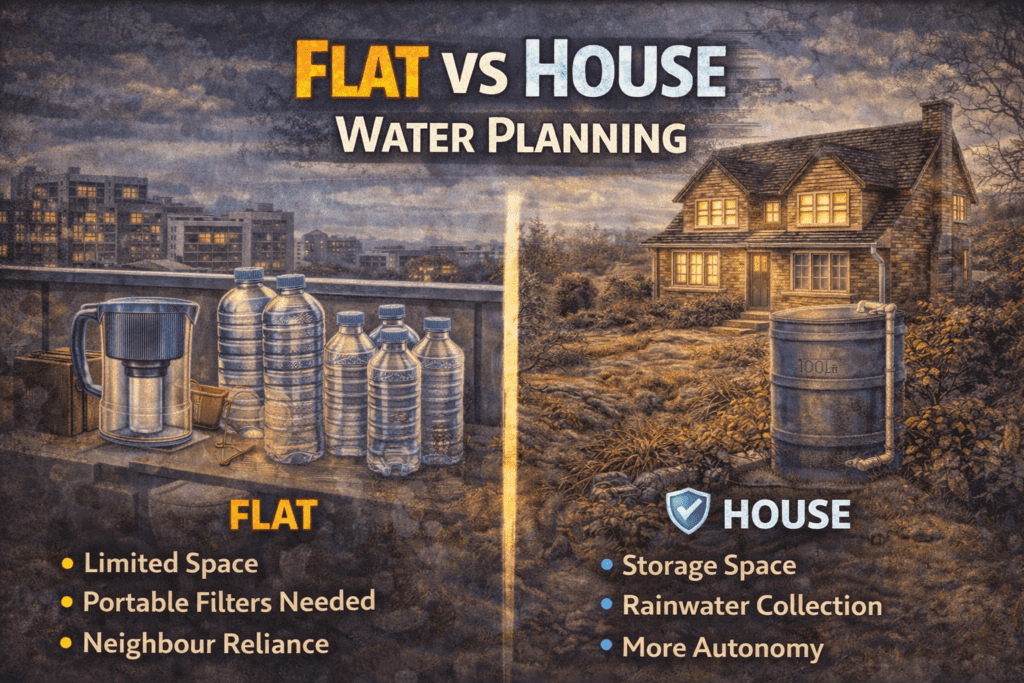
Flats and apartments
Flats are where water planning matters most — not because you’re worse off, but because the system has fewer “workarounds”. If the water pressure drops, you can’t just nip outside and fill a watering can from the hose. If lifts go out, carrying heavy bottles upstairs becomes a proper job. And if you’re short on cupboard space, you need solutions that fit around real life.
Common constraints
- Limited storage space (especially in kitchens)
- No outdoor water access (no hose, water butt, or easy fill point)
- Pressure issues can hit harder on higher floors during pumping problems
Best strategies for flats
- Under-bed storage containers
One of the most overlooked “storage rooms” in a flat. Low profile, out of sight, and ideal for keeping a steady base volume without cluttering cupboards. - Stackable bottles
Boring, reliable, and easy to rotate. Stack them neatly in a wardrobe bottom, hallway cupboard, behind sofa storage, or a corner of the kitchen that normally becomes dead space. - Filtration as a multiplier
In a flat, you might not be able to store a week’s worth of water without turning your home into a warehouse. Filtration helps you make stored water last longer and gives you a backup if the supply is present but questionable. - Bathtub water storage bags
These can provide a serious short-term volume boost — but the key is timing. They only help if you use them early, when you get warning (storms, rising flood risk, planned works, pressure warnings, boil notices). They’re a “top-up” strategy, not a set-and-forget solution.
The aim in a flat is simple: a hidden, stackable base supply you can access quickly, plus a way to stretch it if the disruption lasts longer than expected.
Houses and terraced properties
Houses (including terraces and semis) usually give you more options — but it’s easy to waste those advantages by putting water somewhere that’s awkward to reach when you actually need it.
Natural advantages
- More storage locations (under-stairs, utility room, cupboards, loft access in some homes)
- Sometimes outdoor access (garden tap, water butt, garage)
- Easier to build volume without it feeling intrusive
Additional options that work well
- Larger containers
If you’ve got the space, fewer large containers can be easier than managing piles of small bottles — just make sure you can lift and pour them safely. - Garage or utility room storage
Great for bulk storage, especially if you can keep it cool and away from chemicals. The utility room is ideal; garages can work, but you need to think about temperature swings and what else is stored there.
The winter reality check
Even in a house, prioritise indoor, accessible water. In winter, the “extra” water in a shed or garage may be harder to reach, colder, or affected by freezing conditions — and you don’t want to be tramping outside in the dark during storms just to fill a kettle.
A good rule: keep your main supply where you can reach it in slippers, and treat outdoor/garage water as backup rather than your first line.
Water for Hygiene and Sanitation
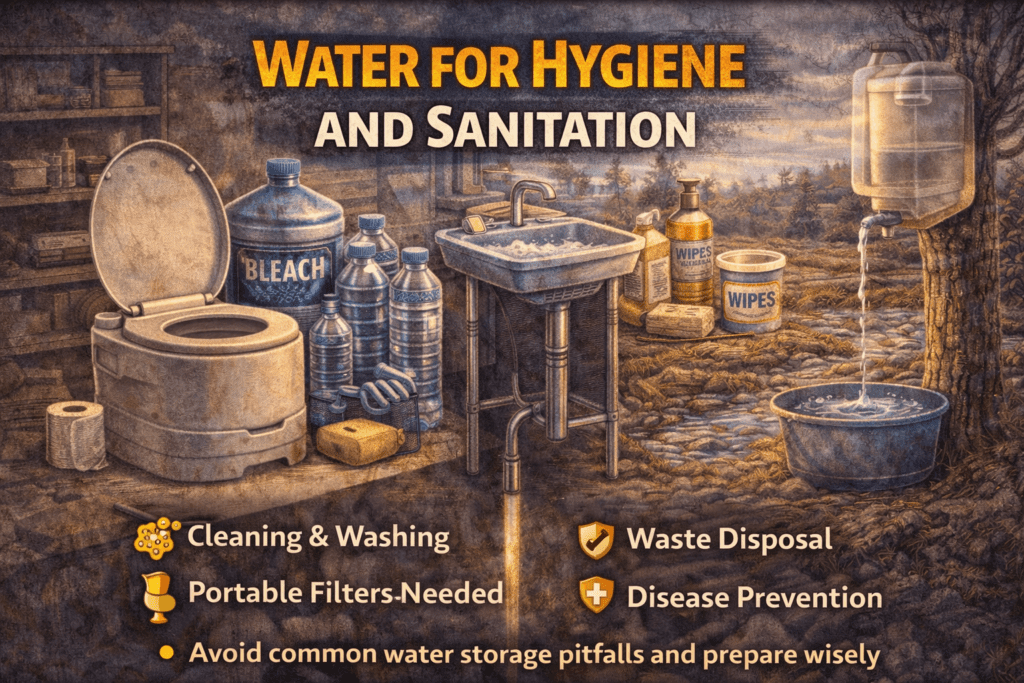
Drinking water is only part of the picture.
In a UK disruption, the thing that tends to catch people out isn’t thirst — it’s hygiene. When you can’t wash properly, small issues build quickly: stomach bugs spread faster, minor cuts get infected, and everyone feels more stressed and run-down. Good hygiene isn’t “nice to have”. It’s one of the easiest ways to keep your household healthy when routines get disrupted.
Water is also needed for:
- Hand washing (especially after the toilet and before handling food)
- Tooth brushing (and basic mouth hygiene)
- Minimal cleaning (wiping surfaces, rinsing essentials, dealing with spills)
- Toilet flushing (if the system is still working, or for basic bucket-flush use)
And here’s the quiet truth: a little hygiene done consistently beats a lot done occasionally. You don’t need a full shower routine — you need the basics done well.
Health & Hygiene Preparedness UK – What Every Household Should Know
Best practice: keep it clean without burning through water
Use sanitiser where it makes sense
Alcohol hand sanitiser is brilliant for conserving water — particularly when hands aren’t visibly dirty. Keep one in the kitchen and one in the bathroom so it’s always within reach.
Reserve water for “high-impact” hygiene
Prioritise the things that prevent illness and keep you functional:
- hands before food prep
- hands after the toilet
- teeth morning and night
- a quick face/underarms wipe if needed for comfort
A small bowl, a cup, and a flannel can go a long way.
Avoid wasteful washing
In a disruption, it’s easy to waste water without realising:
- running taps “just while you…”
- overfilling bowls
- rinsing things that don’t need rinsing
- washing dishes like normal instead of wiping and stacking
Think “wipe first, rinse second”. Use paper towels or cloths to remove food residue before any water touches a plate or pan. Reuse a bowl of water for multiple quick tasks rather than starting fresh each time.
The goal isn’t to be spotless — it’s to stay healthy, comfortable, and in control until normal water access and routines return.
Cooking and Water Efficiency
Food choices affect water use.
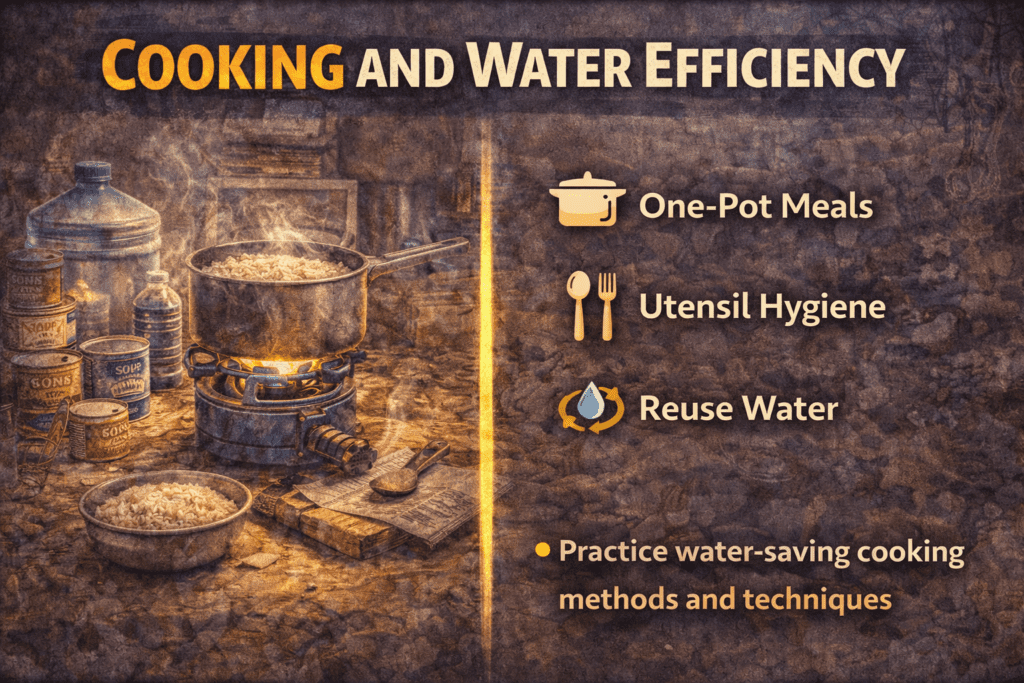
Food choices that protect your water supply
When you’re sheltering in place, water doesn’t just disappear down the tap — it disappears into your meals and your washing-up. The simplest way to make your stored water last longer is to plan foods that don’t demand much of it.
Good low-water options include:
- Tinned meals (chilli, stew, curry, soup, beans — anything you can heat and eat)
- Ready-to-eat foods (tinned fish, tinned fruit, crackers, cereal bars, long-life snacks)
- Porridge and instant oats (especially sachets or “just add hot water” styles)
Foods that quietly use more water are:
- Dried pasta (boiling + draining + often extra rinsing)
- Rice (unless it’s quick-cook, microwave, or pouch rice)
You don’t need to avoid pasta and rice completely — just be aware that they’re water-hungry and can turn a “comfortable” water plan into a tight one surprisingly fast.
Plan meals that:
- use minimal water to cook
- create minimal washing up afterwards
A simple rule that works: one-pot, one utensil, one bowl. If you can eat it from the pan or a single bowl, you’re protecting your water supply as much as you’re protecting your energy.
Common UK Water Prep Mistakes
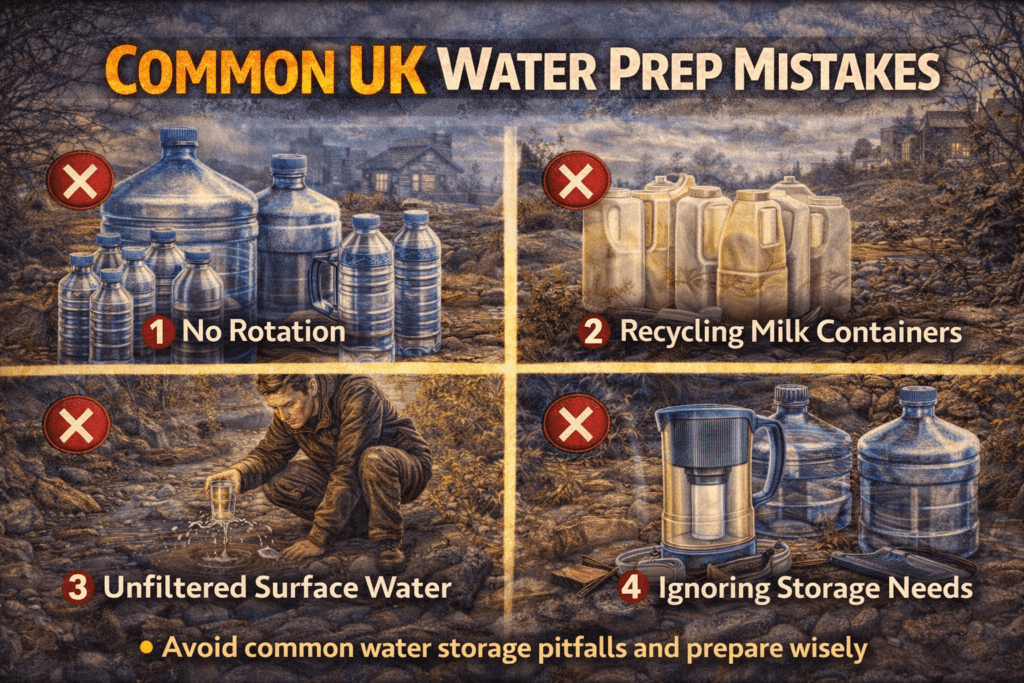
The common mistakes that trigger “water stress”
Most water problems in a UK disruption aren’t caused by dramatic shortages. They’re caused by small planning gaps that snowball into stress within a day or two.
The biggest ones are:
- Relying entirely on filtration
Filtration is brilliant as a backup, but it’s not instant. It takes time, effort, and the right conditions — and if the tap is off or pressure is poor, you may have nothing to filter in the first place. Stored water is what keeps you stable from minute one. - Underestimating daily water use
People often calculate “a couple of drinks each” and assume they’re covered. In reality, water disappears into tea, food prep, small sips through the day, and the constant “little uses” you don’t notice until they’re gone. - Forgetting hygiene needs
The fastest way to turn a minor disruption into a miserable one is letting hygiene slide. If you can’t wash hands properly or keep basics clean, illness risk goes up — and comfort goes down. A water plan that only covers drinking is a fragile plan. - Storing water in unsuitable containers
Anything that isn’t food-grade can taint water or degrade over time. The container matters as much as the volume. Safe storage is what turns “water” into “safe drinking water”. - Not rotating supplies
If you don’t rotate, you don’t trust what you’ve stored — and if you don’t trust it, you won’t use it confidently when you need it. Rotation isn’t about obsession; it’s about keeping your system real and ready.
These mistakes don’t just reduce your supply — they create water stress: that creeping feeling of “we’re running out”, which then drives rushed decisions.
The psychological impact of water security
Having enough water isn’t only practical — it’s calming.
When you know you’ve got sufficient water at home, it:
- reduces anxiety (because you’re not counting every sip)
- improves decision-making (you think clearly and plan sensibly)
- prevents rash behaviour (no late-night shop run, no risky travel, no panic buying)
Water security buys you more than hydration. It buys you headspace. And in a disruption, headspace is the difference between coping and spiralling.
Bottom line: water is non-negotiable
In UK shelter-in-place situations:
- Water is your most critical system
- Stored water beats every other solution for speed, safety, and simplicity
- Filtration extends resilience — it doesn’t replace storage
If you have enough water, most other problems become manageable: you can eat simply, keep clean, stay calm, and wait things out.
If you don’t, everything becomes harder — fast.
2. Power & Lighting Managing Life Without Electricity
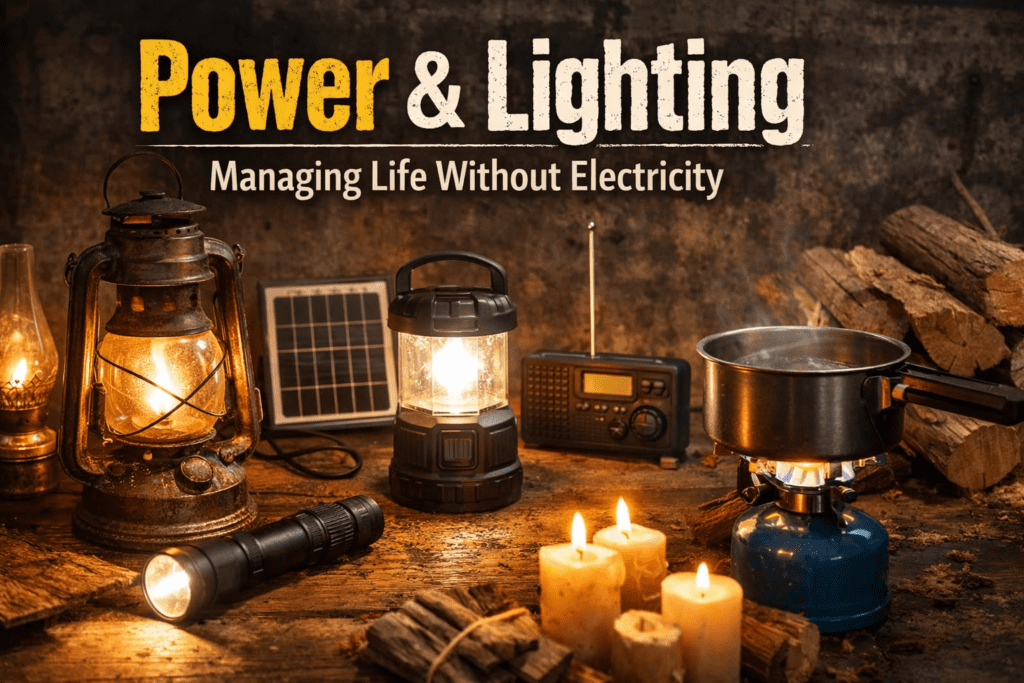
Power cuts are one of the most common — and most disruptive — emergencies in the UK. They can happen after storms and flooding, from infrastructure faults, during fuel disruption, or through planned outages when demand is high. Most are resolved within hours, but some run longer — particularly in rural areas or during severe weather, when repairs take time and conditions are poor.
Shelter-in-place prepping isn’t about turning your home into an off-grid setup. It’s about power continuity: having enough stored power and simple kit to stay safe, stay informed, and stay comfortable until services return.
The aim is straightforward: keep essential devices running, keep lighting safe, and avoid panic decisions.
Essential power priorities
When electricity goes, most households don’t need to “power the house”. They need to cover a few critical jobs:
- Mobile phones (communication, updates, torch function, banking/ID, emergency calls)
- Lighting (safe movement, stairs, children’s rooms, bathroom trips)
- Radio (a reliable backup for official updates if mobile signal is patchy)
- Small medical devices (anything you rely on daily)
Everything else is secondary. If you focus on these priorities, you avoid wasting money and storage space on gear you’ll rarely use.
Power Cuts & Home Warmth (UK)
The reality of UK power cuts
Before buying anything, it helps to be clear about what UK outages typically look like:
- Temporary, not permanent — usually hours, sometimes days
- Emergency services continue operating, although response times may vary
- Mobile networks may still work, but can become strained (especially locally)
- Heating and hot water may fail even in gas homes, because many boilers need electricity
- Shops and fuel stations may close if card machines and pumps can’t operate
This is why stored electrical power is more practical than generators for most households. Generators add noise, fuel storage, ventilation risks, and hassle — and they’re often unnecessary for the core problem, which is simply keeping small devices and lighting working.
Practical UK power options
For most homes, these cover the job without drama:
- High-capacity power banks
Your easiest win. Aim for enough capacity to recharge phones multiple times. Keep them topped up, and store one where you can find it in the dark. - Rechargeable LED lanterns
The best “whole room” lighting option. Safer than candles, more comfortable than a harsh torch beam, and ideal for kitchens, hallways, and evenings. - Battery torches with spare batteries
Simple, reliable, and still one of the most dependable backups. A torch that takes standard batteries is often the “works no matter what” option. - Solar chargers (with realistic expectations)
They can be useful — but UK winter light and heavy cloud mean they’re often slow. Treat solar as a supplement, not a replacement for stored power. If it tops you up, great. If it doesn’t, your plan still works.
Lighting without panic
Lighting is where households accidentally create risk. The goal is calm, safe visibility — not “make it cosy”.
- Prioritise LED lighting first (lanterns, torches, head torches)
- Avoid candles where possible — especially around children, pets, fatigue, or cluttered surfaces
- If you do use candles at all, keep them as a last resort and treat them like an open flame in a small room: stable holder, clear space, never unattended
A good shelter-in-place power plan looks boring on purpose: a few charged devices, a couple of reliable lights, spare batteries, and a clear routine. It keeps your home functional — and keeps you out of the risky, last-minute scramble that makes power cuts feel worse than they need to.
Essential Power Priorities
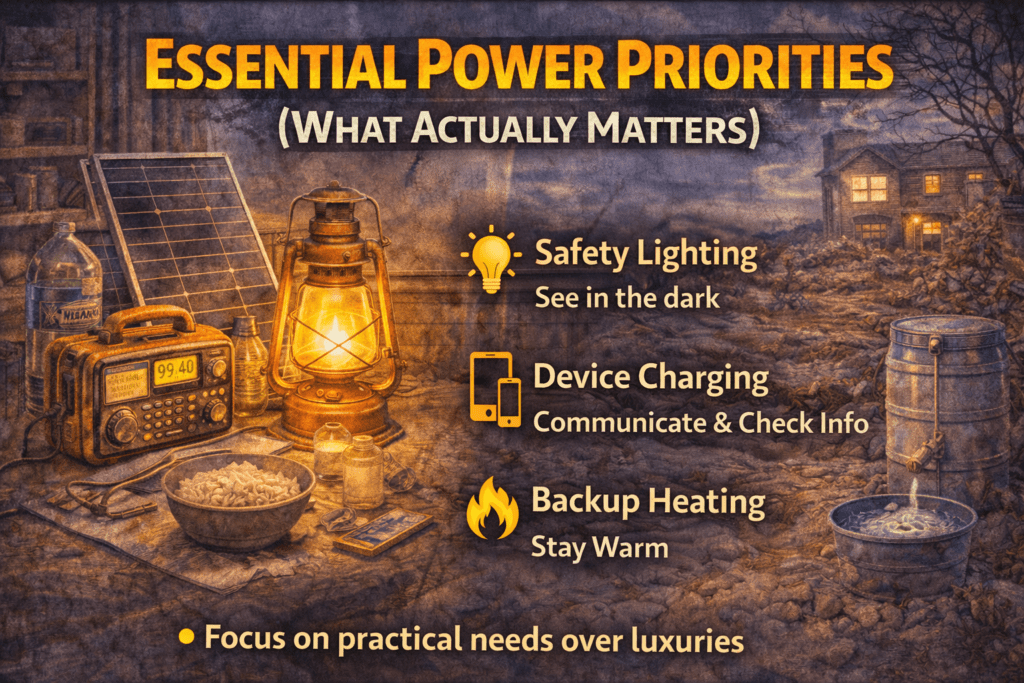
In a power cut, the smart approach is to prioritise the functions that keep you safe and connected — and let everything else go offline without guilt. You’re not trying to “keep life normal”. You’re trying to keep the essentials running smoothly until electricity returns.
1. Mobile phones
Your phone is your main lifeline in a UK outage. It’s how you get:
- emergency alerts and warnings
- updates from family, neighbours, and local groups
- news and official guidance
- local council announcements (road closures, rest centres, disruptions)
When power is out, your phone becomes more valuable — but it also becomes more vulnerable, because you can’t top it up easily. That’s why the goal is simple: protect your battery.
Best practice:
- Keep phones above 80% when severe weather is forecast
Not because you’re panicking — because it’s an easy habit that costs you nothing. - Use low power mode early
Don’t wait until you’re at 20%. Low power mode extends life dramatically when it matters most. - Turn down screen brightness
Your screen is one of the biggest drains. Dim it and use dark mode if it helps. - Disable non-essential activity
Switch off background refresh, location services for apps you don’t need, push notifications you can live without, and anything that’s constantly “checking in”.
Used carefully, one fully charged phone can last several days — especially if you treat it like a tool, not entertainment. Short checks for updates, quick messages, then back on standby.
2. Lighting
Lighting isn’t just about being able to see. It directly affects:
- accident prevention (stairs, bathrooms, kitchens)
- stress and mood (darkness makes everything feel worse)
- night-time routines (especially with children)
- reassurance (a lit room feels safe and controlled)
Poor lighting is where little problems turn into big ones: trips and falls, knocks, burnt fingers, and — in the worst cases — unsafe candle use. Good lighting does the opposite. It restores a sense of normality and makes the whole situation feel manageable.
The aim: stable, safe, room lighting (lantern) plus task lighting (torch/head torch) for moving around.
3. Radios
A battery or hand-crank radio is one of the most underrated items in UK home preparedness. It gives you:
- updates when internet access is patchy or down
- local emergency announcements
- weather warnings and forecasts
Radios use very little power compared to phones, and they work even when mobile networks are strained. Most people only realise how useful they are when they urgently need reliable information — which is exactly why it’s worth having one ready.
4. Small medical devices
This is the category that deserves special attention, because it’s not optional.
If anyone in your household relies on equipment such as:
- nebulisers
- CPAP machines
- glucose monitors and readers
- hearing aid chargers
…you need to build power planning around that reality.
In some households, that may justify:
- higher-capacity power banks
- dedicated backup batteries
- a plan for charging priority and rotation (so critical devices never compete with phones for the last bit of power)
The key is honesty: if a device supports someone’s breathing, sleep, or medical stability, it belongs at the top of the priority list — and your setup should reflect that.
The overall principle stays the same: keep the critical functions powered, and let the rest go dark. That’s how you stay calm, safe, and in control during an outage.
Practical UK Power Options
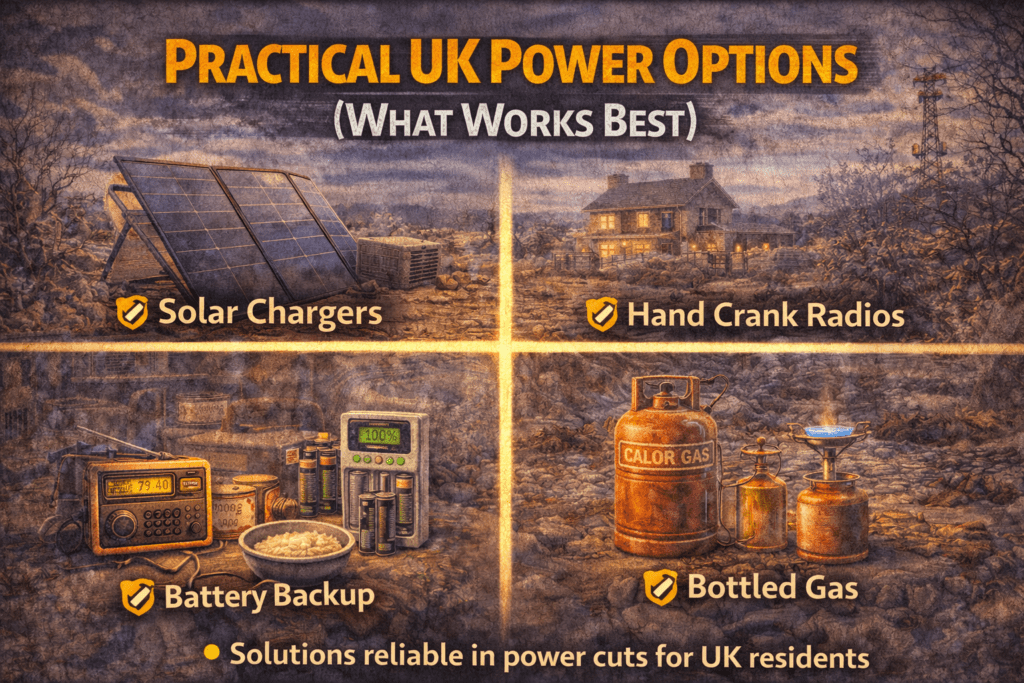
When it comes to power cuts, reliability matters more than raw output. You don’t need a complicated setup. You need a few pieces of kit that are safe indoors, easy to use when you’re tired, and dependable in typical UK conditions.
High-capacity power banks
For most UK households, power banks are the most practical solution.
Why they work so well:
- Safe for indoor use
- Silent
- No fumes or ventilation worries
- Minimal maintenance (compared to anything fuel-based)
A sensible, realistic setup is:
- One high-capacity power bank (20,000–30,000 mAh)
- One smaller backup bank (for redundancy, or as a grab-and-go spare)
This gives you the ability to:
- recharge phones multiple times
- top up radios, torches, and lanterns
- maintain communication for days, even if the outage drags on
Storage and upkeep:
- Keep them fully charged (or topped up regularly)
- Store in a cool, dry place (not on a sunny windowsill or next to a radiator)
- Check every 3–6 months: plug in, confirm they still hold charge, top up, and put them back
That simple routine is what turns “owning a power bank” into “having power when you need it”.
Rechargeable LED lanterns
Lanterns are the upgrade most households don’t realise they need — because area lighting changes everything. A lit room feels safer, calmer, and more normal than a single torch beam.
Why lanterns beat torches for general use:
- illuminate an entire room
- reduce trip hazards
- make evening routines (tea, tidying, kids’ bedtime) feel manageable
- often allow hands-free movement because the room stays consistently lit
Look for lanterns with:
- multiple brightness levels
- USB recharging
- a long runtime on low settings (low mode is where the real value is)
Where to place them:
- one in the main living area
- one in the kitchen
- one near stairways or the hallway
This isn’t about “having loads”. It’s about having light where accidents happen and where you spend time.
Battery torches
Torches are still essential — just for different jobs.
They’re best for:
- quick inspections
- navigating dark corners and cupboards
- short, focused tasks where you want a strong beam
Best practice:
- choose models that use standard batteries (AA or AAA)
- store spare batteries nearby (same drawer or box — don’t make it a treasure hunt)
- avoid flimsy, bargain-bin torches that fail when you finally need them
Head torches are especially useful for cooking, first aid, and small repairs — anything where you need both hands free without balancing a torch under your chin like a cartoon character.
Solar chargers: realistic UK expectations
Solar chargers can be useful — but only if you treat them as a slow top-up tool, not a power plan.
UK-specific limitations:
- limited daylight hours in winter
- frequent cloud cover
- low output in poor conditions, especially when you actually need power most (storms)
The realistic role for solar in the UK is:
- a supplement, not a primary power source
- best for topping up power banks slowly
- far more effective in summer than in the middle of a grey January week
Bottom line: stored power first, solar second. If solar helps, great. If it doesn’t, your plan still holds.
Lighting Without Panic (Fire Safety Matters)
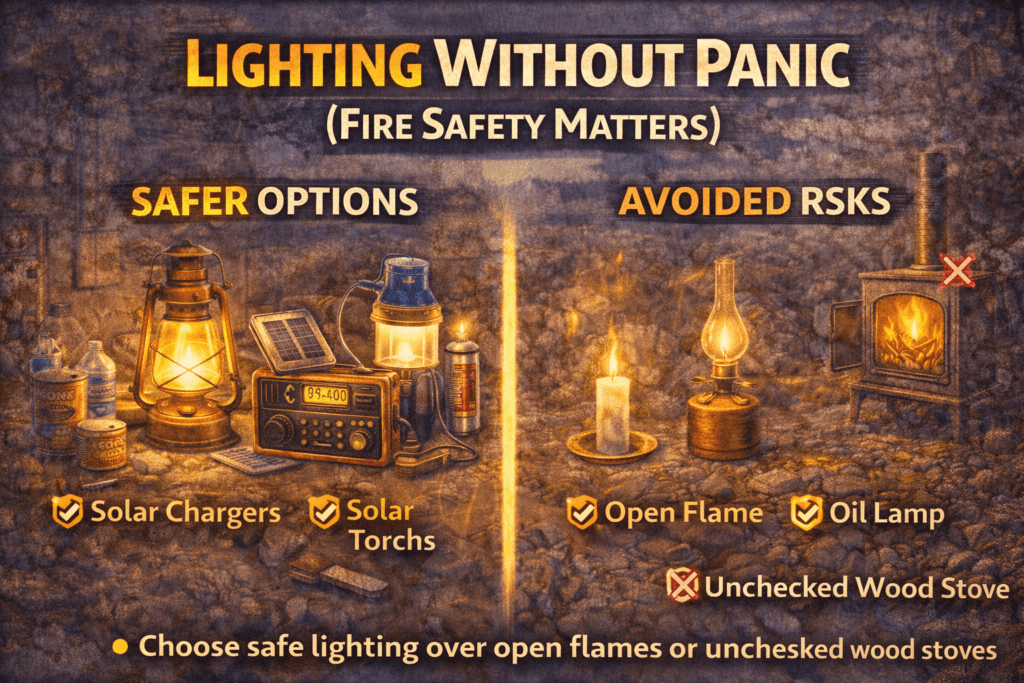
Candles can feel like the obvious choice in a power cut — but they’re also one of the biggest avoidable risks during outages. In real life, the problem isn’t “candles are evil”. It’s that you’re using an open flame at the exact moment your home is darker, you’re more distracted, and routines are disrupted.
Why candles are risky
Candles create a perfect storm of hazards:
- Open flames in a dark environment
When visibility is poor, it’s easier to misjudge distances, knock things, or leave a flame too close to something that can catch. - Easy to knock over
A sleeve, a pet tail, a cluttered side table, a draught — it doesn’t take much. - High risk around children and pets
Curiosity, movement, and unpredictable behaviour make open flames a gamble. - Especially risky in flats and rented homes
Smaller spaces mean less margin for error. There’s often more soft furnishing nearby, tighter walkways, and less ability to “move the candle somewhere safer”.
If your goal is shelter-in-place stability, candles work against you. They add stress and risk when you’re trying to reduce both.
Safer alternatives
LED lighting is the modern default for a reason. It gives you:
- no fire risk
- long runtimes
- adjustable brightness
- cool operation (no heat, no melted wax, no smoke)
Battery-powered and rechargeable LED lights are also cheaper long-term than repeatedly buying candles — and far more controllable. You can choose where the light goes, how bright it is, and how long it stays on. That’s exactly what you want in a disruption.
Creating a calm lighting plan
A good lighting setup isn’t “make the house bright”. It’s about making it safe and calm.
A sensible plan should:
- light main walkways (hallway, stairs, route to the bathroom)
- avoid harsh glare (too-bright light can feel stressful and makes it harder to sleep)
- provide reassurance at night, especially for children
Practical ways to do that:
- Use low-level lighting overnight (just enough to navigate safely)
- Switch to brighter light only when needed (cooking, first aid, finding items)
- Prefer lanterns for rooms instead of relying on a single torch beam
When the lighting feels steady and normal, the whole situation feels more manageable.
Power discipline: making what you have last longer
Shelter-in-place prepping is as much about behaviour as equipment. Most households waste power through small habits — then feel “low on battery” far sooner than expected.
Good power habits include:
- charge devices only when necessary (don’t top up constantly “just because”)
- turn lights off when you leave a room
- use the lowest effective brightness
- prioritise communication over entertainment
This matters because power discipline can double or triple the useful life of what you’ve stored — without buying anything extra.
Common UK power prep mistakes
These are the errors that create hassle, expense, or risk:
- buying generators without understanding indoor safety (fumes, ventilation, storage, noise, fuel handling)
- relying solely on solar chargers (too weather-dependent, especially in winter)
- forgetting spare batteries for torches and radios
- storing power banks uncharged and discovering they’re empty at the worst time
- ignoring lighting safety and defaulting to candles
Avoiding these keeps your setup simple, safe, and genuinely useful.
Bottom line: power for stability, not comfort
In UK shelter-in-place scenarios, power is mainly about:
- staying informed
- staying connected
- staying safe
You don’t need to power your entire home. You need enough electricity to maintain control and calm — until the lights come back on. And for most households, that means stored power plus safe LED lighting, not candles and complicated systems.
3. Food Simple, No-Stress Nutrition
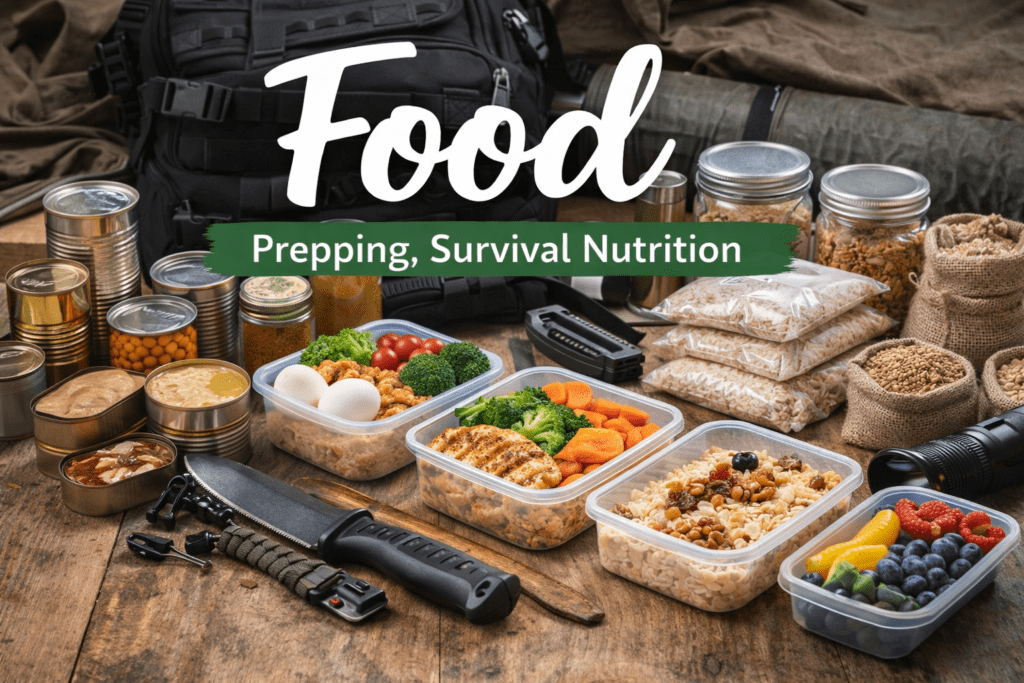
Shelter-in-place food planning isn’t about apocalypse rations, extreme calorie loading, or military-style meal packs. For most UK households, it’s much simpler — and much more realistic.
It’s about making sure you can keep eating normal, familiar meals with minimal effort when life gets disrupted.
In most UK emergencies, you’re not starving in isolation. Food still exists. The issue is usually access: shops may close early, shelves get stripped by panic buying, deliveries slip, or you lose the ability to cook normally for a day or two. Then things stabilise.
Your plan should match that reality.
The aim is straightforward: maintain energy, morale, and routine without stress.
How UK food disruptions usually happen
Food problems in the UK rarely start with “there’s no food”. They start with a chain of annoyances that land all at once:
- Power cuts affecting refrigeration, ovens, hobs, and microwaves
- Severe weather slowing deliveries and reducing stock, especially of basics
- Fuel shortages limiting transport and restocking
- Panic buying emptying local shops before you’ve even had a chance to pop out
In those situations:
- food still exists, but access is reduced
- cooking becomes inconvenient, not always impossible
- stress and uncertainty affect appetite — especially for children, older relatives, or anyone already anxious
That’s why a calm food setup matters. It removes the “What on earth are we going to eat?” conversation at exactly the moment you want predictable, low-effort choices.
What shelter-in-place food should do
Your food supplies should:
- require little thought (no complicated planning, no new recipes)
- be quick to prepare (or ready to eat)
- use familiar ingredients your household already likes
- work for everyone in the home — including children, dietary needs, and comfort foods
Because if food feels strange, unpleasant, or fiddly, it becomes a burden. You don’t want a cupboard full of supplies that technically contain calories but practically create stress.
The best shelter-in-place food is the kind that lets you say, “Right — we’ll just do pasta bake tonight,” or “Beans on toast and soup for lunch,” and carry on with your day. Familiar meals keep morale up, routines steady, and decision-making simple — which is exactly what you’re trying to achieve.
What Works Best
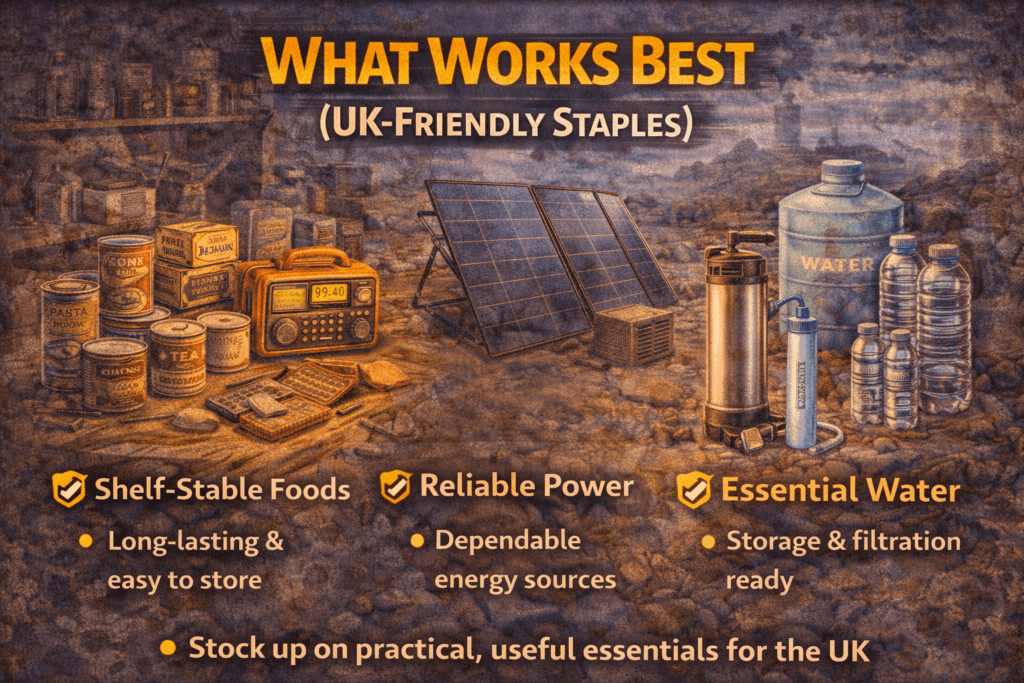
Tinned meals and proteins
Tinned foods are the backbone of a calm, no-stress food setup. They’re reliable, shelf-stable, and work even when your cooking options are limited.
Good options include:
- tinned soups and stews
- beans (baked beans, kidney beans, chickpeas)
- tinned vegetables
- tinned fish (tuna, sardines, mackerel)
- tinned meats (if your household likes them)
Why they’re so useful:
- long shelf life
- can be eaten cold if necessary
- minimal preparation (often just heat and serve)
They’re not “emergency rations” in the dramatic sense — they’re simply the quickest way to turn disruption into a normal meal.
Rice, pasta, and sauces
Rice and pasta are your familiar, filling “bulk” foods. They stretch meals, keep everyone satisfied, and feel normal.
They provide:
- calories
- familiar meals
- flexible combinations
Stick to what you already eat:
- quick-cook rice (or microwave pouch rice if you prefer)
- pasta shapes you actually use
- jarred or tinned sauces (tomato-based, curry, chilli, bolognese-style)
If cooking power is limited, adjust the plan rather than forcing it:
- go for smaller portions that cook faster
- choose shorter cooking times
- aim for one-pot meals to reduce washing up and water use
The goal is food that’s filling without being complicated.
Instant oats and cereals
Breakfast gets overlooked — but it has an outsized effect on morale. A familiar morning routine makes the day feel steadier, especially for children.
Good choices:
- instant oats
- long-life cereal
- porridge sachets
Why they work:
- minimal water
- can be eaten cold if needed
- steady energy without much effort
Even in a disruption, “porridge and a brew” can make the day feel manageable.
Nut butters and calorie-dense foods
When you don’t feel like cooking — or you’re trying to conserve fuel and water — calorie-dense, ready-to-eat foods are gold.
Nut butters are especially effective because they’re:
- high calorie
- shelf-stable
- ready to eat
Other useful options:
- crackers
- oatcakes
- cereal bars
- trail mixes
These are perfect for “no-cook” meals, quick snacks, or topping up energy when you’re cold, tired, or stressed.
Long-life milk and alternatives
Long-life milk is one of those small items that makes a big difference. It supports:
- tea and coffee routines
- breakfast cereals
- simple comfort foods
Also consider:
- powdered milk
- plant-based long-life alternatives
Comfort matters more than people expect. When everything feels slightly disrupted, a normal cuppa and a familiar breakfast can do more for morale than another tin of something you don’t actually like.
No-Cook and Low-Cook Options
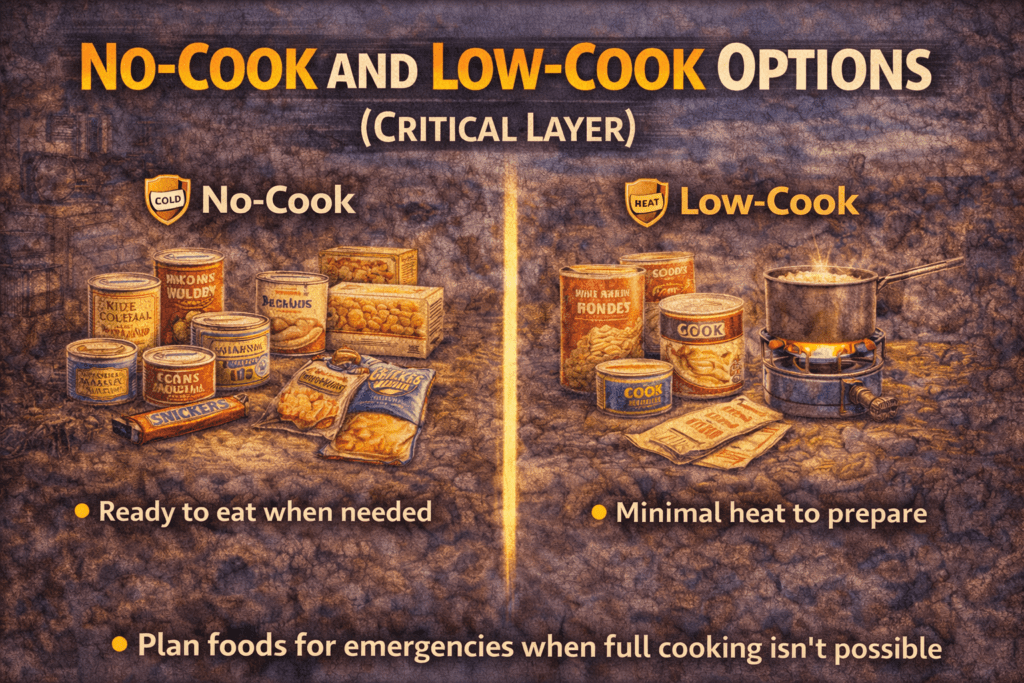
A shelter-in-place food plan has to assume a simple truth: you may not want — or be able — to cook.
That isn’t pessimism. It’s realism. If you’re dealing with a power cut, a dodgy hob, a cold house, stressed kids, or you’re simply tired, the last thing you want is a plan that relies on “proper cooking” to work.
So always include food that:
- requires no cooking
- can be eaten cold
- doesn’t rely on refrigeration
That’s what makes your food plan resilient.
No-cook meal ideas
No-cook meals don’t have to be exciting — they have to be dependable. Think “fuel with minimal effort”.
Reliable options include:
- tinned soup (cold if necessary)
- tinned fish with crackers or oatcakes
- nut butter on oatcakes
- ready-to-eat meals (shelf-stable where possible)
- fruit in juice
These are the meals you can eat even when you’re low on energy, low on light, and not in the mood to faff about.
Low-cook meals (if power or gas is available)
If you have some cooking ability — even limited — you can stretch your options without using much time, fuel, or washing up.
Good low-cook choices include:
- pasta with jarred sauce
- instant noodles
- rice with tinned vegetables
The key is to choose meals with short cooking times and simple prep. One pot, one spoon, done.
Hydration and food go together
Food planning only works if your water plan supports it. When water is tight, certain foods become less appealing — or less usable — very quickly.
Best practice:
- choose foods that require little water to prepare
- avoid overly salty items unless you’ve got plenty of water available
- balance dry foods (crackers, cereal bars, oatcakes) with wet options (soups, fruit in juice, tinned meals)
It’s a simple but powerful principle: water makes food workable. That’s why shelter-in-place planning should treat food and water as one system, not two separate lists.
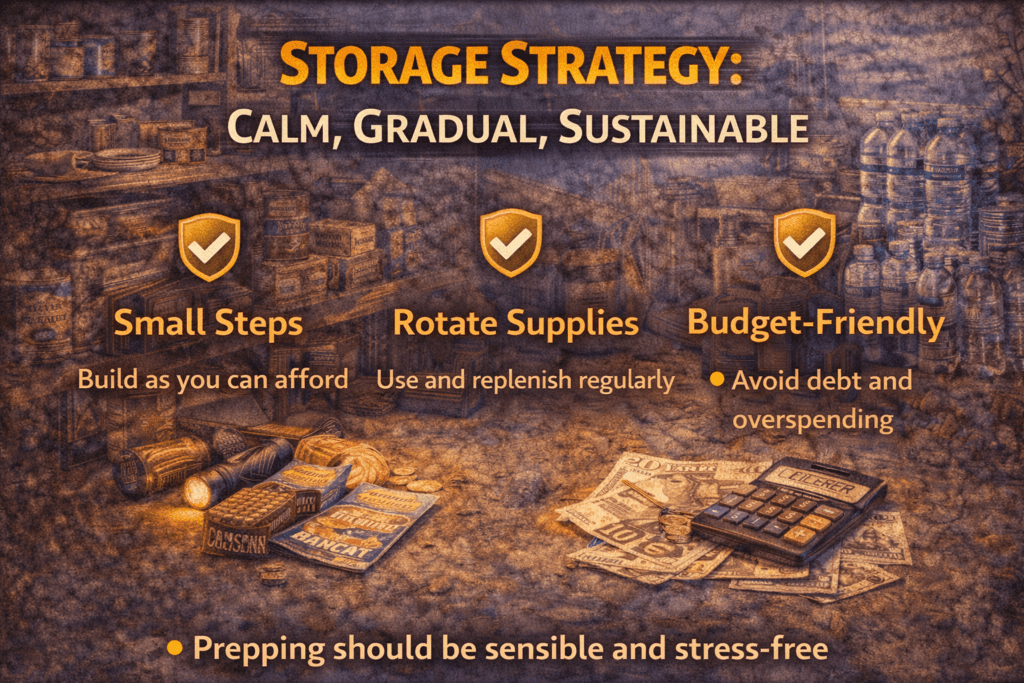
Storage Strategy Calm, Gradual, Sustainable
The best shelter-in-place food system is one you barely notice day to day.
Eat what you store
This is the single most important rule — and it solves most food-prep problems in one go.
If you only store food you already like and already use, you automatically get:
- no waste (because it won’t sit untouched for years)
- no forced meals (you’re not “stuck with it” in a disruption)
- easy rotation (your normal shopping habits do most of the work)
A good reality check is simple: if you wouldn’t choose to eat it on a normal Tuesday, you won’t suddenly love it during a stressful week. In an emergency, comfort and familiarity matter more, not less.
Rotate regularly (without stress)
Rotation doesn’t need spreadsheets, alarms, or an admin-heavy system. The best approach is the one you’ll actually keep doing.
Simple methods:
- use first in, first out (oldest gets used first)
- put newer items behind older ones on the shelf
- replace as you use them — one tin out, one tin back in
That’s it. Rotation is just a habit of “use and replace”, not a project.
The benefit isn’t just freshness — it’s confidence. You know your supplies are current, edible, and part of normal life.
Avoid “special emergency food” you dislike
Freeze-dried meals and specialist rations can sound reassuring, but they often come with downsides that don’t suit most UK shelter-in-place scenarios — especially for beginners.
They’re often:
- unfamiliar in taste and texture
- more water-dependent than you expect
- significantly more expensive per meal than normal cupboard food
They can have a place as a niche backup, but they should rarely be the foundation of your plan. Your primary food setup should be built from everyday UK cupboard staples that your household already enjoys — because that’s what keeps the whole system calm, practical, and sustainable.
Special Considerations for UK Households
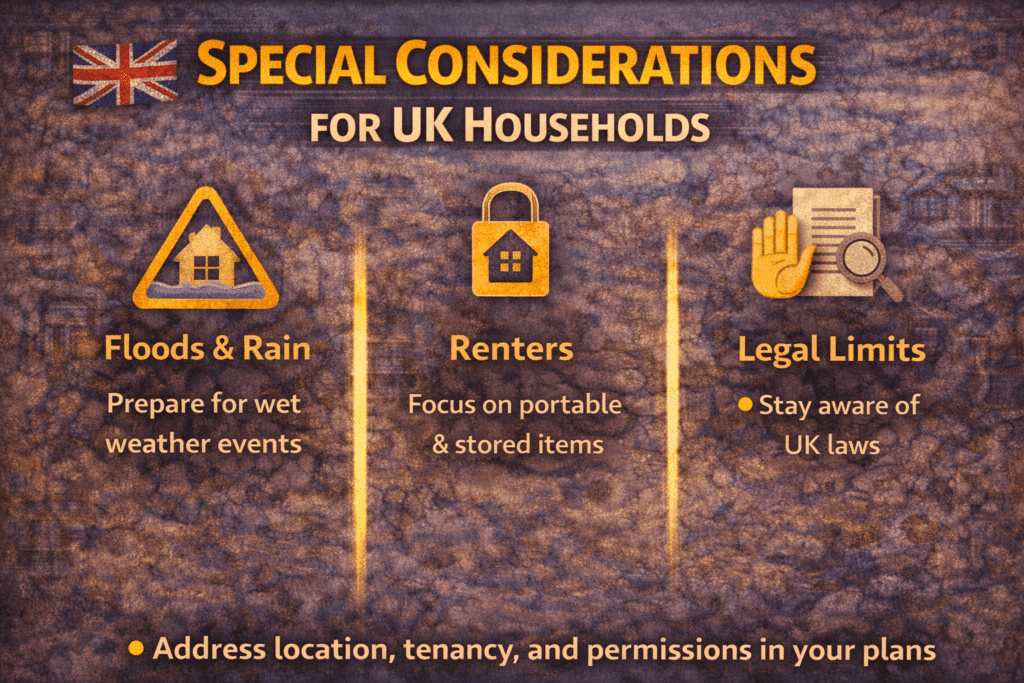
Small spaces and flats: keep it stackable
If you’re working with limited space, the goal is to build a food buffer that doesn’t take over your home. That means thinking in “layers”, not bulky bags and awkward tubs.
Best approach:
- focus on stackable tins (they store neatly and don’t mind being tucked away)
- use under-bed storage or the bottom of wardrobes and cupboards
- avoid bulky containers that waste space and are hard to move in a small home
A tidy, hidden supply you can actually live with beats a “perfect” setup that creates clutter and stress.
Families with children: protect routine
With children, food planning is as much about behaviour and reassurance as it is about ingredients. A disruption is already unsettling — you don’t want meals to become another source of friction.
Key principles:
- include familiar snacks you know they’ll eat
- maintain normal mealtimes where possible (routine is calming)
- avoid sudden dietary changes or “new emergency foods” that trigger pushback
In practice, this can be as simple as having a few reliable options you know work: cereal, pasta, soups they actually like, and snacks that prevent the “hangry” spiral.
Dietary requirements: plan specifically
If someone in your household has allergies, medical needs, or restricted diets, you can’t rely on “we’ll pick something up if needed”. During disruption, substitutes may be sold out, unavailable, or unfamiliar.
Plan for:
- known allergies and intolerances
- medical diets (for example, diabetes-friendly options)
- anything that would cause stress or health issues if supplies ran short
The aim is certainty: you know you have safe food available without having to hunt for alternatives.
Common UK food prep mistakes
These are the errors that make people feel prepared — right up until the moment they actually need to use it:
- buying food you never eat (it becomes waste, not resilience)
- over-relying on freezer storage (power cuts make freezers a weak point)
- forgetting cooking limitations (no power, low gas, minimal water, limited washing up)
- ignoring comfort foods (morale matters more than people expect)
- panic buying instead of gradual prep (expensive, stressful, and often the wrong items)
Avoiding these keeps food prepping calm, practical, and affordable.
Food as morale, not just fuel
In UK shelter-in-place situations, food isn’t just calories. It supports:
- routine
- comfort
- emotional stability
A warm drink, a familiar meal, or a normal breakfast can noticeably reduce stress when everything feels uncertain. That’s not fluff — it’s how people cope.
Keep food boring, familiar, and easy
The best shelter-in-place food plan is deliberately unexciting.
If your plan feels:
- normal
- predictable
- easy
…then you’ve done it right.
4. Heat & Warmth: A UK-Specific Priority
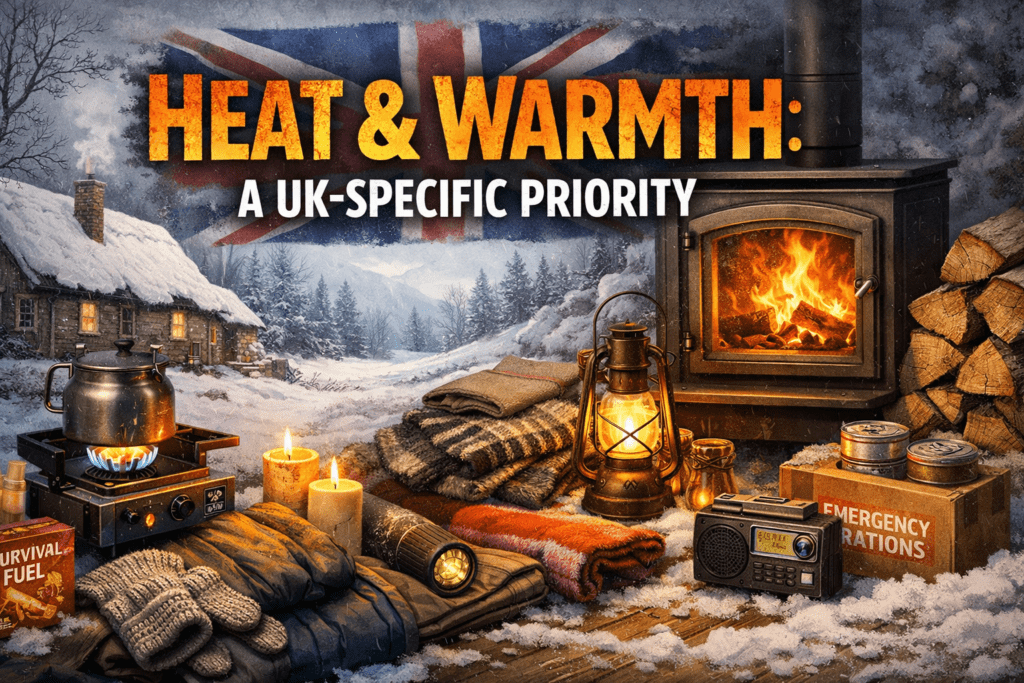
When the power goes out, warmth can become a problem faster than most people expect — especially in winter. Even homes with gas boilers often lose heating and hot water immediately, because modern systems rely on electricity for controls and pumps. That’s why “warmth” deserves its own plan, not just a passing mention.
Shelter-in-place prepping for warmth isn’t about extreme cold survival. It’s about keeping your home safe and livable: maintaining a safe body temperature, protecting vulnerable household members, and stopping minor discomfort from turning into a real health issue.
The aim is simple: retain heat, reduce exposure, and stay comfortably warm using low-tech, low-risk methods.
Why heat loss is a serious UK risk
Most UK homes are designed around central heating. When that system fails:
- indoor temperatures can drop quickly
- damp and cold magnify discomfort (it feels colder than the thermometer suggests)
- sleep quality deteriorates, which makes everything harder the next day
- vulnerable people face higher risk (older adults, babies, anyone unwell, anyone with circulation or respiratory issues)
Cold-related illness doesn’t require freezing conditions. Prolonged time in a cool indoor environment can contribute to fatigue, stiffness, poor circulation, respiratory irritation, and a general drop in morale. And when morale drops, decision-making usually follows.
How UK homes lose heat
Before buying anything, it helps to understand where warmth actually goes. In typical UK homes, heat escapes through:
- poor insulation (lofts, walls, floors)
- older or single-glazed windows
- draughty doors and gaps (letterboxes, keyholes, skirting boards)
- large open-plan spaces that are hard to keep warm
There’s also a pattern worth knowing:
- flats often retain heat better than houses (shared walls can help)
- older terraces and semis can lose heat quickly, especially if they’re draughty or have large front rooms
What warmth planning should focus on
Shelter-in-place warmth planning is mainly about slowing heat loss, not generating new heat sources.
That’s deliberate. In a stressful situation, the safest plan is the one that:
- works without electricity
- doesn’t rely on open flames
- doesn’t create fumes or fire risks
- and still keeps everyone warm enough to function normally
Think of it as “making your home hold onto warmth” — so your body doesn’t have to fight the cold, and your household can stay calm, rested, and safe until heating returns.
Core Warmth Strategy Layering, Not Heating
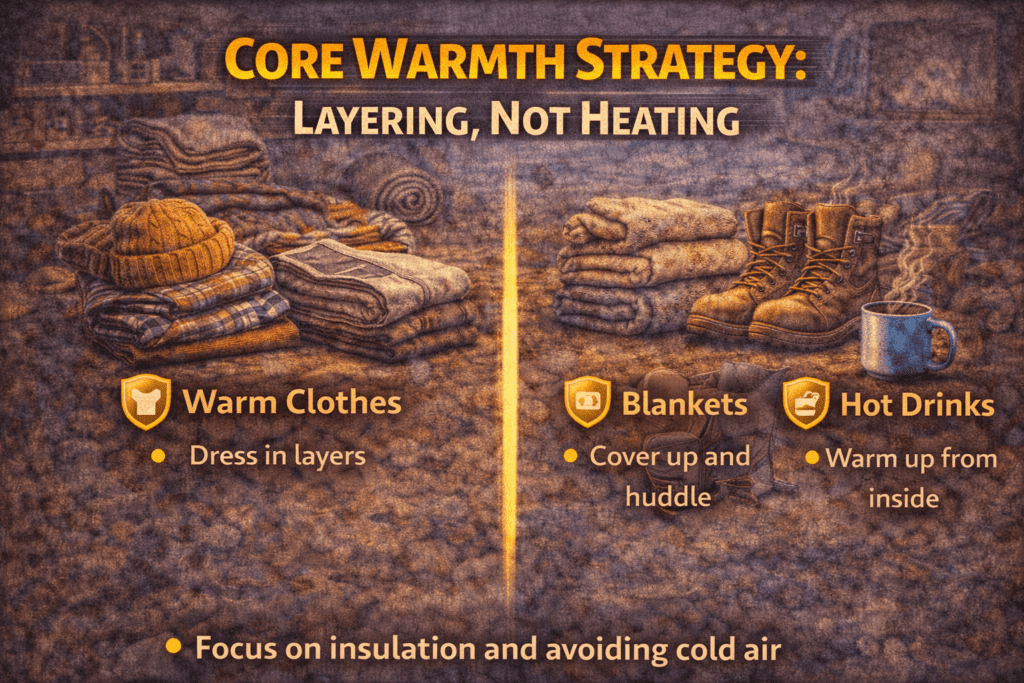
Personal layering
Clothing is your first and most reliable heat source — because it doesn’t depend on electricity, fuel, or equipment. In a UK power cut, the fastest way to feel warmer is usually not “find a heater”, but dress for the indoor temperature you actually have, not the one you’re used to.
Effective layering looks like:
- thermal base layers (top and leggings if you’ve got them)
- a warm jumper or fleece
- thick socks (wool or thermal if possible)
- a hat or beanie indoors if the room is genuinely cold
This is one of those times where small changes make a big difference. A hat, warm socks, and a decent base layer can shift you from “miserable” to “fine” surprisingly quickly.
Why it works: your body loses heat fastest through the areas with lots of blood flow and surface exposure — head, hands, and feet. Keep those warm and your whole-body comfort improves disproportionately. Cold feet in particular make the whole house feel colder than it is.
What to avoid relying on:
- thin cotton layers (they don’t trap heat well and feel colder if you sweat)
- one single bulky layer instead of multiple thinner ones
Layering works because it traps air — and trapped air is insulation. It also lets you adjust easily if conditions change: add a layer when you’re sitting still, remove one if you’re moving around.
Bedding and blankets
Blankets aren’t just for bedtime. In a cold home, they’re one of the most efficient “warmth upgrades” you can use during the day — because they reduce heat loss while you’re stationary (which is when you feel the cold most).
Recommended items:
- a thick duvet (yes, even on the sofa)
- fleece or wool blankets for extra layers
- sleeping bags, especially 3-season models
Sleeping bags are particularly useful because they’re designed to trap heat efficiently. They work brilliantly for:
- children, who cool down faster and often struggle most
- anyone sitting still for long periods
- turning a sofa into a warm “nest” without needing to heat the whole room
Think of blankets and sleeping bags as “portable warmth”. You can move them to wherever you’re spending time, rather than trying to warm every room.
Room zoning: heat the space, not the house
Trying to keep an entire home warm during a power cut is inefficient and unnecessary. The smarter approach is to choose one main room and make it your warm zone — the place you spend most of your time, eat, and settle in the evening.
Warmth planning works best when you concentrate your effort: fewer rooms, fewer draughts, more people in one space, and a much easier job staying comfortable.
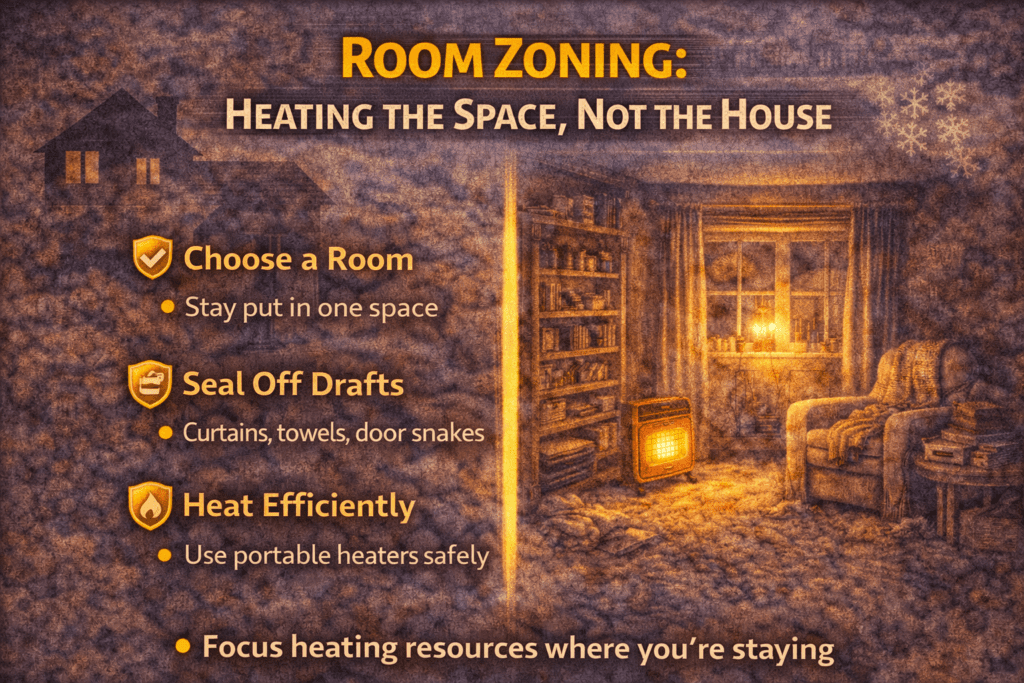
Choose one “warm room” as your base
When heating fails, the smartest move is to stop treating your whole home like it needs to be warm. Pick one room and make it your main living space for the disruption.
A good warm room is usually:
- smaller (small rooms hold heat better)
- has fewer windows (less glass = less heat loss)
- somewhere you can comfortably spend time — living rooms or bedrooms tend to work best
Once you’ve chosen it:
- close doors to unused rooms
- keep everyone mostly in that space (including pets where practical)
- bring key supplies in temporarily: blankets, lanterns, snacks, water, chargers, a radio
This concentrates body heat, reduces draughts through the rest of the house, and makes it far easier to stay comfortable without doing anything complicated.
Use soft furnishings to retain heat
Soft furnishings aren’t “cosy extras” in a cold home — they’re insulation. They reduce heat loss, block draughts, and make cold surfaces feel less harsh.
Helpful items include:
- curtains or thermal blinds (close them as soon as it gets dark)
- rugs on bare floors (especially wood, tile, or laminate)
- cushions and throws for quick extra layers
Even temporary measures help more than people expect. If you’ve got a noticeably draughty doorway or hallway, something as simple as hanging a thick blanket over the opening can cut the “cold air movement” that makes rooms feel freezing.
The principle is simple: reduce airflow, reduce exposed cold surfaces, and your warm room holds onto heat longer.
Hot water bottles and passive heat
Hot water bottles are one of the most effective — and most underrated — warmth tools in the UK. They’re low-tech, cheap, and genuinely powerful when used properly.
Why they’re so useful:
- no electricity needed once filled
- safe when used correctly
- provide targeted warmth for hours, exactly where your body feels the cold most
How to use them well:
- under blankets to trap the heat
- at your feet or lower back (high impact areas for comfort)
- pre-warm beds before sleep so you’re not climbing into cold sheets
If you get a brief window of hot water during an outage, filling bottles early is one of the best “warmth moves” you can make. Done right, they can keep beds and laps warm well into the night — without any extra risk, noise, or faff.
Managing Heat Safely
Cold situations often lead people to take unsafe shortcuts.
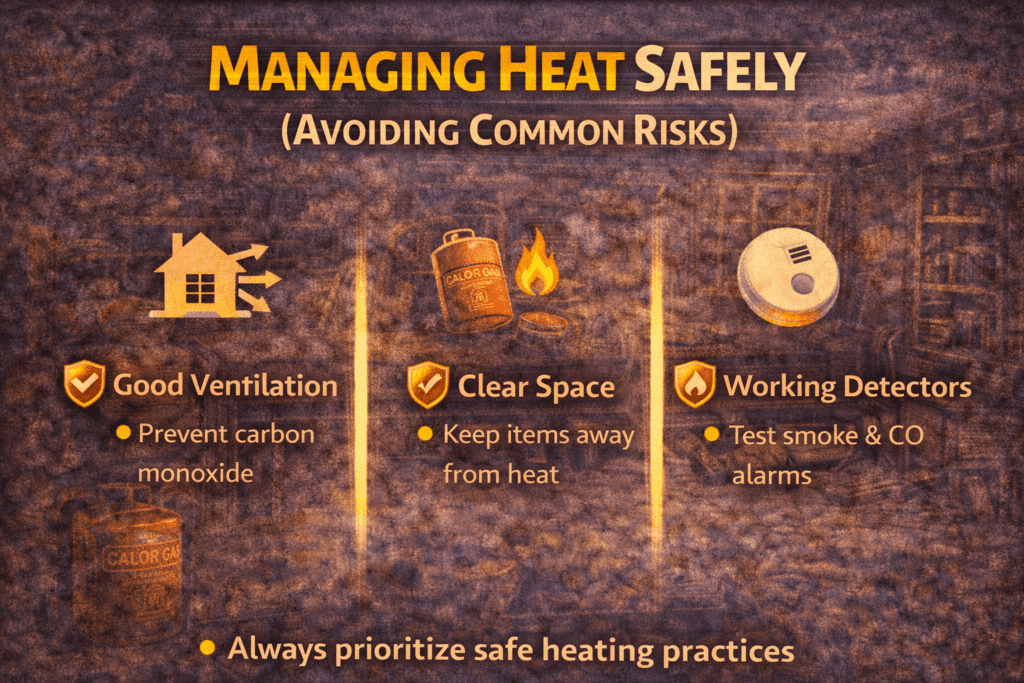
Avoid open flames indoors
When a home is cold and dark, it’s tempting to reach for “anything that makes heat”. In UK shelter-in-place situations, that’s where people accidentally create the biggest risks.
Avoid using open flames indoors, including:
- candles
- camping stoves
- BBQs
- fire pits
In enclosed UK homes — and especially in flats — these can introduce serious hazards: fires, burns, and carbon monoxide build-up. In a disruption you want fewer risks, not new ones.
Avoid improvised heating
This is the line you don’t cross, even if you’re uncomfortable.
Never attempt to:
- burn fuel indoors
- block ventilation
- use outdoor heaters inside
Improvised heating setups can go wrong quickly and quietly. Shelter-in-place prepping prioritises safe, low-risk warmth over “feels warmer for an hour”.
Keeping warm at night
Night-time is when temperatures drop, people are more tired, and risk increases. A calm night plan makes a huge difference to how you cope the next day.
Best practices:
- wear thermal sleepwear (or layered pyjamas)
- use extra blankets or a duvet on top of the duvet if needed
- sleep in the warm room if it’s noticeably colder elsewhere
- keep hot water bottles wrapped properly (cover on, no direct skin contact)
For children and older relatives, comfort can change quickly. The safest approach is usually to adjust layers (socks, an extra jumper, a hat) rather than trying to heat the whole home or overheating one room.
Special considerations for UK households
Flats and apartments
Flats often retain heat better, which is a real advantage — but drafts can undo that quickly.
- avoid opening balcony doors during cold spells
- focus on window insulation (curtains/blinds, draft sealing)
- keep your warm room plan simple and tidy
Houses and older properties
Older UK homes can leak heat fast, but small fixes help a lot.
- use draught excluders at doors
- seal unused fireplaces (temporary draught blockers work surprisingly well)
- close off stairwells if possible to stop warm air rising away from living spaces
Vulnerable individuals
Some people are simply at higher risk in cool indoor temperatures:
- older adults often feel cold sooner and recover heat more slowly
- some medical conditions increase cold sensitivity or risk
Extra monitoring matters. Check in more often, keep drinks warm, and prioritise layers, blankets, and a consistently warm base room so their comfort doesn’t quietly slip into a problem.
Heat, Hydration, and Nutrition Work Together
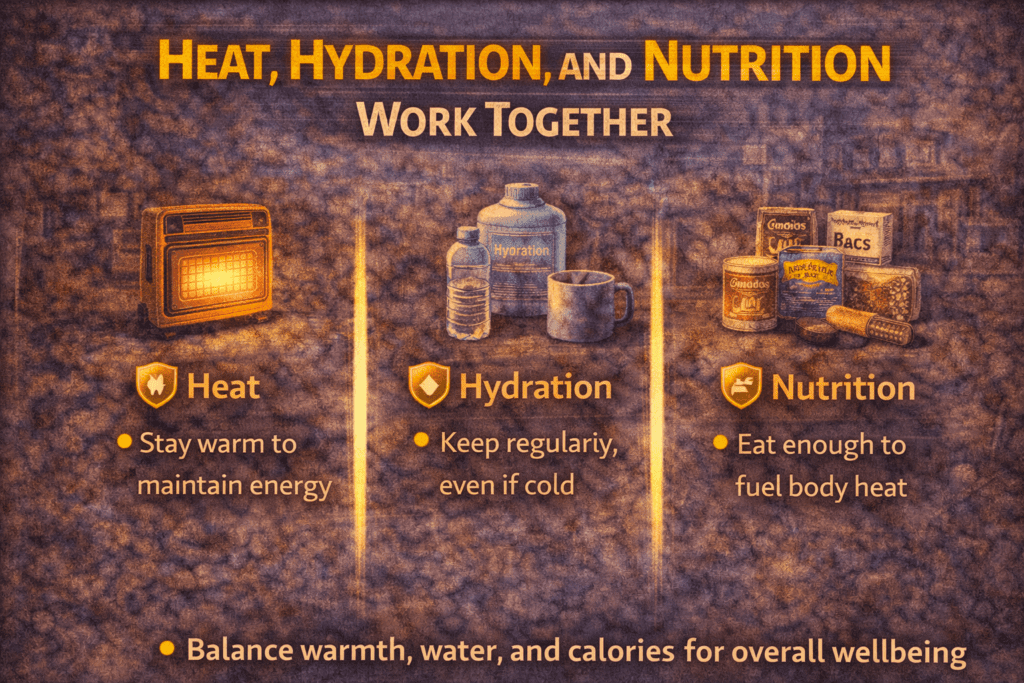
If you’re trying to stay warm during a disruption, don’t underestimate the basics. Warmth is easier to maintain when:
- you’re well-fed
- you’re properly hydrated
Your body generates heat through metabolism. If you’re under-eating or dehydrated, you’ll feel colder and tire faster — even if the room temperature hasn’t changed.
Warm drinks help too. They’re not “heating the house”, but they do improve comfort and morale in a very real way — especially when they’re prepared earlier and kept in a flask or insulated bottle. A steady supply of warm drinks can make a cold evening feel manageable rather than miserable.
Common UK warmth prep mistakes
These are the missteps that make homes colder — or less safe — than they need to be:
- Relying solely on electric heaters
If the power is out, they’re useless. Even if power is on, they can be inefficient for whole-house warmth and often encourage bad habits like heating unused rooms. - Ignoring draughts
A draughty home will never feel warm, no matter how many blankets you own. Blocking airflow is one of the highest-impact, lowest-effort fixes. - Wearing too few layers indoors
People often dress for “normal central heating” and then wonder why they can’t get warm. Layering is the quickest win you control. - Heating unused rooms
Spreading warmth thinly across the house is a fast way to feel cold everywhere. A single warm base room is far more effective. - Taking fire risks out of desperation
Candles, improvised heaters, indoor burning, blocked ventilation — these feel like solutions in the moment, but they’re high-risk choices that can turn a manageable situation into an emergency.
Avoiding these mistakes keeps your plan simple, safer, and much more effective.
Warmth is about retention, not generation
In UK shelter-in-place scenarios, staying warm comes from:
- clothing (layering properly)
- insulation (soft furnishings, blocking draughts, closed curtains)
- room management (one warm room, doors closed)
- simple, safe tools (blankets, sleeping bags, hot water bottles)
You don’t need to heat your home like normal. You need to slow heat loss and protect people, not spaces — and when you get that right, most cold-weather disruptions become far more manageable.
5. Information & Communication
In UK shelter-in-place scenarios, people rarely face complete isolation — but they often face something that feels just as disruptive: conflicting information, rumours, and patchy digital services.
Shelter-in-place communication planning is simply about keeping your household steady by doing three things well:
- receiving accurate, official updates
- maintaining basic contact with family and neighbours
- reducing anxiety caused by uncertainty
The objective is straightforward: stay informed without draining power or overwhelming yourself.
Why information matters more than you expect
In most UK disruptions, help still exists — but timing is unclear. Services are stretched, not gone. Updates arrive quickly, but not always accurately.
That uncertainty is what makes people burn through supplies and battery life. Without reliable information:
- people make rushed decisions (“we need to leave now”, “we need to buy everything”)
- anxiety rises — and stress makes everything feel worse
- power and supplies get wasted on low-value activity (constant scrolling, repeated calls, unnecessary trips)
A calm, informed household often copes better than a better-equipped but uninformed one — because they use what they have more wisely.
The UK information landscape during disruptions
It helps to know what usually happens to communications in the UK when things are disrupted:
- mobile networks may stay live but become congested (local demand spikes)
- internet access can be slow or unavailable (power issues, damaged infrastructure, overloaded networks)
- local radio often continues broadcasting and can be the most dependable source
- government and council updates are prioritised, especially for travel, closures, rest centres, and safety advice
That’s why redundancy matters. If you rely on one source — your phone, your broadband, social media — you’re vulnerable when that one thing becomes unreliable.
Core information priorities
A good communication plan supports three priorities:
- Receiving official updates
Clear, accurate information you can act on. - Maintaining essential contact
Quick check-ins with family, neighbours, and anyone vulnerable. - Preserving battery life
Because your ability to communicate tomorrow matters as much as today.
Everything else is secondary. The goal isn’t to stay online constantly — it’s to keep a calm, low-effort information loop running so your household can make good decisions and avoid unnecessary stress.
Primary Information Tools
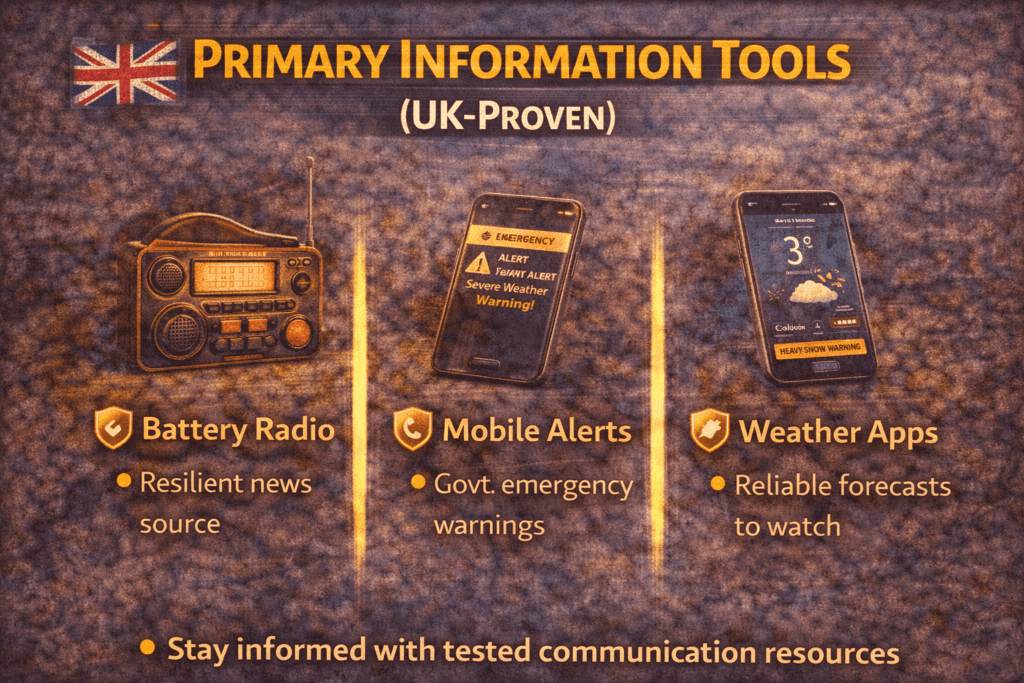
Radio: your most reliable update channel
When digital services get patchy, a radio becomes the calm, dependable option. It’s one of the few ways to receive updates that doesn’t depend on broadband, apps, or a functioning phone signal.
Why radios matter:
- independent of the internet
- low power use compared to phones
- still used for public messaging during disruptions
What to look for (keep it simple):
- FM and AM bands
- battery operation (AA/AAA keeps it easy)
- optional hand-crank backup for extra resilience
Local radio is especially useful because it often carries area-specific information — road closures, local flooding, school closures, rest centre locations — that national news won’t prioritise.
Mobile phones: powerful, but manage them
Phones are brilliant tools in an outage — but only if you treat them like tools, not entertainment.
Best practice during disruptions:
- use your phone for updates and messages, not endless scrolling
- enable low power mode early
- reduce screen brightness
- disable background refresh and non-essential notifications
Also: messaging usually beats calling. Texts and messaging apps often go through even when calls struggle, and they use far less battery.
Power discipline for communication
A communication plan falls apart if your devices go flat. The fix isn’t fancy kit — it’s simple rules.
Adopt a few habits:
- check updates at set intervals (not constantly)
- avoid the “refresh spiral”
- prioritise essential contacts first
- keep one phone as a reserve if your household has more than one
These small behaviours can stretch your communication window from hours into days.
Offline information: your silent backup
Digital access can disappear suddenly — and that’s when you realise how much you rely on your phone for basic details.
Keep physical or downloaded copies of:
- emergency contact numbers
- medical information (medications, conditions, allergies, NHS numbers if relevant)
- local council emergency guidance (printed or saved)
- utility provider contact details (power, water, gas)
A single printed sheet stored with your supplies is often enough — and it removes the “I can’t access anything” panic.
Local knowledge matters
National advice is helpful, but local instructions take priority. The most useful information in a disruption is often hyper-local.
Know:
- your local council website and where they post urgent updates
- any flood risk areas near you and safe routes
- nearby community support hubs or rest centres (where applicable)
This local awareness helps you make faster, more confident decisions — with less guesswork and far less stress.
Family & Household Communication Planning
Information is only useful if everyone understands it.
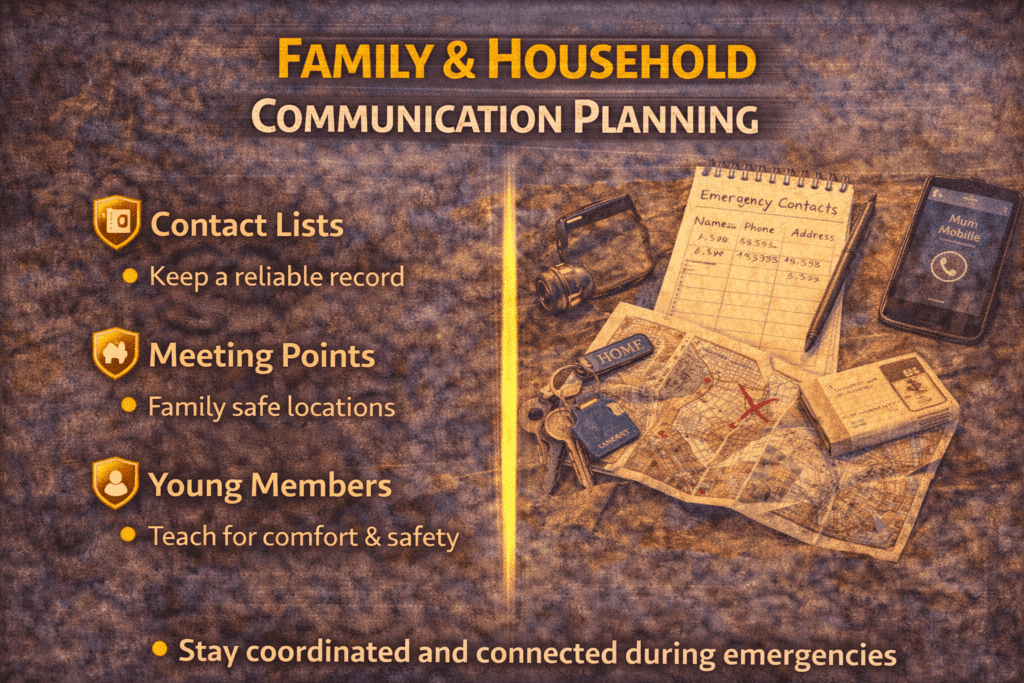
Internal Communication
Ensure everyone in the household:
- Knows where the radio is
- Understands basic power rules
- Knows who makes decisions
Children benefit from reassurance and routine rather than constant updates.
External Contacts
Agree in advance:
- One out-of-area contact
- Who checks in with whom
- How often updates are shared
This prevents repeated calls and unnecessary power use.
Neighbours and Community Awareness
UK emergencies are often managed at a community level.
Simple actions help:
- Checking on vulnerable neighbours
- Sharing verified information
- Avoiding rumour spread
A quick conversation can provide clarity when digital updates lag.
Avoiding Information Overload
Too much information can be as harmful as too little.
Common problems include:
- Doom-scrolling
- Conflicting social media posts
- Speculation and rumours
Set boundaries:
- Limit update checks
- Use trusted sources only
- Ignore unverified claims
Calm information consumption preserves mental health and decision-making ability.
Common UK Communication Mistakes
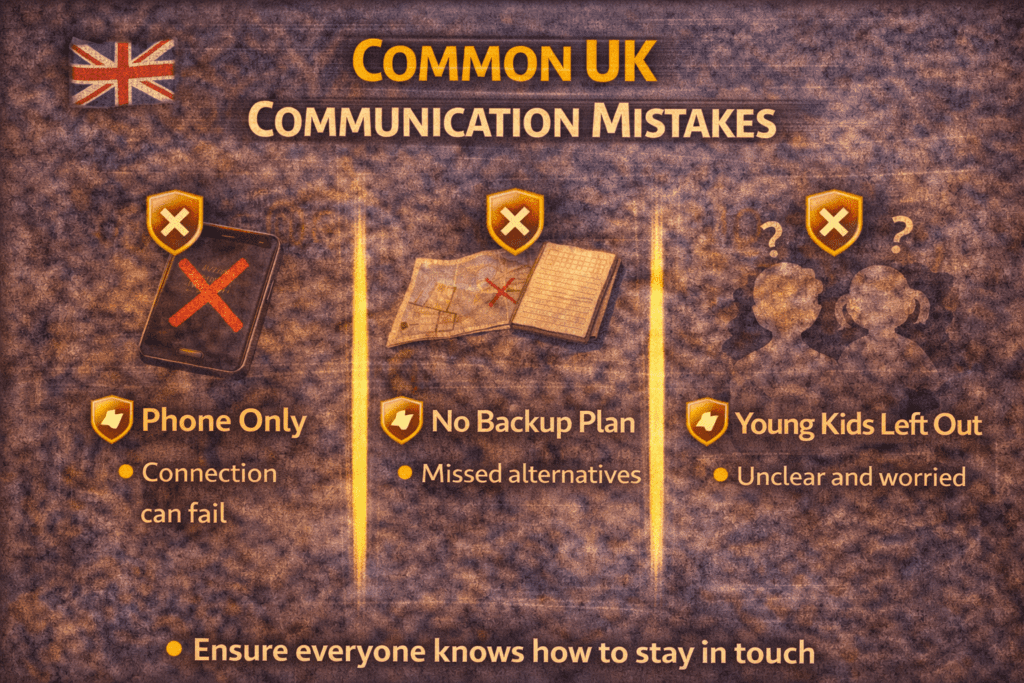
- Relying solely on smartphones
- Forgetting radios entirely
- Draining batteries on entertainment
- Believing unverified social media claims
- Ignoring local updates
Avoiding these mistakes keeps communication reliable.
Information as a Stability Tool
Accurate information provides:
- Reassurance
- Predictability
- Confidence in decisions
A household that understands what is happening and why remains calmer, even when conditions are uncomfortable.
Redundancy Beats Technology
In UK shelter-in-place scenarios, the best communication setup is:
- Simple
- Redundant
- Power-efficient
6. Hygiene & Sanitation
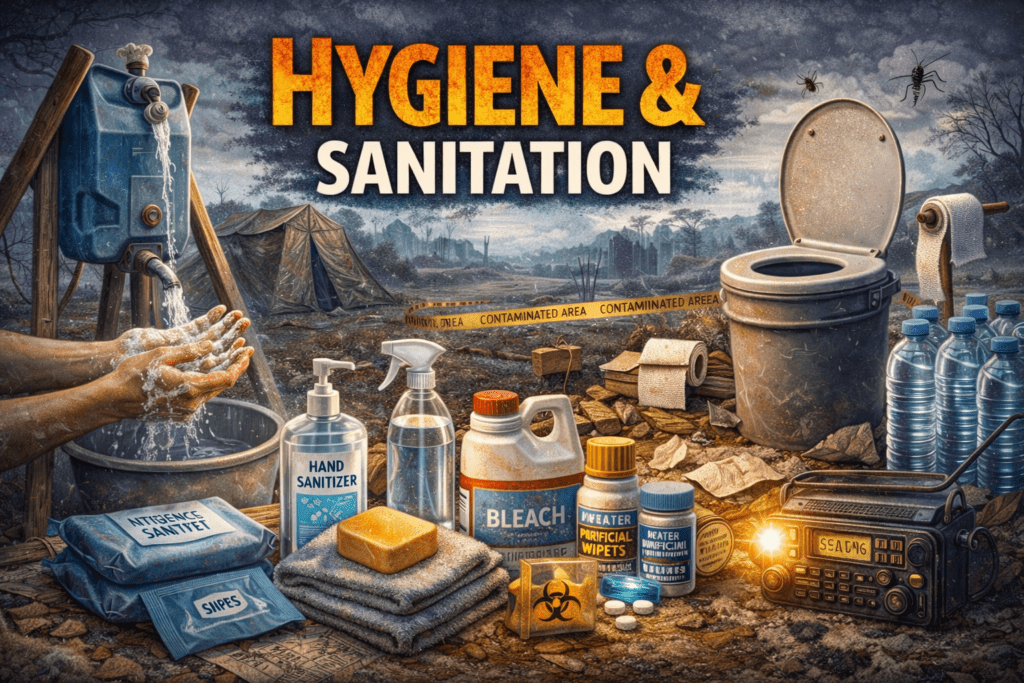
In the UK, most homes rely on:
- Mains water
- Flush toilets
- Regular waste collection
When any of these are disrupted—even temporarily—small hygiene issues escalate quickly.
Common problems include:
- Limited water for washing
- Toilets becoming unusable
- Rubbish building up
- Increased risk of stomach bugs or infections
Good hygiene planning prevents minor inconvenience from becoming a serious problem.
Understanding Likely UK Sanitation Disruptions
In most shelter-in-place situations:
- Water pressure may be reduced, not completely cut
- Toilets may still flush but should be conserved
- Waste collection may be delayed
This means your goal is reduced usage, not full replacement of modern sanitation.
Core Hygiene Priorities
Hygiene planning should focus on three priorities:
- Hand cleanliness
- Toilet management
- Waste control
If these are managed, most other issues remain minor.
Hand Hygiene The Single Most Important Factor
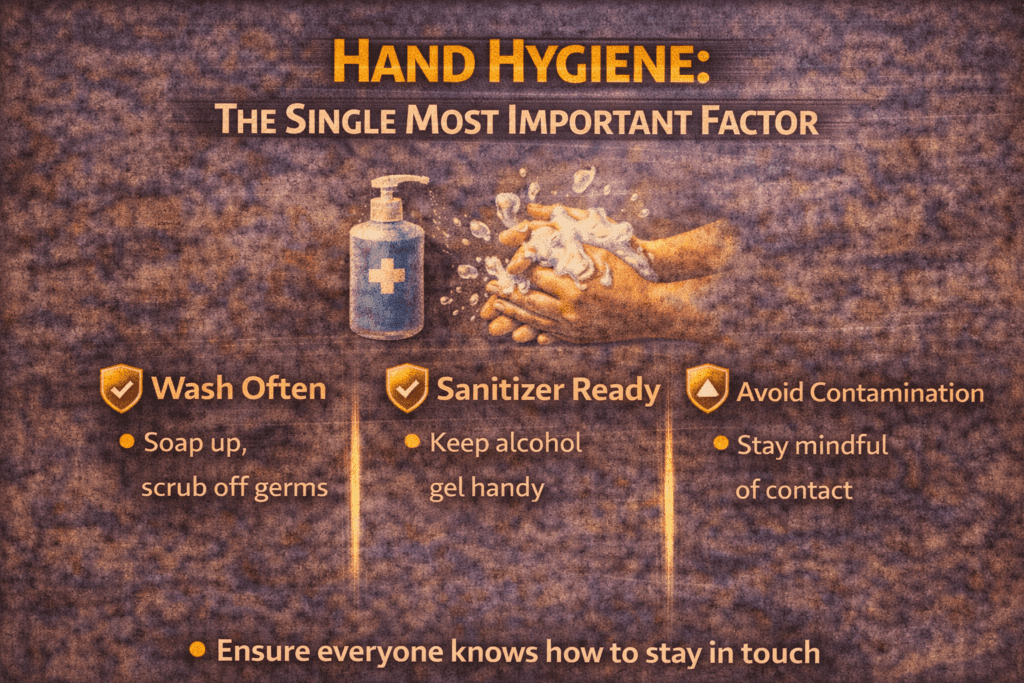
Clean hands prevent the spread of illness more effectively than almost any other measure.
When Water Is Available
Best practice:
- Wash hands before food preparation
- Wash after toilet use
- Wash after handling rubbish
Use:
- Minimal water
- Soap rather than just rinsing
- Shared hand-washing routines if water is scarce
When Water Is Limited or Unavailable
Alcohol-based hand sanitiser becomes essential.
Recommended approach:
- Keep multiple small bottles
- Place one near food prep areas
- Place one near toilet facilities
Wet wipes can also be used, but should not replace hand sanitiser entirely.
Toilet and Wastewater Management
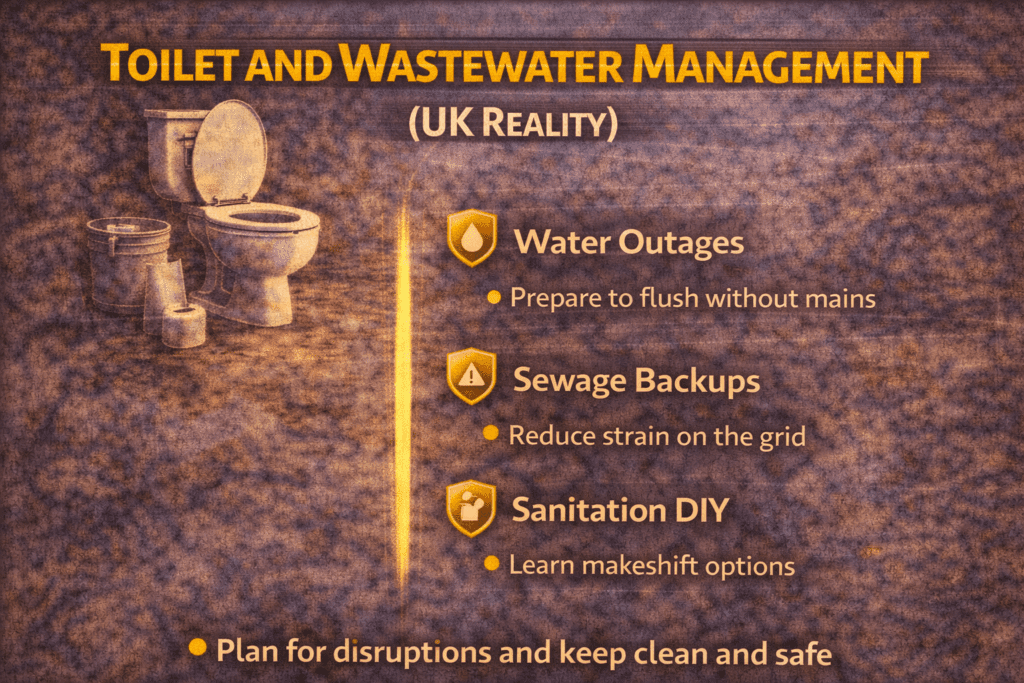
For most short-term UK disruptions, toilets will still work—but usage should be conservative and planned.
Conserving Toilet Use
If flushing still works:
- Avoid unnecessary flushing
- Use reduced flush options where possible
- Combine flushes when appropriate
This reduces strain on plumbing systems and water supply.
If Toilets Become Unusable
This is rare but possible in severe disruptions.
A simple contingency approach includes:
- Heavy-duty bin bags
- Absorbent material (cat litter, sawdust, shredded paper)
- Secure sealing and double-bagging
Waste should be:
- Stored securely
- Kept away from living areas
- Disposed of according to local guidance once services resume
This is unpleasant but manageable with preparation.
Personal Hygiene Without Showers
Maintaining personal cleanliness improves comfort and morale.
Low-Water Washing Methods
Effective alternatives include:
- Baby wipes or hygiene wipes
- Flannel washes using small amounts of warm water
- Targeted cleaning (hands, face, underarms)
You do not need full-body washing every day to remain healthy.
Oral Hygiene
Do not neglect dental care.
Ensure you have:
- Toothbrushes
- Toothpaste
- Minimal water for rinsing
Good oral hygiene prevents discomfort and infection.
Feminine and Personal Care Needs
Hygiene planning must be inclusive of all household members.
Ensure supplies for:
- Menstrual hygiene (pads, tampons, cups)
- Incontinence products
- Nappies and baby wipes
Running out of these items causes significant stress and health issues.
Managing Rubbish and Waste Build-Up
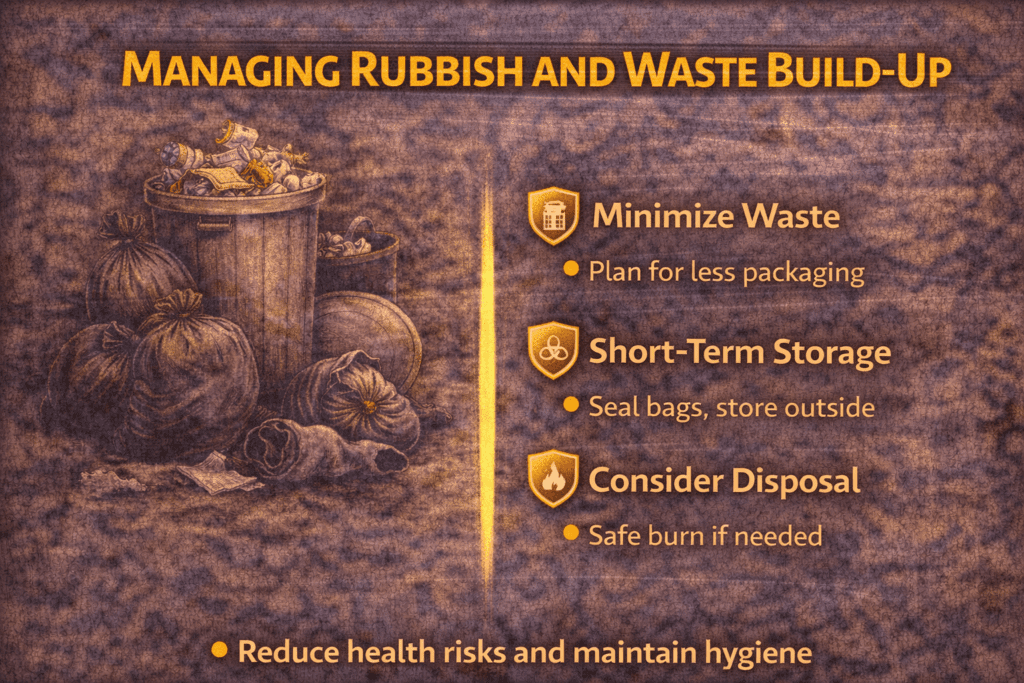
When collections are delayed, rubbish management becomes critical.
Best Practices
- Use strong bin bags
- Seal rubbish tightly
- Store waste away from living areas
- Avoid food waste exposure
If possible:
- Separate food waste from general waste
- Compress rubbish to reduce volume
This prevents smells, pests, and contamination.
Cleaning Surfaces and Living Areas
You do not need full household cleaning during outages, but high-touch surfaces matter.
Focus on:
- Door handles
- Kitchen surfaces
- Toilet areas
Use:
- Antibacterial wipes or sprays
- Minimal water where necessary
A small amount of regular cleaning goes a long way.
Special Considerations for UK Households
Flats and Apartments
- Limited storage space requires efficient waste management
- Avoid placing waste on balconies or shared areas
- Follow building guidance where applicable
Families With Children
- Extra wipes and nappies
- Clear routines for hand hygiene
- Reassurance around cleanliness
Elderly or Vulnerable People
- Higher hygiene standards may be required
- Extra monitoring for skin issues or infections
Common UK Hygiene Mistakes
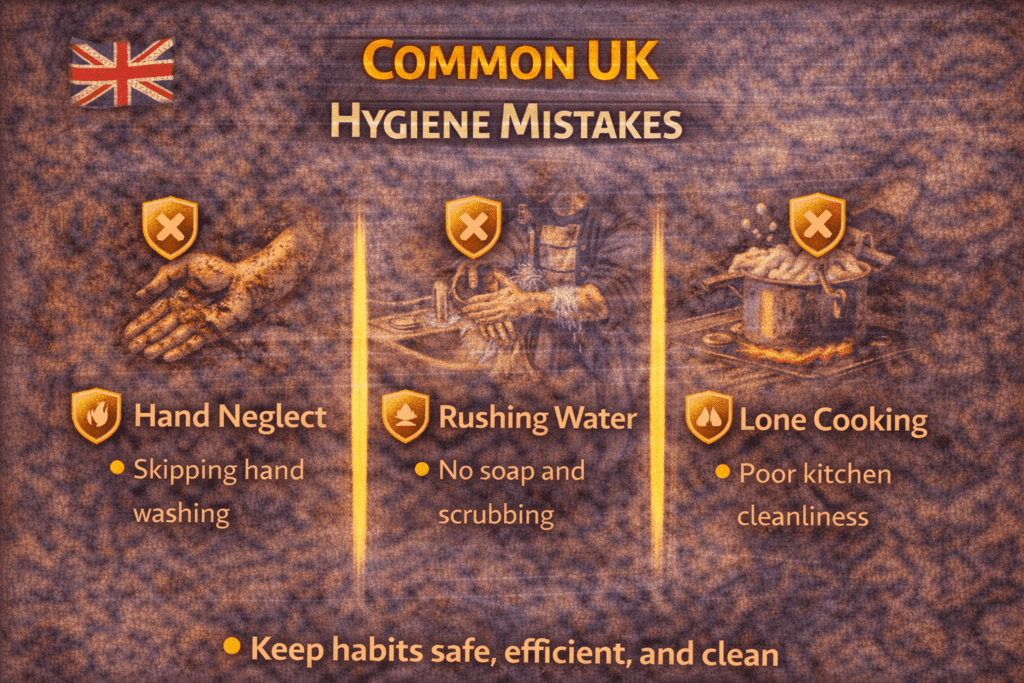
- Assuming water will always be available
- Forgetting rubbish storage
- Ignoring hand hygiene
- Overusing wipes instead of sanitiser
- Leaving waste unsecured
Avoiding these mistakes prevents secondary health problems.
Hygiene and Morale Are Closely Linked
Feeling clean helps people:
- Sleep better
- Eat more normally
- Stay calmer
Even small hygiene routines provide structure and reassurance during disruption.
Clean Enough Is Good Enough
You do not need perfection. You need:
- Clean hands
- Managed waste
- Basic personal care
In UK shelter-in-place scenarios, adequate hygiene prevents illness, preserves dignity, and keeps households functioning until normal services return
7. Medical & Personal Needs
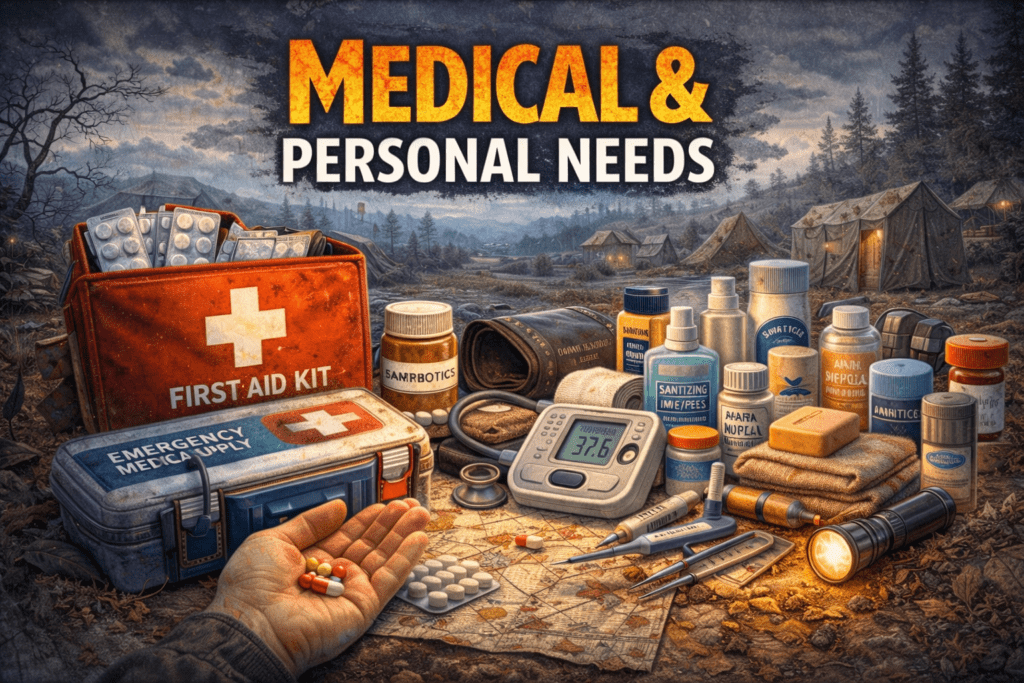
Essentials
In UK shelter-in-place situations, medical and personal needs are often the first things that become stressful. Even short disruptions can interfere with access to prescriptions, pharmacies, carers, or everyday health routines.
This section is not about extreme medical emergencies. It is about continuity of care, preventing minor issues from escalating, and ensuring that everyone in the household can function safely and comfortably until normal services resume.
The objective is clear:
maintain health stability and avoid preventable medical problems during disruption.
Why Medical Preparedness Matters More Than Supplies
In most UK emergencies:
- Hospitals remain operational
- Emergency services are stretched, not absent
- Pharmacies may close temporarily or operate reduced hours
This means non-urgent medical issues can quickly become serious if not managed at home.
Examples include:
- Running out of regular medication
- Minor infections becoming worse
- Injuries without basic first aid
- Disruption to daily health routines
Good preparation reduces the need to seek help during periods when services are under pressure.
Core Medical Priorities for Shelter-in-Place
Medical planning should focus on four priorities:
- Medication continuity
- First aid capability
- Managing existing conditions
- Maintaining personal health routines
If these are covered, most short-term situations remain manageable.
Prescription Medications
Maintaining a Medication Buffer
In the UK, prescription access is regulated, but most people can still build a small safety buffer.
Best practice:
- Order repeat prescriptions as early as allowed
- Avoid running supplies down to the last few days
- Track expiry dates
Even a 7–14 day buffer can make a significant difference during disruptions.
Storage and Organisation
Medications should be:
- Clearly labelled
- Stored in original packaging where possible
- Kept in a cool, dry place
Create a simple list noting:
- Medication name
- Dosage
- Prescribing GP or pharmacy
This is invaluable if assistance is required.
Over-the-Counter Essentials
A well-stocked home medical kit should include items for common issues.
Useful examples:
- Paracetamol and ibuprofen
- Antihistamines
- Anti-diarrhoeal medication
- Rehydration salts
- Throat lozenges
These handle the majority of minor ailments that arise during stressful periods.
First Aid Managing Minor Injuries at Home
Accidents are more likely during power cuts and disruptions.
Your first aid kit should include:
- Plasters and dressings
- Antiseptic wipes or spray
- Bandages
- Tweezers
- Disposable gloves
The goal is basic injury management, not advanced medical care.
Ensure at least one household member knows:
- How to clean and dress wounds
- When to seek professional help
Managing Long-Term Health Conditions
Households with ongoing medical needs require tailored planning.
Examples of Additional Considerations
- Asthma: spare inhalers
- Diabetes: glucose monitoring supplies
- Heart conditions: medication consistency
- Mobility issues: pain relief and support aids
Do not assume emergency replacements will be immediately available.
Medical Devices and Power Dependence
Some medical equipment relies on electricity.
Examples include:
- CPAP machines
- Nebulisers
- Powered mobility aids
If applicable:
- Identify minimum power requirements
- Keep devices fully charged
- Include them in power planning
In some cases, this may justify additional power banks reserved specifically for medical use.
Vision, Hearing, and Sensory Needs
These needs are often forgotten until disrupted.
Ensure access to:
- Spare glasses
- Contact lens supplies
- Hearing aid batteries or chargers
Without these, communication and safety are significantly reduced.
Personal Care and Comfort Items
Comfort items are not luxuries—they support mental health and routine.
Examples include:
- Skincare products
- Lip balm (especially in cold weather)
- Moisturiser
- Deodorant
Small comforts help people feel normal during abnormal situations.
Children’s Medical and Personal Needs
Children require additional planning.
Consider:
- Child-specific medication dosages
- Thermometers
- Familiar comfort items
- Routine maintenance (nappies, wipes, creams)
Maintaining familiar routines reduces stress and behavioural issues.
Elderly and Vulnerable Household Members
Older adults and those with disabilities may:
- Feel cold more quickly
- Be more sensitive to medication timing
- Require assistance with hygiene or mobility
Ensure:
- Clear routines
- Extra monitoring
- Easy access to supplies
Preparation reduces the need for emergency intervention.
Mental Health and Emotional Wellbeing
Medical preparedness is not only physical.
Disruptions can increase:
- Anxiety
- Confusion
- Sleep disturbances
Simple steps help:
- Maintain routines
- Limit distressing news
- Encourage rest and hydration
Calm environments support recovery and resilience.
Medical Information Readiness
Keep essential information accessible.
This may include:
- NHS numbers
- GP contact details
- Medication lists
- Emergency contacts
Store copies both digitally and on paper.
Common UK Medical Prep Mistakes
- Running medications down too far
- Forgetting over-the-counter basics
- Ignoring device charging needs
- Assuming pharmacies will always be open
- Neglecting mental health
Avoiding these mistakes reduces risk significantly.
Stability Over Self-Sufficiency
Medical and personal preparedness in UK shelter-in-place scenarios is about:
- Continuity
- Prevention
- Calm management
You are not replacing healthcare systems—you are bridging short gaps safely.
When medical needs are covered, households remain calmer, healthier, and better able to cope until normal services resume.
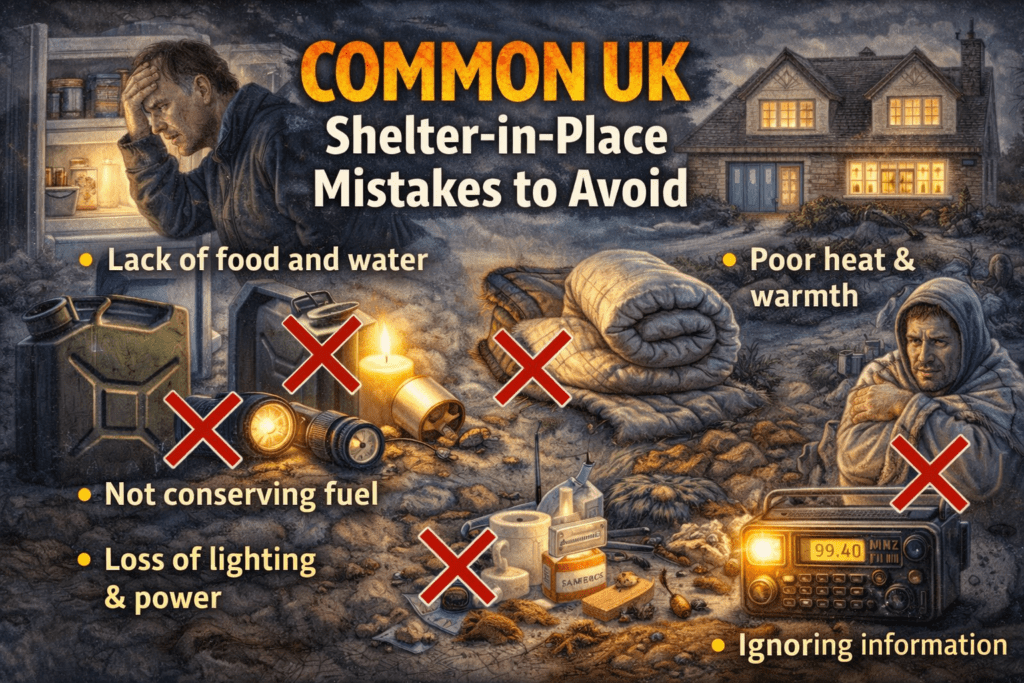
Common UK Shelter-in-Place Mistakes to Avoid
Most problems during short-term emergencies in the UK do not come from lack of supplies. They come from poor decisions, unrealistic assumptions, and panic-driven behaviour.
Shelter-in-place prepping is effective precisely because it avoids extremes. Understanding what not to do is just as important as knowing what to prepare.
The objective of this section is simple:
help you avoid the mistakes that turn manageable disruptions into unnecessary crises.
Mistake 1 Treating Every Situation as a Disaster
One of the most common errors is assuming that any disruption automatically means a worst-case scenario.
In the UK:
- Most outages are temporary
- Emergency services remain active
- Infrastructure failures are usually localised
Overreacting leads to:
- Poor use of supplies
- Increased anxiety
- Unsafe decisions
Shelter-in-place preparedness works best when approached calmly and proportionally.
Mistake 2 Over-Stocking Fuel or Using Unsafe Heat Sources
Attempting to generate heat or power indoors using inappropriate equipment is one of the most dangerous mistakes people make.
Common risks include:
- Storing petrol indoors
- Using camping stoves inside
- Burning fuel in enclosed spaces
- Blocking ventilation to “keep heat in”
These actions significantly increase the risk of fire and carbon monoxide poisoning.
UK shelter-in-place planning prioritises heat retention and safety, not improvised heating.
Mistake 3 Relying Too Heavily on Technology
Modern homes rely heavily on:
- Smartphones
- Internet access
- Smart heating systems
When power or connectivity is disrupted, over-reliance on technology quickly becomes a weakness.
Examples:
- Phones running flat due to constant updates
- No radio backup
- Smart devices becoming unusable
Low-tech backups—radios, printed information, basic lighting—are often more reliable in short-term emergencies.
Mistake 4 Ignoring Power Discipline
Having power banks and batteries is not enough if they are used poorly.
Common issues:
- Charging unnecessary devices
- Using high brightness constantly
- Streaming entertainment during outages
Power discipline extends your available energy from hours to days.
Use electricity deliberately, not habitually.
Mistake 5 Buying Specialist “Survival” Gear Instead of Basics
Many people waste money on equipment that:
- Is difficult to use
- Requires practice
- Is unsuitable for UK homes
Examples include:
- Military-style rations
- Large generators
- Complex water systems
In most UK shelter-in-place scenarios, simple household items outperform specialist gear.
Preparedness should reduce stress, not introduce complexity.
Mistake 6 Neglecting Hygiene and Waste Management
Hygiene is often deprioritised until it becomes a problem.
Common oversights:
- Too few bin bags
- No hand sanitiser
- No plan for reduced water use
Poor hygiene quickly leads to:
- Illness
- Low morale
- Unpleasant living conditions
Maintaining basic cleanliness is far easier than dealing with the consequences of neglect.
Mistake 7 Forgetting Medical and Personal Needs
Many households prepare food and water but overlook:
- Regular medication
- Medical devices
- Child-specific supplies
- Vision or hearing aids
Running out of essential medication causes stress far faster than running out of food.
Medical continuity should always be a priority.
Mistake 8 Panic Buying Instead of Gradual Preparation
Panic buying:
- Creates shortages
- Increases costs
- Adds stress
Gradual preparation:
- Spreads cost over time
- Builds familiarity with supplies
- Avoids waste
Shelter-in-place prepping is a slow, deliberate process, not a reaction to headlines.
Mistake 9 Isolating Instead of Engaging with Neighbours
In UK emergencies, community matters.
Mistakes include:
- Avoiding neighbours
- Hoarding information
- Refusing help
Simple neighbour awareness provides:
- Shared information
- Mutual assistance
- Increased safety
Prepared households are assets to their communities, not isolated islands.
Mistake 10 Consuming Too Much Unverified Information
Constant exposure to:
- Social media speculation
- Rumours
- Alarmist news
Leads to:
- Anxiety
- Poor decision-making
- Misinformation spread
Limit updates to:
- Official sources
- Local authorities
- Trusted broadcasters
Less information, consumed intentionally, is often better.
Mistake 11 Failing to Rehearse or Think Through Scenarios
Preparation is not just storage—it is understanding.
Common failures include:
- Not knowing where supplies are stored
- Not explaining plans to family members
- Not thinking through night-time or cold scenarios
A brief discussion or mental walkthrough makes a significant difference.
Mistake 12 Expecting Comfort to Remain Normal
Shelter-in-place situations are inconvenient, not catastrophic.
Expecting:
- Full comfort
- Normal routines
- Immediate resolution
Leads to frustration.
Preparedness is about coping comfortably enough, not recreating normal life.
The Pattern Behind Most Mistakes
Nearly all shelter-in-place failures come from:
- Panic
- Over-complexity
- Unrealistic expectations
Calm, simple, legal preparation avoids these traps.
Avoid Extremes, Focus on Stability
The most resilient UK households are not the most heavily equipped—they are the most balanced.
Avoiding common mistakes:
- Preserves safety
- Reduces stress
- Makes shelter-in-place practical and manageable
Preparedness is not about fear.
It is about quiet confidence and sensible planning.
How Long Should You Be Prepared For?
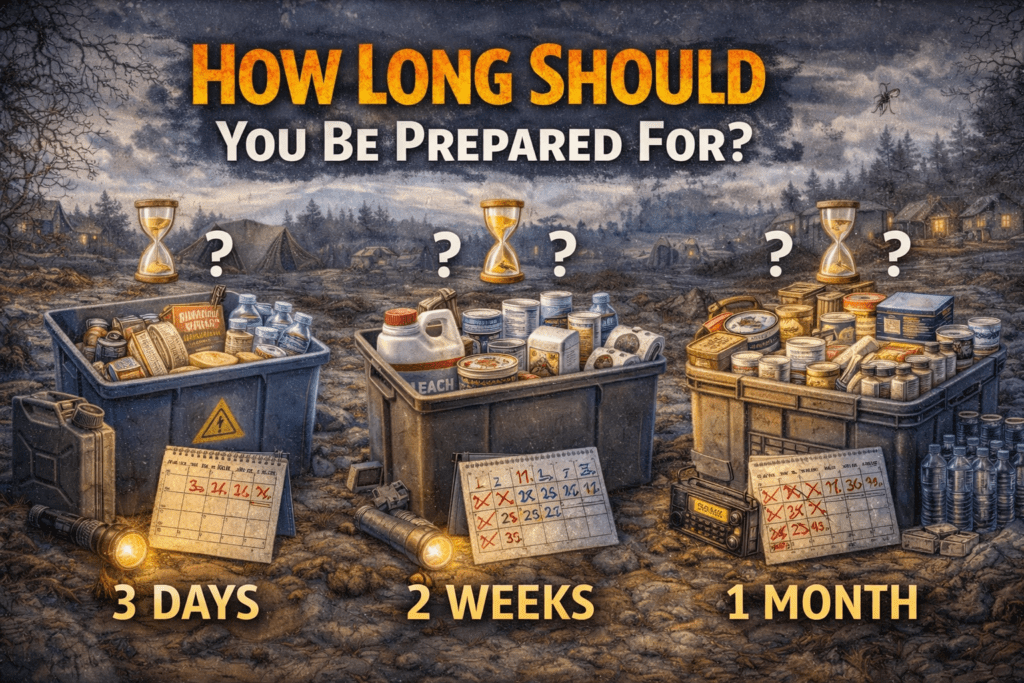
One of the most common questions people ask when starting to prepare is:
“How long do I actually need to be ready for?”
In the UK, this question is often misunderstood. Many people assume preparedness means weeks or months of supplies. In reality, most UK disruptions are measured in hours or days, not long-term collapse.
Shelter-in-place prepping works best when it is scaled to realistic risks, not worst-case scenarios.
The objective of this section is simple:
give you a clear, achievable preparedness timeframe that fits UK conditions.
What UK Disruptions Typically Look Like
Looking at real UK events provides useful context.
Common examples:
- Power cuts resolved within hours or a few days
- Severe weather disrupting transport for 1–3 days
- Flooding affecting local areas for several days
- Fuel or supply issues stabilising within a week
During these events:
- Emergency services remain operational
- Shops reopen gradually
- Infrastructure is repaired incrementally
This means short-term self-reliance bridges the gap, rather than replacing society.
The Three Preparedness Timeframes That Matter
Instead of aiming for an arbitrary number, it is more useful to think in tiers.
Tier 1 (72 Hours)
A 72-hour preparedness level is the most important starting point for UK households.
Why 72 hours matters:
- Covers most power cuts and weather disruptions
- Allows time for authorities to respond
- Reduces pressure on emergency services
At this level, you should be able to:
- Stay warm
- Eat simple meals
- Drink safe water
- Receive information
- Manage basic hygiene and medical needs
This is not extreme preparation—it is responsible readiness.
Tier 2 (5–7 Days)
Once the 72-hour baseline is met, extending to 5–7 days provides a significant improvement in comfort and resilience.
This level accounts for:
- Delayed repairs
- Repeated outages
- Limited shop access
- Fuel disruptions
At 5–7 days, you gain:
- Reduced anxiety
- More food flexibility
- Greater power management options
- Less pressure to “rush out” as soon as services partially resume
For many UK households, this is the ideal long-term goal.
Tier 3 (10–14 Days)
Preparedness beyond one week is optional, not essential, for most people.
This level may suit:
- Rural households
- People with medical vulnerabilities
- Those living in flood-prone areas
- Households far from shops or services
Beyond 10–14 days:
- Storage becomes more complex
- Costs increase
- Diminishing returns apply
Longer timeframes should only be pursued if they align with your location and lifestyle.
Why “As Long As Possible” Is the Wrong Goal
Trying to prepare for indefinite periods often leads to:
- Overbuying
- Wasted food
- Unsafe storage
- Anxiety rather than confidence
Preparedness should reduce stress, not create it.
In the UK, aiming for realistic timeframes produces better outcomes than chasing extreme scenarios.
Matching Timeframes to UK Living Situations
Flats and Apartments
- 72 hours is essential
- 5–7 days is achievable with planning
- Focus on water, power, and warmth
Houses and Rural Properties
- 5–7 days is often practical
- Consider weather and access routes
- Plan for delayed services
Families and Vulnerable Households
- Longer buffers reduce stress
- Medical continuity becomes more important
- Routine stability matters more than stock volume
Why Authorities Recommend 72 Hours
UK emergency guidance often references at least 72 hours of preparedness.
This is not arbitrary. It reflects:
- Typical emergency response timelines
- Repair and recovery patterns
- Realistic household capabilities
Meeting this standard means you are better prepared than the majority of households.
Preparedness Is a Range, Not a Deadline
You do not need to reach your ideal timeframe immediately.
A sensible progression looks like:
- Build 72 hours gradually
- Extend to 5–7 days over time
- Adjust based on experience
Preparedness evolves—it is not a one-off task.
The Psychological Benefit of Time-Based Planning
Knowing how long you can cope provides:
- Calm decision-making
- Reduced panic
- Better resource management
Uncertainty causes stress. Clear timeframes remove it.
Start With 72 Hours, Aim for One Week
For most UK households:
- 72 hours is essential
- 5–7 days is ideal
- Beyond that is optional
If you can shelter safely at home for a week, you are well-prepared for the vast majority of real UK emergencies.
Preparedness is not about preparing for everything.
It is about being ready for what actually happens.
Shelter-in-Place vs Bug-Out: The Balanced View
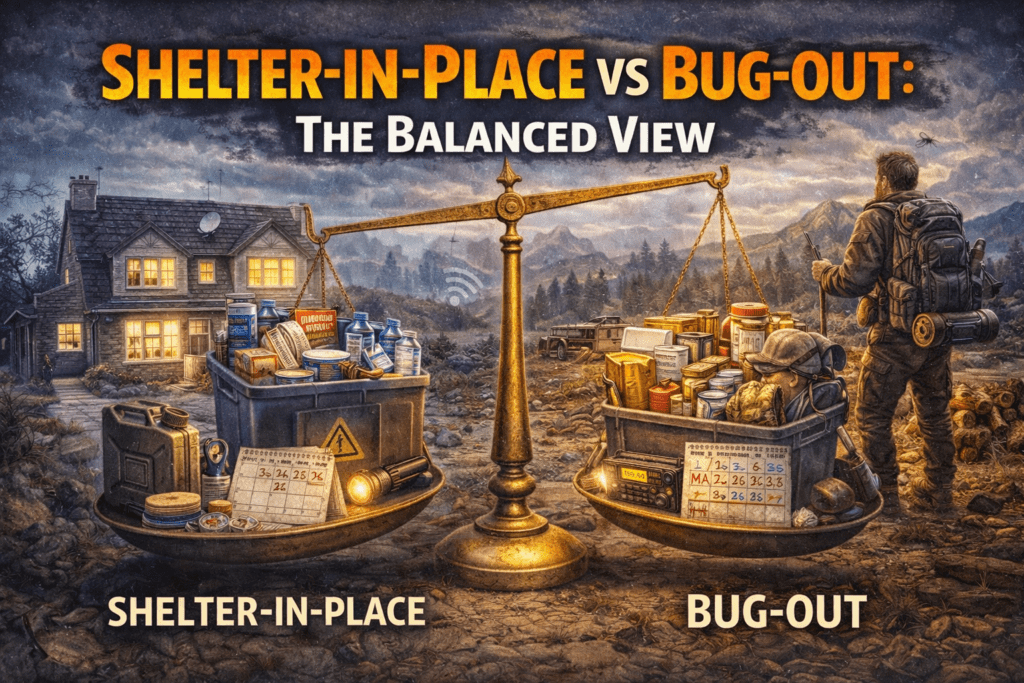
Few topics in preparedness create more confusion than the idea of bugging out. Online content often frames evacuation as the default response to any serious disruption. In the UK, this is rarely accurate—and in many cases, leaving home can increase risk rather than reduce it.
A balanced preparedness mindset recognises that both shelter-in-place and bug-out planning have roles, but they apply to very different situations. Understanding the difference is essential for calm, rational decision-making.
The objective of this section is simple:
help you know when staying put is safer, and when leaving is genuinely necessary.
What “Bug-Out” Actually Means in the UK
Bugging out is not simply “going somewhere else.” It involves:
- Leaving your home at short notice
- Travelling during disrupted conditions
- Carrying essential supplies
- Reaching a safer location
In the UK, this usually means:
- Staying with friends or family
- Moving to temporary accommodation
- Following official evacuation instructions
It does not usually mean:
- Living off the land
- Heading into wilderness areas
- Avoiding all contact with authorities
Understanding this distinction removes much of the confusion.
Why Shelter-in-Place Is Usually the Better Default
For the vast majority of UK disruptions, staying at home is safer, simpler, and more effective.
Reasons Shelter-in-Place Works Well in the UK
- Homes provide shelter from weather
- Emergency services remain active
- Infrastructure failures are usually local
- Travel conditions often worsen during emergencies
Leaving a secure, familiar environment introduces new risks at exactly the wrong time.
Common UK Scenarios Where Staying Put Is Best
Shelter-in-place is usually the correct choice during:
- Power cuts
- Severe storms
- Snow and ice events
- Fuel shortages
- Supply chain disruptions
- Transport strikes
In these situations, your home is still structurally safe, and services are expected to resume.
When Bug-Out Becomes the Right Choice
Bugging out is not wrong—it is simply less common.
Leaving home becomes the safer option when the building itself is no longer safe.
Examples include:
- Flooding inside the property
- Structural damage
- Fire or gas risks
- Official evacuation orders
- Environmental hazards
In these cases, shelter-in-place is no longer viable.
The Legal and Practical UK Context
In the UK, authorities generally:
- Encourage people to stay put when safe
- Issue clear evacuation guidance when necessary
- Provide support centres and shelters
Ignoring official advice can:
- Increase personal risk
- Complicate rescue efforts
- Create legal and insurance issues
Preparedness should work with, not against, local guidance.
The Risks of Unnecessary Bug-Outs
Leaving home unnecessarily introduces risks that are often underestimated.
Travel Risks
- Congested roads
- Accidents in poor weather
- Limited fuel availability
Supply Risks
- Carrying limited water and food
- Losing access to stored supplies
- Relying on uncertain destinations
Stress and Fatigue
- Decision-making under pressure
- Managing children or elderly family members
- Unfamiliar environments
In many cases, these risks outweigh the benefits of leaving.
Why Bug-Out Planning Still Has Value
A balanced approach does not ignore bug-out planning—it keeps it proportional.
Useful bug-out preparation includes:
- Knowing evacuation routes
- Having essential documents ready
- A small “grab bag” for overnight stays
- Agreed destinations with friends or family
This is contingency planning, not a primary strategy.
Shelter-in-Place as the Foundation
A key principle of sensible preparedness is:
If you cannot manage at home, you will struggle even more away from it.
Shelter-in-place readiness supports bug-out capability by:
- Keeping you calm and rested
- Preserving supplies
- Allowing time to make informed decisions
It is the foundation upon which all other plans sit.
A Simple UK Decision Framework
When deciding whether to stay or go, ask:
- Is my home structurally safe?
- Have authorities advised evacuation?
- Does staying put reduce exposure to risk?
- Do I have a safer, confirmed destination?
If the answers favour staying, shelter-in-place is the correct response.
Avoiding the “One-Plan Trap”
Some people focus exclusively on one strategy.
Problems arise when:
- Shelter-in-place is ignored entirely
- Bug-out plans are unrealistic or extreme
Balanced preparedness allows flexibility without panic.
Psychological Comfort of Staying Home
Remaining at home provides:
- Familiar surroundings
- Access to stored supplies
- Emotional reassurance
This stability is especially important for:
- Children
- Elderly family members
- Anyone with medical needs
Comfort supports better decision-making.
Stay Unless You Must Go
In the UK, shelter-in-place should be your default response to most emergencies.
Bug-out planning is:
- Important
- Sensible
- Secondary
Prepared households do not rush to leave—they leave only when staying becomes unsafe.
True preparedness is not about dramatic action.
It is about choosing the safest option, calmly and deliberately.
Practical First Steps
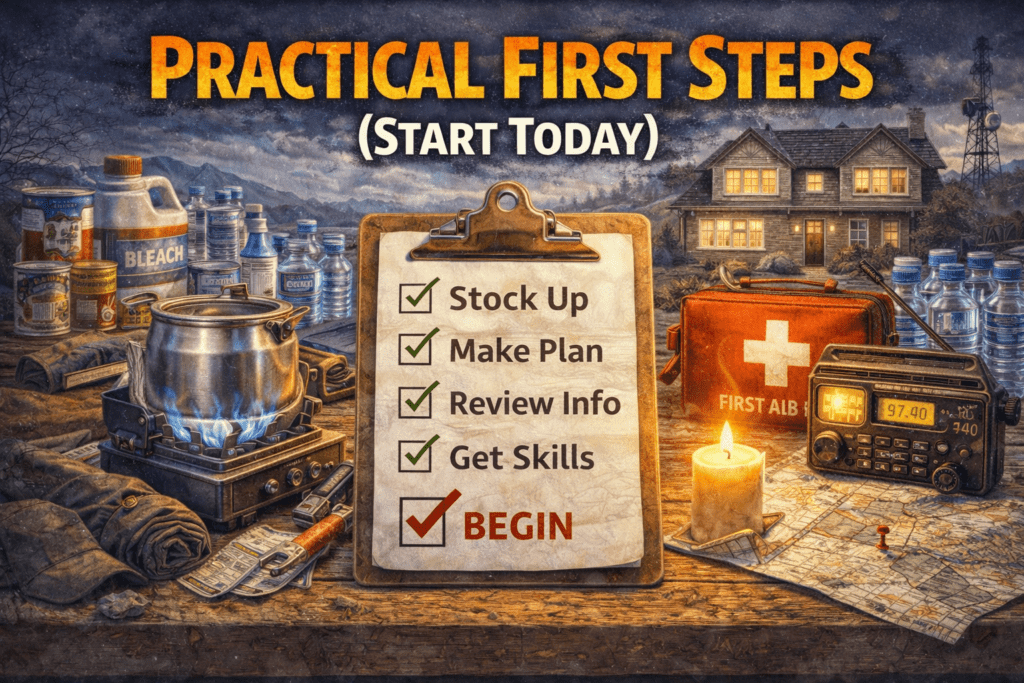
If you are new to prepping, begin with these actions:
- Store 3 days of water
- Build a simple power kit
- Create a no-cook food buffer
- Assemble basic lighting
- Download a checklist and track progress
Download Your Free 72-Hour Checklist
To make this simple, we have created a UK-specific 72-Hour Emergency Checklist designed for real households, not extreme scenarios.
It covers:
- Water
- Food
- Power
- Warmth
- Communications
You can download it free and work through it at your own pace.
Frequently Asked Questions (UK Focused)
Is shelter-in-place prepping legal in the UK?
Yes. Preparing food, water, and emergency supplies for your household is entirely legal.
How much water should I store in a flat?
As much as space allows, with filtration as a backup.
Do I need a generator?
For most UK homes, no. Power banks and batteries are sufficient.
Is this expensive?
No. Shelter-in-place prepping can be built gradually using everyday items.
Final Thoughts Calm, Practical Preparedness
Shelter-in-place prepping is not about fear or extremes. It is about quiet confidence, knowing that if something unexpected happens, your household can cope calmly and safely.
Preparedness in the UK should be:
- Legal
- Practical
- Community-aware
- Sustainable
If you can shelter safely at home, you are already ahead of most people.
This shelter in place prepping UK guide will walk you through exactly how to prepare your home, step by step, using sensible systems rather than extreme measures. For official guidance, consult the UK government’s Prepare for Emergencies
Practicing shelter in place prepping UK regularly will ensure you and your family can comfortably shelter at home during emergencies.