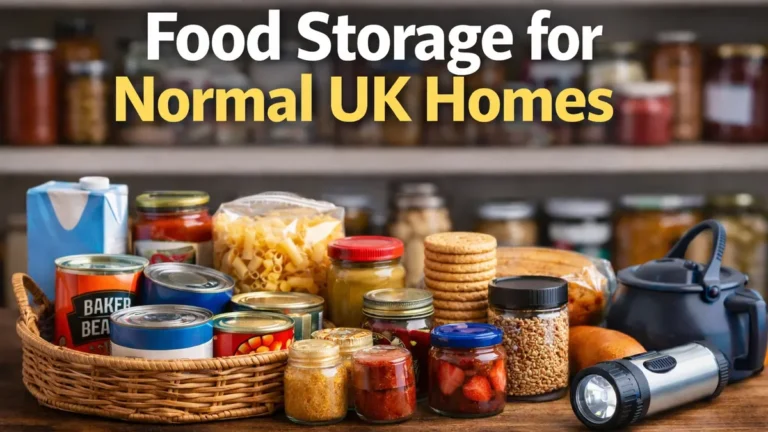
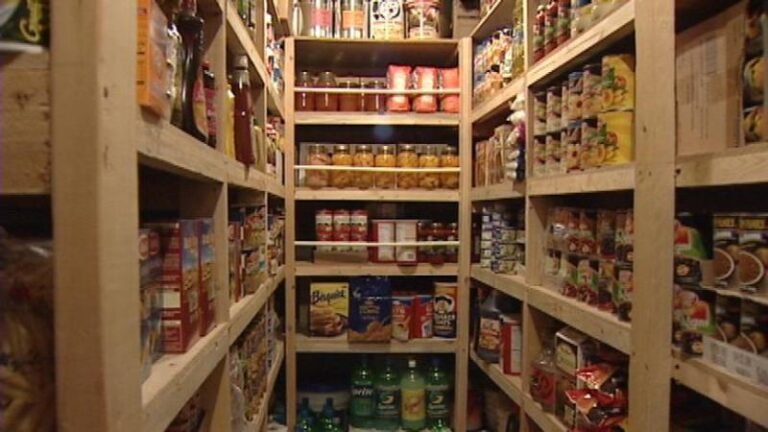
If you’ve ever Googled 72 hour emergency food uk, you’ve probably seen two extremes: expensive “survival buckets” on one side, and vague advice like “buy tins” on the other.
Here’s the calm middle ground: a 3-day emergency meal setup you can build from any UK supermarket (Tesco, Asda, Sainsbury’s, Aldi, Lidl, Morrisons, Co-op, Waitrose) that:
- works even if you can’t cook properly
- fits in a normal cupboard
- doesn’t require “prepper” gear
- rotates naturally into your regular meals
This guide gives you a realistic 3 day emergency food supply UK you’ll actually use, not something you feel guilty about every time you open the kitchen cupboard.
Key takeaways
- Your best 72 hour emergency food uk plan is mostly normal food, plus a small “no-cook / kettle” backup.
- Aim for simple, familiar meals you’d eat on a tired weeknight.
- Build around “plug-and-play” components: carbs + protein + veg + flavour.
- Choose options that still work during a power cut (no-cook and kettle meals).
- Store it as a small buffer box/shelf and rotate it into normal life.
- Link your food plan to your wider 72-hour home setup (water, warmth, power, hygiene).
Start with the bigger picture
Food is only one part of staying calm for three days. If you haven’t already, read The UK 72-Hour Home Plan Calm 7-step System first. It gives the full “boring but effective” system that makes this kind of food plan easier to maintain.
You can also start with Prepping for Beginners UK Calm 72-Hour Starter System or if you want the simplest on-ramp Prepping UK The Complete System
What 72 hour emergency food uk really means in real life

For most UK households, “72 hours” usually looks like inconvenience, not apocalypse:
- a localised power cut
- a burst pipe or water disruption
- snow/ice that stops deliveries
- illness in the house where you can’t get to the shops
- transport issues or short-term shortages
So your goal is not “survival calories”. Your goal is normal-ish meals, steady energy, and fewer decisions.
Think of your 3 day emergency food supply UK as a comfort buffer: enough to keep routines working when the day goes sideways.
The supermarket rule that makes this easy
Here’s the rule that keeps this calm and cheap:

Build 9 simple meals, not a mountain of random tins
For three days, you’re roughly covering:
- 3 breakfasts
- 3 lunches
- 3 dinners
- snacks + hot drinks (because morale matters)
You’re not trying to eat like it’s a fitness plan. You’re trying to avoid the “nothing in” panic when life gets disrupted.
Use the “base + add-on” method
Pick a base, then add one protein, one veg, and one flavour. That’s it.
Bases:
- microwave rice
- pasta
- instant noodles
- wraps
- couscous (kettle-friendly)
- oatcakes/crackers
Proteins:
- tinned tuna/salmon/mackerel
- tinned beans/lentils/chickpeas
- tinned chilli/curry/stew
- peanut butter
- UHT milk / protein drinks (if you like them)
Veg and “make it feel like food”:
- tinned sweetcorn, peas, mixed veg
- jar sauces (pasta sauce, curry sauce)
- tinned soup
- olives/pickles (optional, but brilliant for flavour)
The no-fuss 72-hour supermarket shopping list
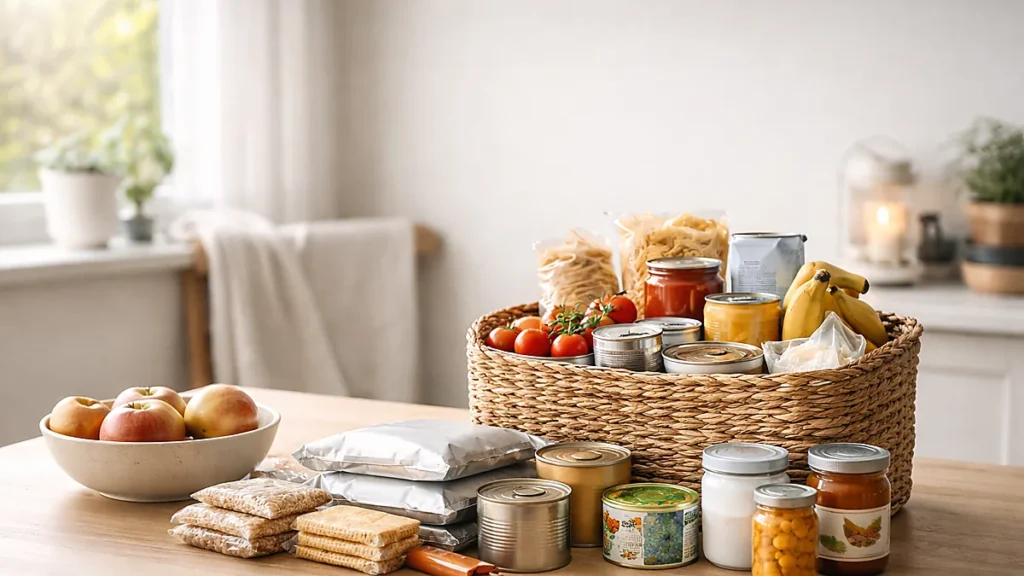
This list is designed so it works in three situations:
- normal power (hob/microwave)
- partial power (kettle only)
- no cooking at all
The core list
- Breakfast
- porridge oats or instant porridge pots
- UHT milk (or powdered milk if you prefer)
- tinned fruit / dried fruit
- tea/coffee/hot chocolate
- Lunches
- wraps or pittas (or crackers/oatcakes if you want longer-lasting)
- tuna / beans / hummus pots (eat today) / peanut butter
- crisps, nuts, or cereal bars
- Dinners
- 2–3 microwave rice pouches or instant noodles
- 2–3 “tins that are already a meal” (chilli, curry, stew, ravioli, meatballs, lentils)
- 1–2 jar sauces (pasta or curry)
- tinned veg or soup as a side
- Snacks and calm extras
- biscuits
- chocolate
- squash (massively underrated for “everything feels normal”)
Simple comparison table what works when you can’t cook
| Food type | No-cook | Kettle-only | Microwave/normal |
|---|---|---|---|
| Tuna + crackers | ✅ | ✅ | ✅ |
| Tinned chilli/curry | ✅ (cold if needed) | ⚠️ (warm with kettle methods only if safe) | ✅ |
| Couscous | ❌ | ✅ | ✅ |
| Instant noodles | ❌ | ✅ | ✅ |
| Microwave rice | ❌ | ❌ | ✅ |
| Tinned soup | ✅ (drinkable cold if needed) | ⚠️ | ✅ |
If you want more “storage that fits real kitchens”, read Emergency Food Storage UK Food Storage for Normal UK Homes
A realistic 3-day meal plan you can copy

This is a calm example that uses normal supermarket food, with easy swaps.
Day 1
- Breakfast: porridge (UHT milk or water) + banana or tinned fruit
- Lunch: tuna or bean salad wraps + crisps + squash
- Dinner: microwave rice + tinned chilli + tinned veg or soup on the side
Day 2
- Lunch: crackers/oatcakes + peanut butter + fruit + chocolate
- Breakfast: cereal + UHT milk + tea/coffee
- Dinner: pasta + jar sauce + tinned meatballs or tinned lentils
Day 3
- Breakfast: instant porridge pot + fruit
- Lunch: cup soup or instant noodles + oatcakes + nuts
- Dinner: tinned curry + microwave rice + dessert pot or biscuits
If power cuts are part of your reality (winter, rural areas, older housing), pair this with UK Power Cuts: Managing Life Without Electricity Safely and Power Cuts and Home Warmth UK: Stay Warm Safely
How to make this work during a power cut
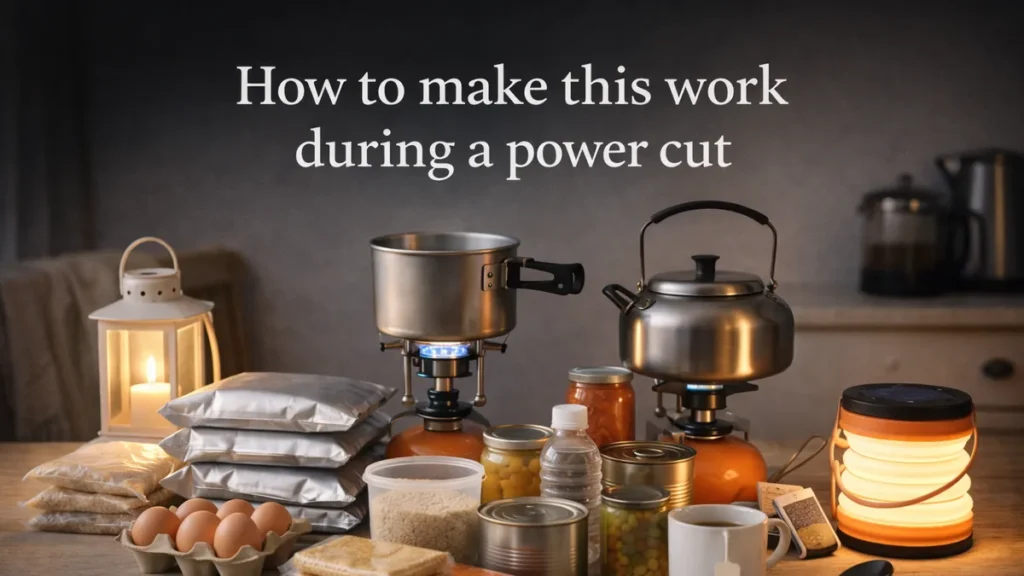
Most people overthink cooking. The calm move is to plan for:
No-cook day
Have at least one full day where meals require zero heating:
- crackers + tuna
- wraps + peanut butter
- tinned fruit
- cereal bars + nuts
- ready-to-eat soup (not tasty, but functional)
Kettle-only day
If you’ve got a kettle (or can boil water another safe way), you can do:
- couscous + tinned chickpeas + spices
- instant noodles + tinned sweetcorn
- cup soups + oatcakes
- instant mash + tinned beans
Normal day
When power is on, use your “regular lazy meals”:
- pasta + sauce + tinned protein
- microwave rice + curry/chilli
- soup + bread + snacks
This is exactly why a 3 day emergency food supply UK built around familiar items wins: it flexes with the situation.
Water

the thing people forget when they plan meals
Even the best 72 hour emergency food uk plan falls apart if you’ve planned lots of salty, dry food… and no water buffer.
Two calm rules:
- include drinks you’ll actually consume (tea, coffee, squash)
- avoid building a plan that requires loads of cooking water if you’re not sure you’ll have it
For the water side, read Common UK Water Prepping Mistakes It’ll save you from the classic beginner errors.
Storage and rotation that doesn’t create clutter
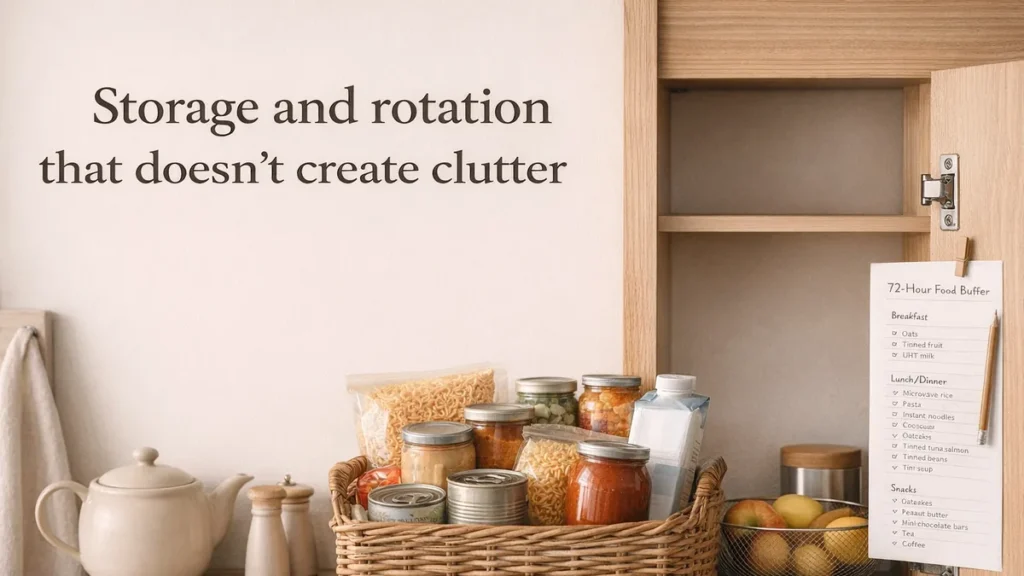
The easiest way to keep this maintained is not “a prep cupboard”.
It’s a buffer box.
The buffer box method
- Use one crate, box, or a single shelf.
- Keep the list taped inside a cupboard door (or saved as a phone note).
- When you use something, replace it on your next shop.
Rotation rules that work in real life:
- put the newest items at the back
- pull the oldest forward into normal meals once a week
- don’t keep “special emergency food” you never fancy
For a clean step-by-step routine, use UK Prepping Checklists: 30 Minutes, 2 Hours, 1 Weekend (Internal link).
What should this cost in the UK
This is where people get surprised: you don’t need a massive spend.
A basic 72-hour food buffer often lands around:
- budget: roughly £15–£30 per adult (very basic, lots of own-brand)
- comfortable: roughly £30–£60 per adult (more variety, better snacks, extra drinks)
It varies by:
- dietary needs
- how much “ready meal” convenience you want
- whether you’re stocking from scratch or topping up
The cheapest approach is simply: buy one extra of what you already eat until the buffer exists.
Common mistakes that make people give up
Buying food nobody in the house eats
If it’s only “for emergencies”, it won’t rotate. It’ll become clutter and guilt.
Planning meals that depend on cooking
If the plan collapses when the power goes off, it’s not a 72-hour plan.
Forgetting the “boring extras”
- spoons/bowls you can use easily
- washing-up basics
- hot drinks
- snacks for kids (and adults)
Pair food with the hygiene basics in Health and Hygiene Preparedness UK What Every Household Should Know It’s the difference between “fine” and “grim by day two”.
Overbuying all at once
Do it in layers. A calm plan that you maintain beats a dramatic shop you never repeat.
FAQs
What is the easiest 72 hour emergency food uk setup?
The easiest setup is “normal meals plus no-cook backups”: cereal/porridge, wraps/crackers with tuna or peanut butter, and two or three tinned “meal tins” with microwave rice or pasta.
Do I need a camping stove for a 3 day emergency food supply UK?
Not usually. Most UK disruptions are short. A no-cook + kettle plan covers the majority of realistic scenarios. If you do consider cooking options, keep it simple and safety-first.
Can I use frozen food as part of my 72-hour plan?
Yes, but treat it as a bonus layer, not the foundation. Freezers are brilliant when power is stable, but your 72-hour plan should still work if the freezer becomes unreliable.
What about picky eaters or kids?
Build around what they already eat: cereal, pasta, noodles, fruit snacks, biscuits. The goal is calm and familiar, not “perfect nutrition”.
How do I store this in a small flat?
Use under-bed storage, the bottom of wardrobes, or one dedicated kitchen shelf. Build a compact buffer (oatcakes, tins, pouches) and rotate weekly. Emergency Food Storage UK covers realistic storage ideas.
How often should I rotate items?
Light rotation weekly (use one or two items in normal meals), and a quick monthly check for dates. If you use the buffer box method, rotation becomes automatic.
Is “best before” the same as “use by”?
No. “Use by” is safety-related. “Best before” is usually quality. Always follow official guidance and the label on the product.
Next step: build this in one shop
Do this on your next supermarket run:
- Pick 3 breakfasts, 3 lunches, 3 dinners from the lists above.
- Add one no-cook day and one kettle-friendly meal.
- Put it in a single box or shelf.
- Read The UK 72-Hour Home Plan and connect food to the rest of your setup (Internal link).
That’s it. A calm 72 hour emergency food uk plan that feels like normal life — even when normal life isn’t behaving.