Prepping UK doesn’t need panic, cosplay gear, or a garage full of kit. It’s just a calm system that makes everyday UK disruption easier to handle: power cuts, boiler failures, water issues, delivery delays, short-notice school closures, and rough winter weather.
This hub is the complete prepping UK system you can follow in order. If you do the steps one at a time, you’ll end up with a home that rides out inconvenience smoothly—without overspending.
Want the system in one printable page?
What “Prepping” In The UK Actually Means
In the UK, most “emergencies” are short and local. The goal of prepping UK is not to “survive the apocalypse”. The goal is to keep life normal when normal gets wobbly.
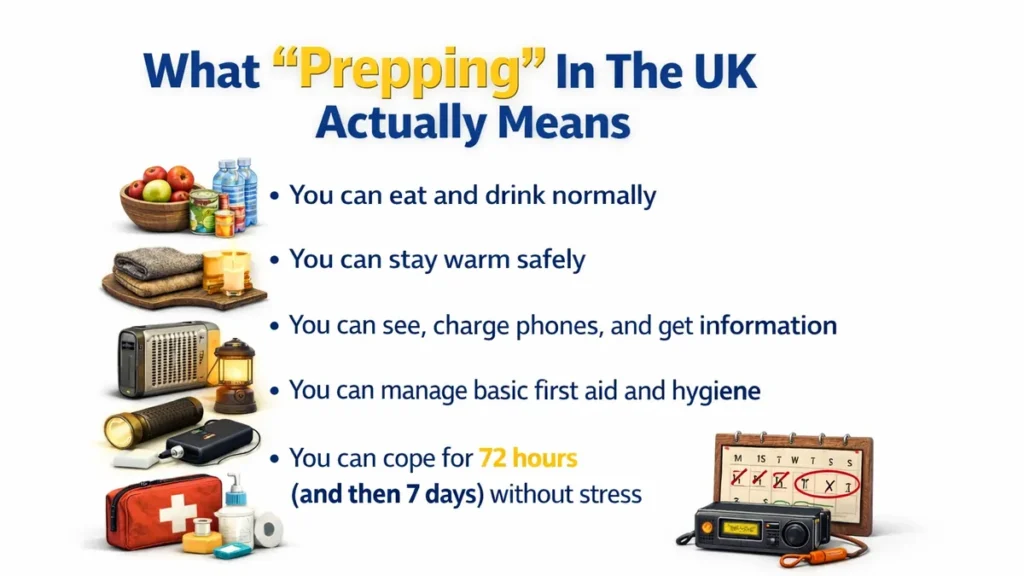
- You can eat and drink normally
- You can stay warm safely
- You can see, charge phones, and get information
- You can manage basic first aid and hygiene
- You can cope for 72 hours (and then 7 days) without stress
UK Prepping The Complete System
Step 1) Start with a simple household plan
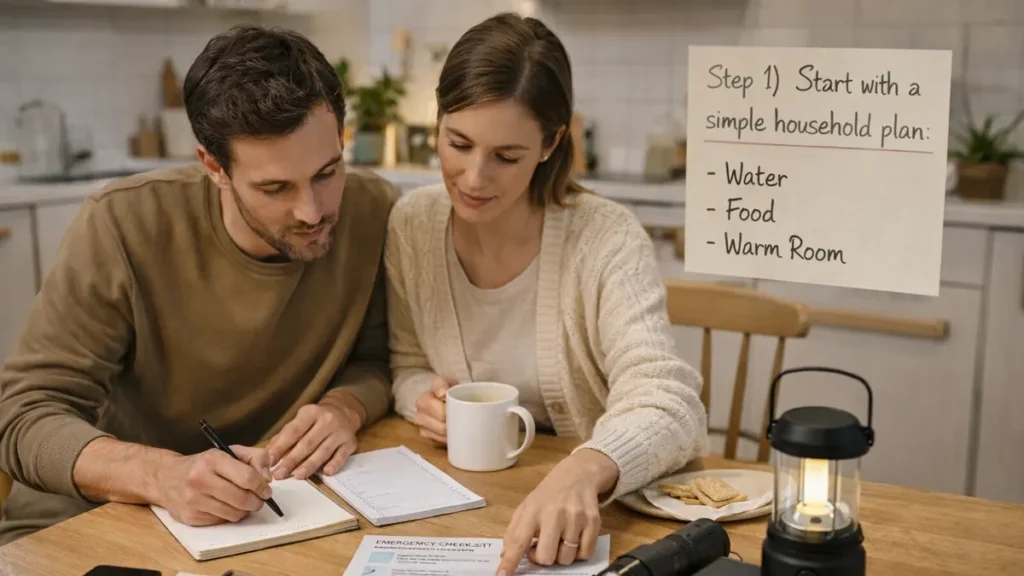
You don’t need a bunker. You need a plan your household can follow when you’re tired, stressed, and your phone signal is being weird.
Do this today (10 minutes)
1) Pick a meeting point (if comms fail)
Choose one nearby spot everyone knows—outside the home and easy to reach. Think: the corner shop, a neighbour’s gate, or the end of the street. Keep it simple.
2) Write a “what we do first” list for three common situations
One short checklist for each—so nobody has to think on the spot:
- Power cut: torches, warmth, food, phone charging
- Water issue: drinking water, cooking plan, hygiene back-up
- Severe weather: stay in vs go out, heating, supplies, travel changes
3) Save key numbers now (so you’re not searching later)
Create a contact list called “Emergency – Household” and include:
- GP and out-of-hours number
- Local pharmacy
- School/nursery
- Landlord/letting agent
- Council services (and emergency line if available)
This is the boring foundation—and it’s what makes everything else feel calm instead of chaotic.
[Emergency Planning for Renters in the UK]
Step 2) Water first
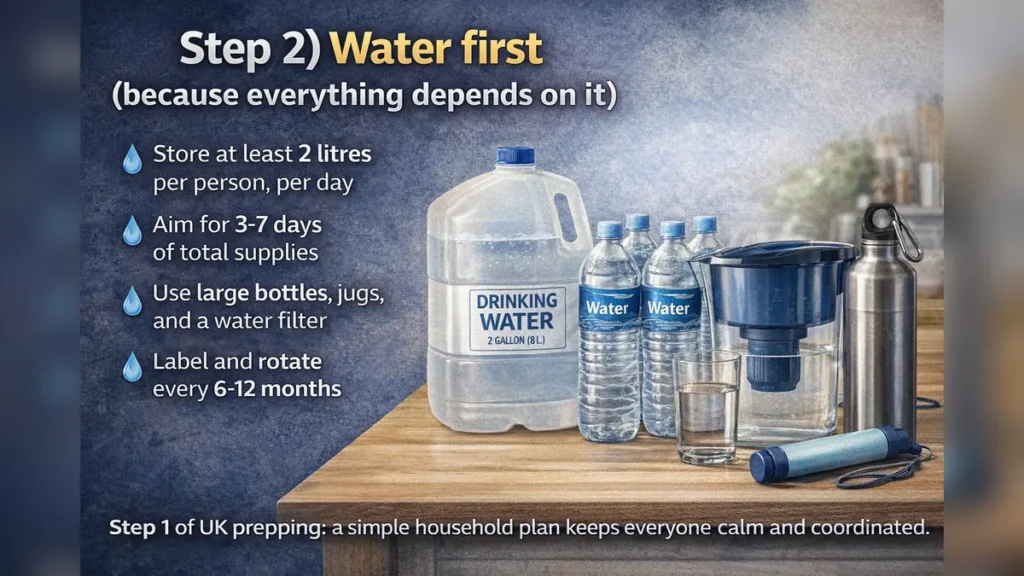
If you only do one thing, do water.
Water is the fastest, most practical prep you can make in a UK home. It keeps your day feeling normal when everything else gets noisy—because without water, everything becomes harder.
The calm baseline (what you’re actually aiming for)
Your priority is simple:
- Drinking water
- Basic cooking water
That’s it. Hygiene and comfort can come later. Nail the essentials first.
The goal: a realistic buffer you can maintain
Forget perfection. Forget complicated targets. You want a buffer that’s:
- Easy to start
- Easy to store
- Easy to rotate
- Easy to live with
No spreadsheets. No big shopping trip. Just steady progress.
Quick wins you can do today
1) Start with supermarket bottles
- Pick up a few bottles on your normal shop
- Keep them topped up
- Rotate them as you use them (use the oldest first)
2) Store water where you actually have space
Real UK homes don’t have spare cupboards, so use the hidden spots:
- Under the bed
- Bottom of wardrobes
- Behind the sofa
- Low shelves in a hall cupboard
Out of the way. Still easy to grab.
The simple “don’t forget” rule
Front gets used, back stays stored.
If your water setup is easy to access and easy to rotate, it won’t turn into clutter—it becomes part of how your home works.
Water first. Calm follows.
Want a more specific guide check these:
- [Water Storage & Filtration in The UK]
- [Common UK Water Prepping Mistakes]
- [How Long Does Bottled Water Last in the UK?]
Step 3) Food that you already eat
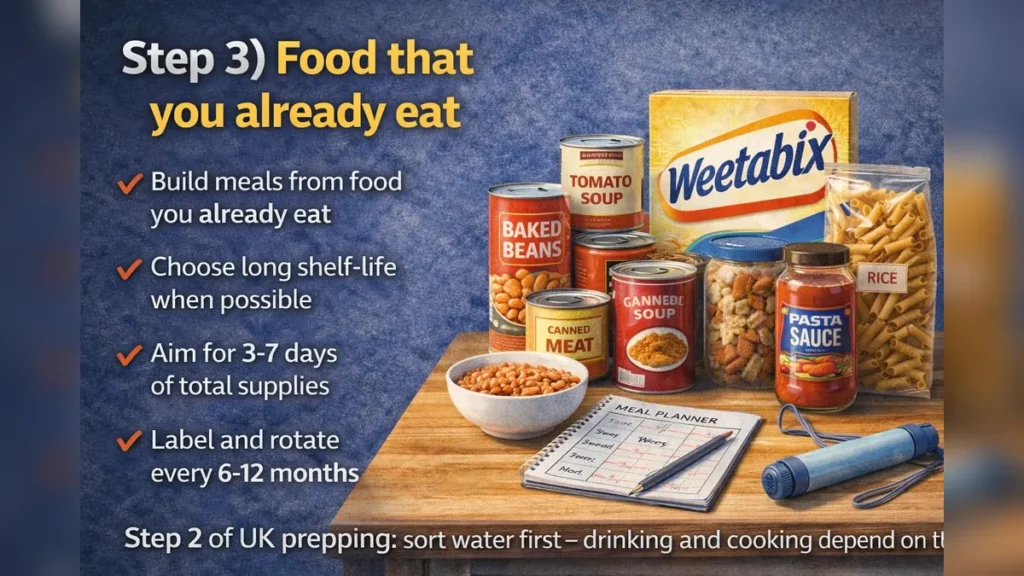
UK prepping works best when your emergency food is… your normal food.
The fastest way to build a solid emergency food setup in the UK isn’t “survival food.” It’s making your everyday cupboard do a little extra work.
Your goal: a calm buffer (no big shop required)
You’re not trying to create a second kitchen. You’re aiming for a quiet, reliable cushion—so if deliveries stop, the weather turns, or you’re stuck at home for a few days, you’re covered without panic-buying.
A simple system that actually sticks
1) Build a 72-hour layer (easy wins)
Start with meals you already eat that need minimal effort:
- cupboard staples (pasta, rice, tins, sauces)
- quick protein (beans, tuna, lentils, soup)
- “no-cook” backups (crackers, peanut butter, cereal, UHT milk)
Think: three days of normal-ish meals, not gourmet, not grim.
2) Then build a 7-day layer (repeat what worked)
Once 72 hours feels easy, extend it by doing more of the same.
You’re basically copying your best, most realistic meals and stretching the buffer to a week.
No new system. No dramatic shopping list. Just a bit more of what already works in your home.
3) Rotate without thinking (front-to-back rule)
Make rotation automatic:
- eat from the front of the shelf/cupboard
- refill at the back on your next shop
That’s it. No waste, no “emergency-only” food that sits there for two years, and no stress when you actually need it.
The whole point is boring reliability: normal food, calm system, always ready.
Read More:
- [Food Storage for Normal UK Homes: Calm, Affordable Emergency Food]
- [72-Hour Emergency Meals from Any UK Supermarket]
- [Kettle-Only Emergency Meals UK]
- [Why Survival Food Is Unnecessary in the UK]
Step 4) Warmth and safety

A lot of UK prepping advice online jumps straight to extreme solutions. Real life is usually simpler than that. When the heating goes off, the win is one safe, comfortable warm room—not trying to heat the whole house.
The warm-room setup (calm, realistic, effective)
1) Pick one room you can actually live in
Choose the room where you can sit, eat, and sleep if you need to. Ideally it’s:
- the smallest practical room (easier to keep warm)
- away from external doors
- close to a toilet and somewhere you can make drinks/food
The goal isn’t “perfect.” It’s one space that stays noticeably warmer than the rest.
2) Build warmth in layers (don’t rely on one big solution)
Layering beats expensive gear every time:
- bedding you can pile up (duvets, spare blankets, throws)
- warm clothing you already own (hoodies, thermals, socks, hats)
- a “warm kit” you can grab fast (one bag/box in that room)
Think trap heat, not “generate heat.”
3) Safety matters more than comfort
This is the one rule you don’t bend: never use indoor BBQs or anything not designed for indoor use.
Carbon monoxide is the real danger because you often don’t notice it until it’s too late. If you’re using any heater, stick to proper indoor-rated options and keep ventilation sensible.
4) Stop heat leaking out (drafts are sneaky)
Warm-room comfort is usually won by sealing the gaps:
- roll towels at door gaps
- close curtains at dusk
- shut unused doors
- add an extra layer at windows if you can (even a blanket helps)
The payoff is immediate: the room feels calmer, warmer, and more controllable—exactly what you want when everything else is unpredictable.
More specific:
- [How to Stay Warm Safely During a Winter Power Cut]
- [Power Cuts & Home Warmth (UK)]
- [Common UK Warmth Mistakes]
Step 5) Lighting and phone power
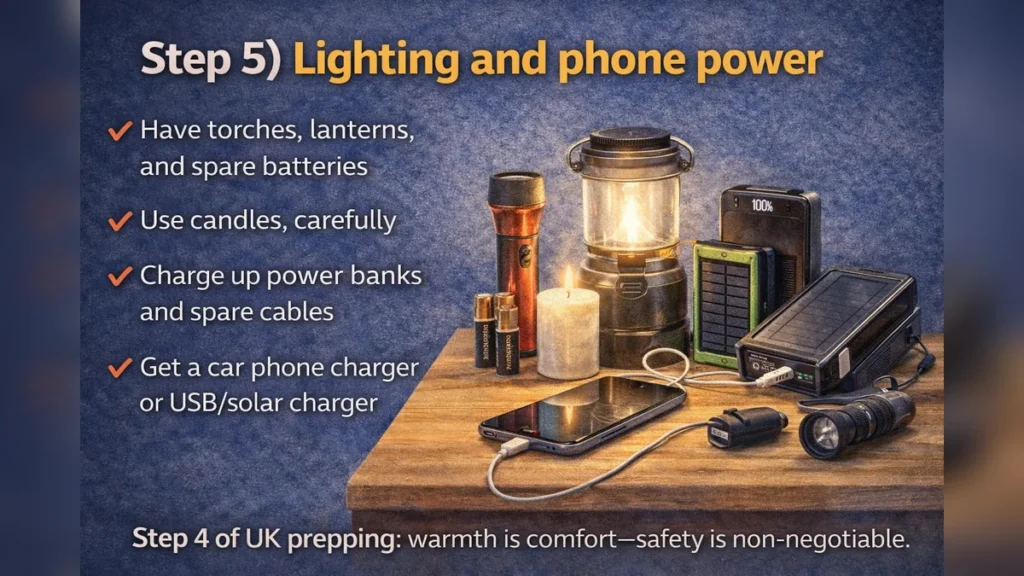
If you can see and keep your phone alive, everything feels about 80% more manageable. Light and power aren’t just practical—they’re morale. They turn a power cut from “chaos” into “annoying but fine.”
The practical stack (simple, calm, reliable)
1) A torch per person (plus backups)
One each means nobody is stealing the only light source. Keep them where you’ll reach instinctively—bedside, hallway drawer, kitchen “junk” drawer.
If your torch uses batteries, stash a small pack of spares with it. If it’s rechargeable, make charging part of your routine.
2) One lantern for the main room
A lantern changes the vibe. It lights the whole warm room so you can eat, talk, tidy, and find things without everyone squinting or pointing torches at the ceiling.
Think of it as your “normal life” light during an outage.
3) Power banks you actually keep charged
A power bank that’s flat is just dead weight. The trick is making charging automatic:
- keep one plugged in at home like a spare battery on standby
- top it up after you use it
- aim for one you can grab with your keys when you leave the house
This whole setup is deliberately boring—and that’s why it works. When the lights go out, you’re not improvising. You’re just switching systems.
Read More:
- [Best Torches for Power Cuts (UK Reality)]
- [Solar Chargers in the UK: A Reality Check]
Step 6) Information and alerts
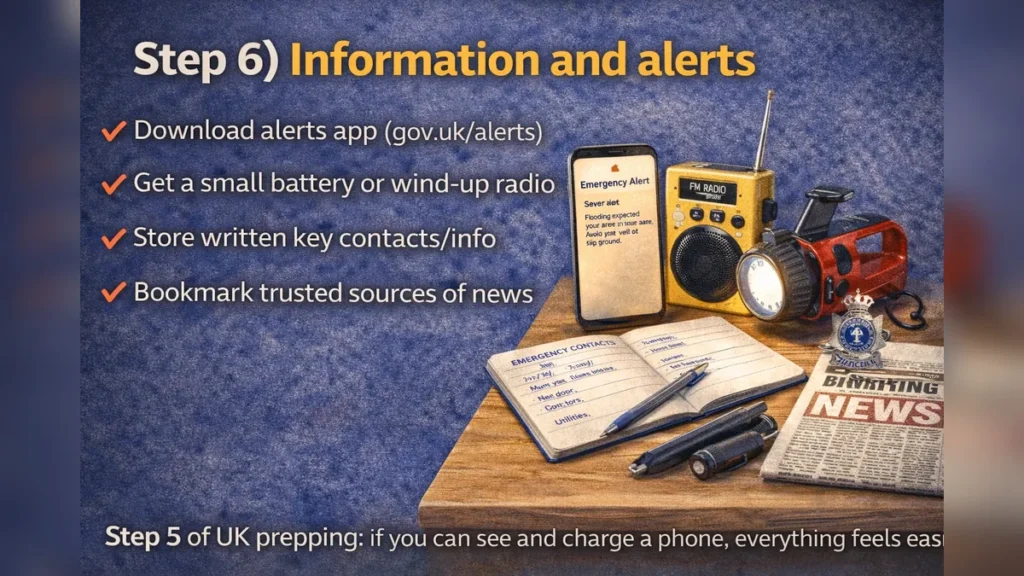
Prepping UK isn’t just “stuff” — it’s staying informed.
When things get messy, the calm advantage isn’t having more gear. It’s having good information early, from sources that still work when Wi-Fi doesn’t.
Do this (set it once, forget it)
1) Keep a small battery radio (your “no internet” backup)
A basic battery radio gives you updates even if mobile data is patchy. Keep it with a fresh set of spare batteries so it’s actually usable when you grab it.
Phone radio apps can help — but don’t assume they’ll work without signal. Test yours now, once, so you’re not guessing later.
2) Turn on the local alerts that actually matter
If flooding is a risk where you live, sign up for flood warnings. Add weather warnings too so severe wind/snow doesn’t catch you off guard. (Prepare)
3) Know how UK Emergency Alerts work on mobiles (and keep them enabled)
Emergency Alerts can come through as a loud, siren-like sound even on silent, plus vibration and a full-screen message. The alert is based on your current location, and you don’t need location services turned on to receive it. (GOV.UK)
Quick checks worth doing now:
- Update your phone software (compatibility depends on version). (GOV.UK)
- Make sure Emergency Alerts are switched on in settings (you can opt out, but most people are better off leaving them on). (GOV.UK)
Bottom line: being informed is a prep you feel immediately — because uncertainty is what spikes stress, not the outage itself.
Step 7) Health, first aid, and medication continuity
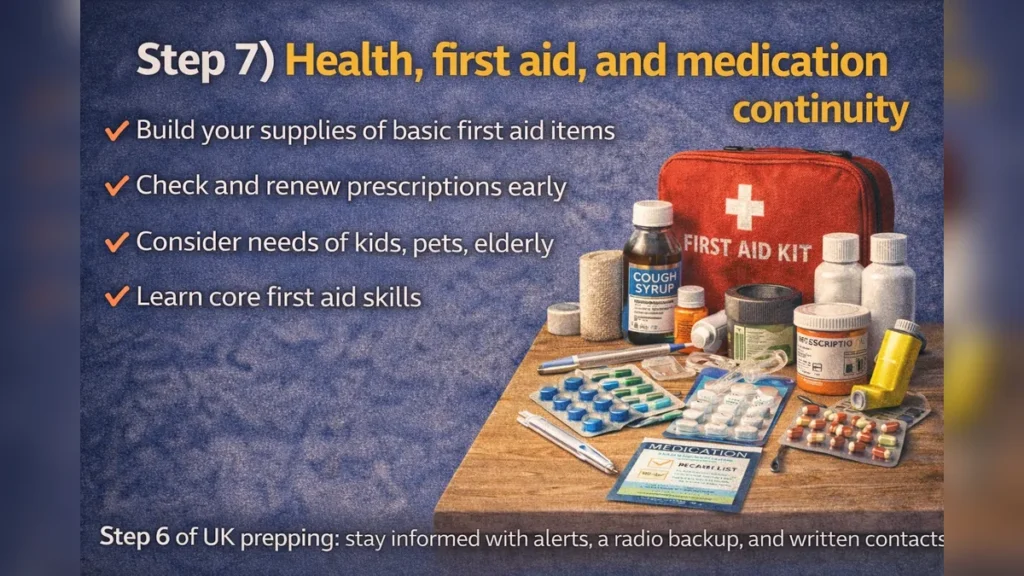
This is where UK prepping gets genuinely life-easing
A decent first aid setup doesn’t need to be fancy. You’re aiming for a baseline kit that handles the boring-but-common stuff—cuts, grazes, minor burns, headaches, fevers—without rummaging through drawers while someone’s bleeding on the kitchen floor.
Baseline first aid kit (the “cover 80%” list)
Wounds + bleeding
- Plasters (a mix of sizes)
- Sterile dressings / wound pads
- Bandages (to hold dressings in place or support a sprain)
- Antiseptic wipes (for cleaning around minor cuts) (SJA)
Basic checks
- Thermometer (because guessing a fever is useless) (NHS England)
Pain + fever relief
- Pain relief you can safely take (and that you actually tolerate)
If you’re unsure what’s appropriate for you/your household, your pharmacist is the best quick check. (NHS England)
Personal essentials (non-negotiables)
- Any prescribed essentials you rely on (e.g., inhalers, allergy meds, epi-pen if prescribed)
- A small “repeat meds” reminder note (what, where it is, when it runs out)
Small add-ons that make the kit actually usable
- Disposable gloves (hygiene + infection control)
- Scissors (cut tape/bandages/clothing if needed)
- Eye pad (useful if something gets into an eye)
- Triangular bandage (handy for support and securing) (HSE)
Make it work in real life (not just in theory)
- Keep it easy to grab (kitchen cupboard top shelf or hallway cupboard)
- Add a sticky note on the lid: “Restock after use”
- Do a 2-minute check every few months (plasters, wipes, meds you rely on)
St John Ambulance has a straightforward “what to put in a first aid kit” checklist that’s ideal for building your baseline.
Next Read:
- [Basic First Aid Every UK Home Should Have]
- [Mental Health & Stress During UK Emergencies]
Step 8) Hygiene and sanitation
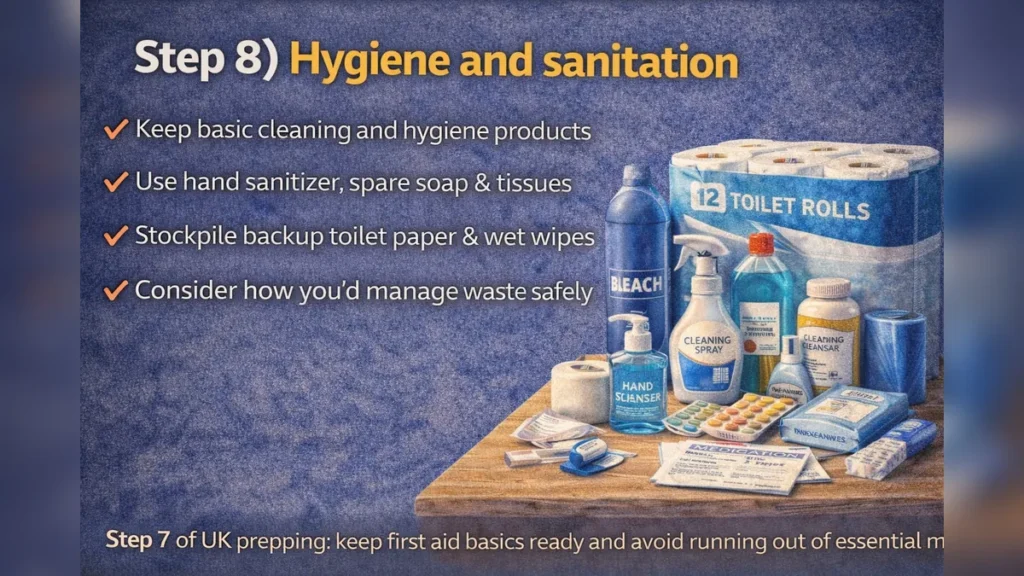
When water is limited or the power is off, hygiene slips fast — and then everyone feels grim.
This isn’t about being spotless. It’s about staying comfortable, low-stress, and socially normal when the usual routines break.
The simple hygiene buffer (covers 80% of the problem)
Hands + quick clean-ups
- Hand sanitiser (pump bottle + a couple of pocket minis)
- Baby wipes / cleansing wipes (multi-use: hands, faces, quick wipe-downs)
Waste control (the real mood-saver)
- Bin bags (a mix of sizes)
- Bag ties / cable ties (stops smells and mess)
- Optional but brilliant: nappy sacks for small, smelly waste
Basic cleaning
- All-purpose cleaning spray
- A few microfibre cloths (washable, low water)
- Optional: disinfectant wipes for high-touch spots (handles, taps)
Household essentials (don’t get caught short)
- Period products (enough for at least one full cycle per person who needs them)
- Baby needs if relevant (nappies, wipes, nappy cream, spare bags)
Quick rules that keep things feeling normal
1) Prioritise hands first
If you only do one hygiene habit, do this:
- before eating
- after the toilet
- after handling rubbish
2) Create a “wipe-down routine” (30 seconds, twice a day)
Hit the high-touch bits:
- door handles
- kitchen surfaces
- bathroom touch points
It keeps the house feeling under control with minimal effort.
3) Lock down smells and rubbish early
Don’t let waste build up:
- tie bags before they’re overfull
- double-bag anything wet/smelly
- store tied bags in one place (away from the warm room if you can)
Make it easy to grab (so you actually use it)
Keep a small “hygiene box” together in one spot:
- bathroom cupboard or under the sink
- or with your “power cut box” if you have one
The win here is comfort: when hygiene stays decent, everyone’s calmer, sleep is better, and the whole situation feels manageable instead of miserable.
Read More:
- [Health & Hygiene Preparedness UK – What Every Household Should Know]
- [Hygiene Preparedness UK During Power Cuts]
- [Hygiene During Water or Power Disruption]
- [Hygiene Preparedness UK for Renters and Small Flats]
Step 9) Rotation and “maintenance”
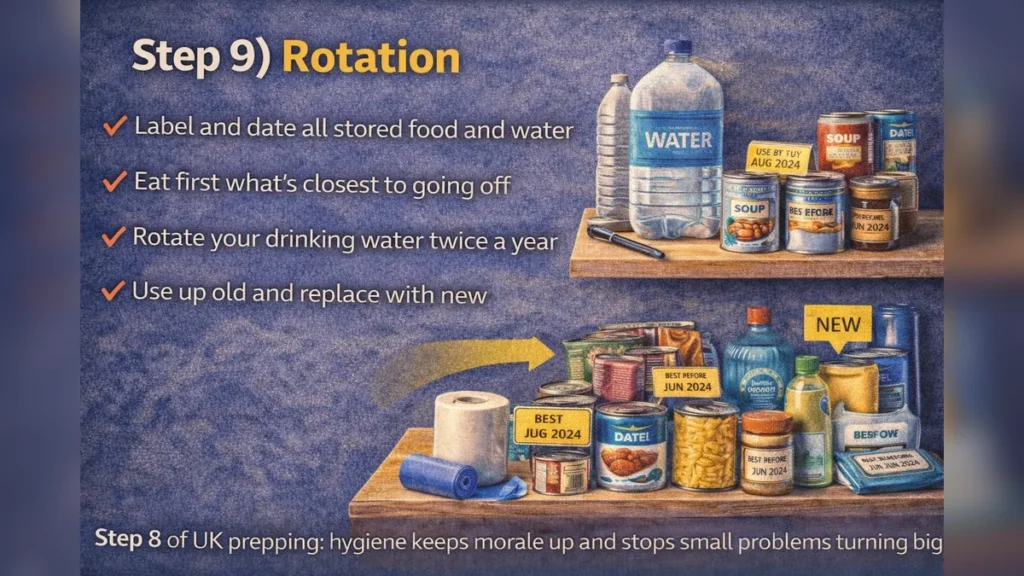
UK prepping usually fails in the boring way things quietly expire, batteries die, and the torch “vanishes.”
The fix isn’t more gear. It’s a tiny routine that keeps your setup alive.
The 10-minute monthly reset (set a reminder, done)
1) Power + light (2 minutes)
- Test torches (and headlamps if you have them)
- Top up power banks (and check charging cables are actually in the box)
- If you use batteries: make sure spares are there and not leaking
2) Restock what you used (2 minutes)
- Replace anything you’ve dipped into: wipes, bin bags, plasters, batteries
- If it’s half-empty, top it up now so you don’t “forget later”
3) Food rotation (3 minutes)
- Pull 3–5 everyday items to the front (stuff you’ll actually eat)
- Refill behind them on your next normal shop
Rule: front gets eaten, back gets refilled.
4) Meds you rely on (3 minutes)
- Check the dates on anything you genuinely depend on (e.g., pain relief you keep for headaches, allergy meds, inhalers if applicable)
- Replace anything out of date before you need it
- Make sure it’s stored where you’ll find it fast (not buried in a random drawer)
Make it effortless
- Keep everything in one obvious place (a “power cut box” / cupboard / lidded crate)
- Stick a label on it: “Monthly Reset – 10 mins”
- Do it on an easy anchor day: first Sunday or first payday of the month
This is the unsexy part that makes prepping feel genuinely calming: you’re not “getting ready for something.” You’re just keeping your house slightly more organised than yesterday.
[A Simple Weekly Routine That Makes Hygiene Preparedness UK Automatic]
The 30-Day Prepping UK Starter Path
If you want a dead-simple order:
Week 1: Plan + lighting
Week 2: Water + 72-hour food
Week 3: Warm room + phone power
Week 4: First aid + hygiene + rotation routine
That’s a complete beginner-friendly prepping UK system without the stress spiral.
Common Prepping UK Mistakes
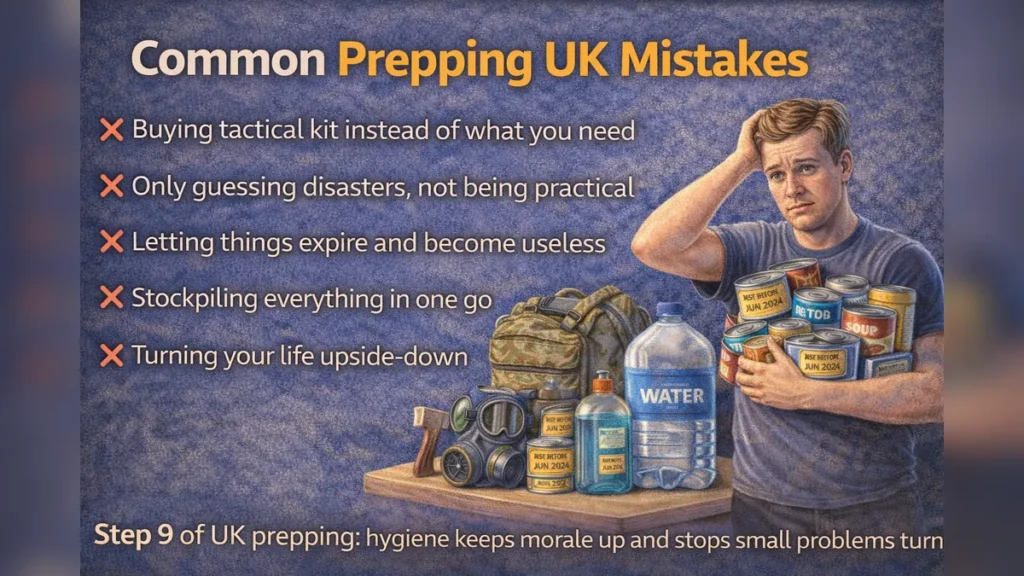
The common mistakes that quietly break UK prepping
Most people don’t “fail” because they didn’t buy enough gear. They fail because the plan stops fitting real life.
1) Buying gear before basics
It’s tempting to start with shiny kit. But the basics are what carry you through most UK disruptions.
Do this instead
- Water first (drinking + basic cooking)
- Food second (normal cupboard buffer)
- Warmth third (one safe warm room)
Gear only matters after those foundations are boringly handled.
2) Copying US advice
A lot of popular prepping content is built around US homes, US weather patterns, US distances, and different emergency realities.
UK reality check
- Smaller homes, less storage
- Different heating setups (boilers, combis, radiators)
- Common risks are more “boring”: power cuts, storms, local flooding, delivery delays, short-term disruption
So the best UK plan looks like calm household resilience, not extreme scenarios.
3) No rotation (so the “kit” turns into junk)
If food sits untouched and batteries die in a drawer, you don’t have a kit—you have clutter with an expiry date.
Simple rule
- Eat from the front
- Refill from the back
- Check torches/power banks once a month (10 minutes, done)
Rotation is what keeps prepping cheap, fresh, and real.
4) Too much, too fast
Big shopping lists and “do it all this weekend” energy usually ends in one thing: burnout.
Slow prep is sticky prep
- Add one small win per week (or per shop)
- Build layers: 72 hours first, then 7 days
- Keep it realistic enough that you’ll still do it in February, not just January
The goal isn’t to become a different person. It’s to make your normal life slightly more prepared—without making it harder to live.
[Common Mistakes That Break Hygiene Preparedness UK]
FAQs
Q: What is the best way to start prepping UK as a beginner?
A: Start with a simple plan, then do water, then 72-hour food. After that, build warmth, lighting, and phone power. This order gives the biggest comfort boost fast.
Q: How much food should I store for prepping UK?
A: Build a 72-hour layer first using supermarket food you already eat, then expand to 7 days by repeating what worked. Rotation matters more than bulk.
Q: Do I need “survival food” for prepping UK?
A: For most UK households, no. Normal long-life supermarket food is cheaper, easier to rotate, and more likely to be eaten.
Q: What’s the most important item for prepping UK?
A: Water. After that, safe warmth and lighting/phone power usually make the biggest difference to comfort and decision-making.
Q: How can renters do prepping UK with limited space?
A: Focus on portable, tenancy-friendly prep: bottled water in small distributed stashes, no-cook food, torches/power banks, a grab folder for documents, and a warm-room plan.
Q: Where can I find official UK guidance for emergencies?
A: Use the UK government’s Prepare guidance for baseline advice on planning and household essentials, then follow the step-by-step system above to make it practical at home. GOV.UK Prepare
Check out these articles for more in depth guides.