Residential generators can be a sensible part of a calm home-prep plan: not for drama, just for keeping the basics running when the mains is down. In the UK that usually means staying warm, keeping food safe, charging phones, running the router, and maybe keeping a small medical device powered.
But residential generators are not “plug it in and forget it” kit. Used badly, they can be genuinely dangerous. Used well, they’re a dependable, practical backup option alongside simpler choices like battery power stations.
This guide walks you through residential generators in plain English: which types suit UK homes, how to size one, what they cost, how fuel works, and what “safe” actually looks like.
If you like to start at the beginning then start here: Prepping UK The Complete System
Key takeaways
- Most UK households don’t need a “whole house” setup: a smaller residential generator that covers essentials is usually cheaper, quieter, and simpler.
- The safest default is a portable inverter generator powering appliances via extension leads outdoors, not tied into your home wiring.
- Never run residential generators indoors or in garages, and don’t place them near doors/windows because of carbon monoxide risk.
- If you want to power fixed circuits (lights, boiler controls, sockets), you need a qualified electrician and a proper changeover/transfer arrangement. Part P applies to domestic electrical work.
- In the UK you can store up to 30 litres of petrol at home without informing your local Petroleum Enforcement Authority, but storage must be sensible and safe.
- For flats and renters, a battery power station is often safer and more practical than residential generators that burn fuel.
Residential generators what they are and when they make sense
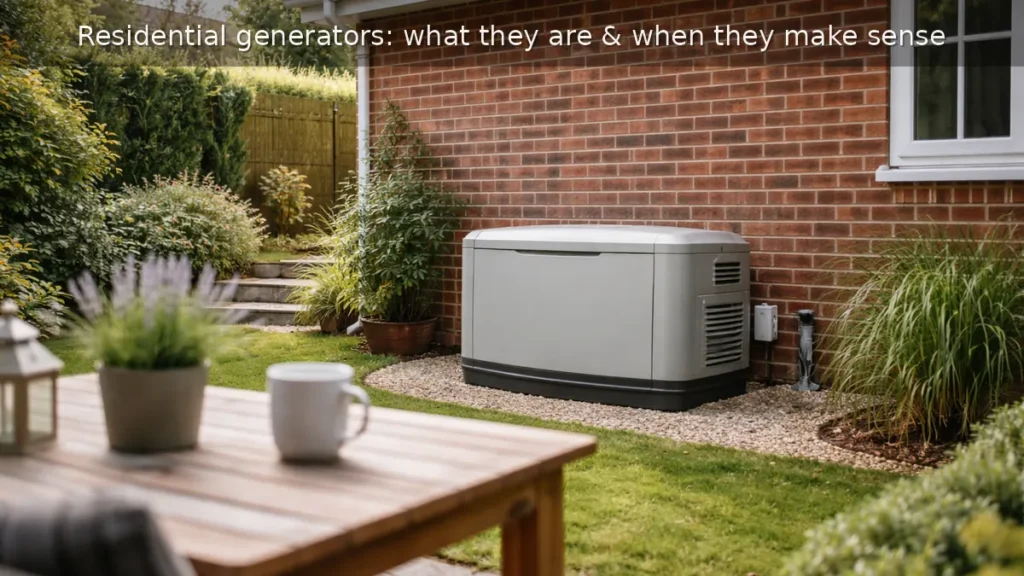
Residential generators are engines (or sometimes gas-powered units) that produce electricity so you can run appliances when the mains supply is off. In UK homes they’re usually used for:
- Keeping a fridge/freezer cold
- Charging phones, power banks, radios, torches
- Running a router for Wi-Fi (when your provider’s network is still up)
- Powering a small heater fan briefly (not ideal, high load)
- Running medical equipment (only if you’ve checked requirements properly)
Residential generators make most sense if you have one or more of these realities:
- You get power cuts a few times a year and you’re fed up losing food and heating control.
- Someone at home has a higher need for reliable charging/power (medical, care needs, work).
- You live in a rural area where repairs can take longer.
- You want a backup plan that doesn’t rely on keeping big battery banks charged.
If your goal is simply “phones, lights, router” for 24–48 hours, you may not need residential generators at all — a battery power station can be simpler and quieter. We’ll cover that later.
[Power cuts UK guide]
[UK Power Cuts Managing Life Without Electricity]
Types of residential generators for UK homes
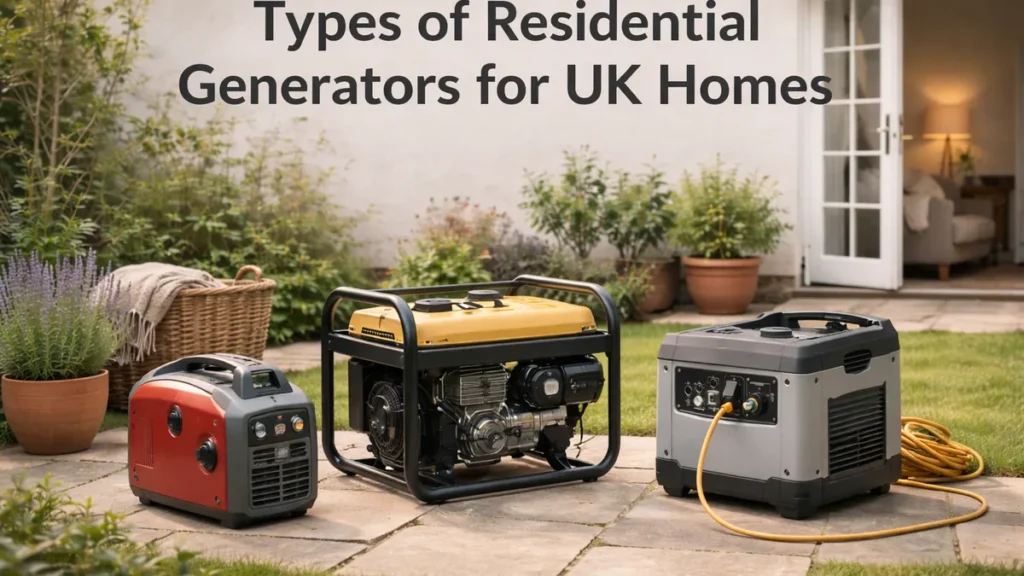
The word “generator” covers a few different options. Here’s the simple breakdown for residential generators in the UK.
Portable open-frame generators
- Usually the cheapest “watts for money”
- Often louder
- Power quality varies (some are fine, some are rougher for sensitive electronics)
Best for: occasional use, tools, basic appliances, people who can tolerate noise.
Portable inverter generators
- Cleaner, more stable power (better for electronics)
- Often quieter and more fuel-efficient at lower loads
- Typically more expensive for the same output
Best for: family backup, phones/laptops/router, fridge/freezer, calmer everyday use.
Standby generators (fixed installation)
- Permanently installed outside
- Can start automatically
- Can feed selected circuits or (with the right design) much of the home
- Requires professional installation and electrical work
Best for: higher-need households and people who want a “turnkey” solution.
Battery “solar generators” (not fuel generators)
These aren’t residential generators in the engine sense, but they’re often what people actually need: a big rechargeable battery with sockets.
Best for: flats/renters, quieter neighbourhoods, quick “grab-and-go” power.
Quick comparison table
| Option | Typical use | Pros | Cons |
|---|---|---|---|
| Open-frame portable | Tools + basics | Lower cost per watt | Noisy, power quality varies |
| Inverter portable | Essentials + electronics | Quieter, cleaner power | Costs more per watt |
| Standby fixed | Whole-home or key circuits | Automatic, convenient | Higher cost, installation required |
| Battery power station | Lights + charging + router | Quiet, indoor-safe | Limited runtime for high loads |
Sizing residential generators what you actually need to run
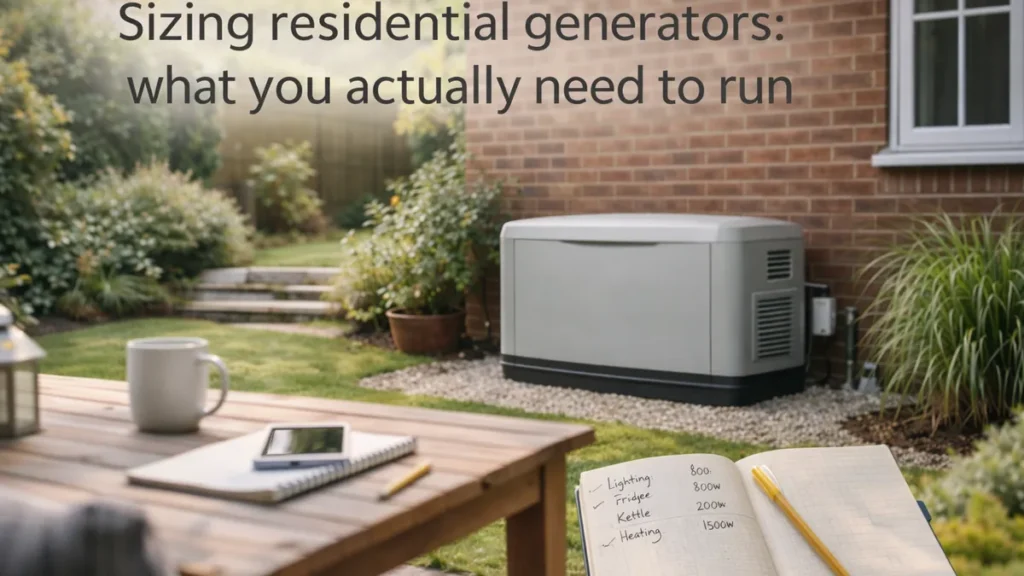
Most people overspend because they size for “everything” instead of “essentials”. With residential generators, a realistic UK approach is:
- Pick 3–6 essentials you actually want at the same time
- Check running watts and start-up surge watts
- Add a safety margin
- Choose the generator that meets that number comfortably
A practical “UK essentials” watt guide
These are rough typical figures (always check your exact appliance label/manual):
| Item | Typical running watts | Start-up surge |
|---|---|---|
| Wi-Fi router | 10–20W | Low |
| Phone charger | 5–20W | Low |
| Laptop charger | 45–100W | Low |
| LED lamp | 5–15W | Low |
| Fridge/freezer | 100–250W | 2–3× surge |
| Microwave | 800–1500W | Some surge |
| Kettle | 2500–3000W | High (avoid) |
| Toaster | 800–1500W | Medium |
| Electric heater | 1000–3000W | High (avoid) |
Two realistic sizing examples
Example 1: “Keep-it-simple” essentials
- Fridge/freezer + router + 2 LED lamps + chargers
You’re often fine with a smaller inverter unit, as long as it can handle the fridge start-up surge.
Example 2: “Add a microwave occasionally”
You’ll need more headroom. The microwave plus fridge surge is where a lot of small units struggle.
A good rule for residential generators: buy for the surge, not the average.
Do this now make your “power cut essentials list”
Write down:
- Must-have items
- Nice-to-have items
- Definitely-not items (kettle, oven, tumble dryer… basically anything that’s a heavy heater)
Fuel options for residential generators in the UK

Fuel choice affects storage, noise, servicing, and practicality.
Petrol
- Common for portable residential generators
- Easy to buy, but needs safe storage
- Not great for long storage without rotation
UK rule of thumb: you can store up to 30 litres of petrol at home (or other non-workplace premises) without informing your local Petroleum Enforcement Authority.
Diesel
- Common for larger, standby-style residential generators
- Often better for long runs and fuel efficiency
- Can be louder/heavier and more expensive upfront
LPG (bottled gas) or natural gas
- Cleaner burning, often quieter for standby setups
- LPG storage is a separate safety topic (follow bottle storage rules)
- If you have mains gas and a suitable standby system, it can be very convenient
A quick note on permits and “bigger” installs
Most homes won’t be dealing with environmental permitting. But if you’re looking at a larger fixed generator (or you’re using it for business premises), it’s worth being aware that the UK has rules around “specified generators” for air quality and permitting in some cases. If you’re going down the fixed-install route, a reputable installer should guide you.
Safety first with residential generators
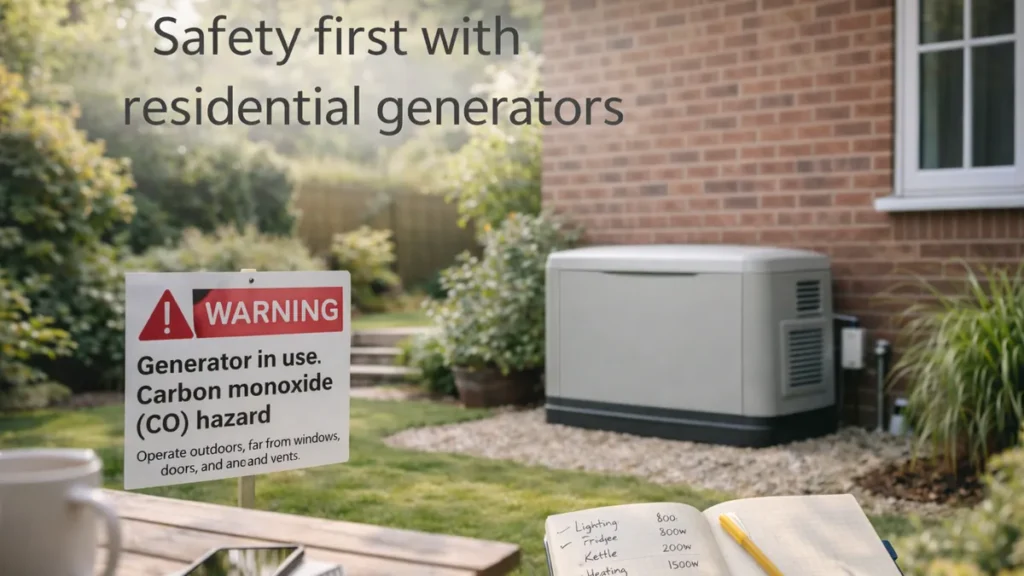
This matters more than specs. The biggest real-world risks with residential generators are carbon monoxide, unsafe electrics, and poor fuel handling.
Carbon monoxide: the non-negotiable rule
Never use a portable generator indoors during a power cut — including garages and partly enclosed spaces.
National Grid specifically warns not to use portable generators indoors during power cuts because of carbon monoxide risk.
And it’s not enough to “crack a window” or use fans — safety guidance warns this does not prevent dangerous build-up.
If you want a clear, calm rule: residential generators live outdoors, well away from doors, windows, vents, and air bricks.
For extra protection, use carbon monoxide alarms that meet EN 50291 and have recognised certification marks. NICE CKS includes this recommendation.
If you suspect exposure and feel unwell, GOV.UK guidance is to get medical help (NHS 111/GP, or 999 in an emergency).
Electrical safety avoid “DIY backfeed” at all costs
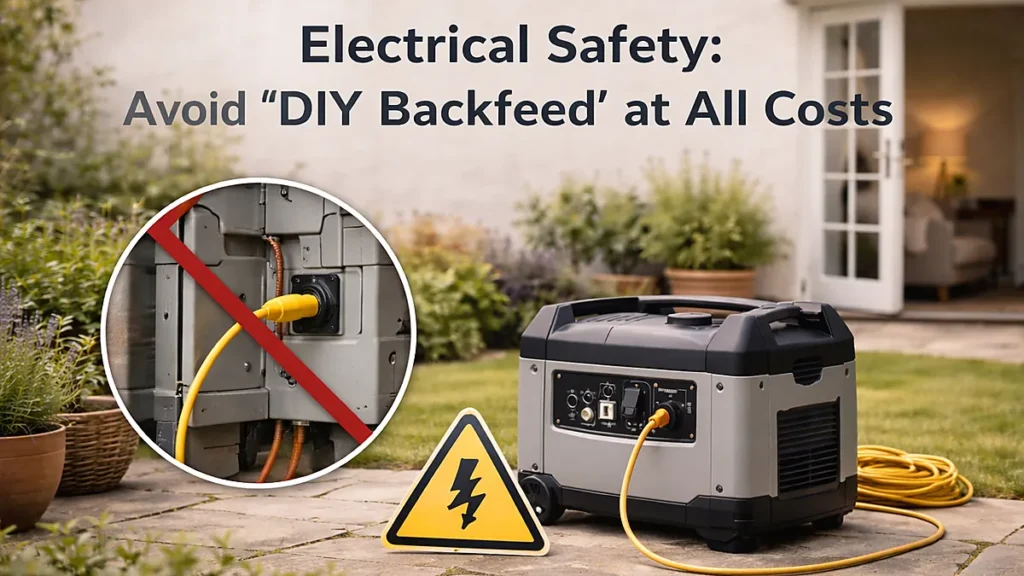
If you’re only powering appliances via extension leads straight from the generator, your setup is simpler.
If you want to power house circuits (lights, boiler controls, sockets), do not “DIY connect” into your consumer unit. Domestic electrical installation work falls under Building Regulations requirements, including Part P.
The safe route is: a qualified electrician designs and installs a proper changeover/transfer arrangement so your home is isolated from the grid before any generator supply is connected.
Product safety look for proper UK compliance marking
In the UK, electrical products may need UKCA marking (or equivalent compliant marking depending on the product category and rules). GOV.UK has the official guidance on UKCA.
This isn’t about “being fancy” — it’s about avoiding dodgy kit for something that can cause harm.
Fuel storage basics
If you store petrol, keep within sensible limits and store it in suitable containers, away from living areas and ignition sources. The HSE states you can store up to 30 litres at home without informing your local Petroleum Enforcement Authority.
Do this now a residential generators safety checklist
- Generator stored dry and ready, with oil checked
- Extension leads rated for outdoor use, fully uncoiled
- Carbon monoxide alarm(s) in the home (EN 50291 standard)
- Plan where the generator will sit outdoors (not near doors/windows)
- If powering house circuits: electrician + proper changeover/transfer setup (Part P applies)
[Internal link: Home safety checklist for outages]
How to use residential generators in a power cut
Here’s a calm, repeatable routine.
Step 1: Decide what you’re powering
Use your “essentials list” and start small. You can always add later.
Step 2: Set the generator up safely outdoors
- Flat, stable surface
- Away from doors/windows/vents
- Protected from rain (without enclosing it)
Step 3: Start the generator, then connect loads
- Start the generator first
- Let it stabilise
- Plug in one device at a time
This reduces overload trips and helps you notice if something is drawing more than expected.
Step 4: Rotate “high draw” items
If you’re using residential generators for a microwave, for example: run it briefly, then switch it off before turning other things back on.
Step 5: Shut down safely
- Unplug devices
- Let the generator run briefly with no load if the manual recommends it
- Switch off and cool before refuelling
What residential generators cost in the UK
Costs vary massively by output, noise level, and whether you’re installing a standby system.
Here are realistic ranges you’ll see in UK cost guides:
- Portable generators: often priced in the hundreds to a couple of thousand pounds depending on size and type
- Standby/whole-home type systems: several thousand pounds and up, before/including installation depending on capacity
Cost snapshot table
| Setup | What it covers | Typical cost feel |
|---|---|---|
| Small inverter portable | Essentials | £500–£1,500-ish |
| Larger portable | More appliances | £1,000–£2,500-ish |
| Standby generator | Key circuits / more coverage | £3,000–£15,000+ depending on scope |
(Those are guide ranges — always price-check and quote properly.)
Running costs and fuel use
Running costs depend on fuel price, load, and generator efficiency. A UK generator retailer guide suggests small generators can cost roughly £1.50 to £3 per hour to run (depending on fuel and usage).
Fuel use also scales with load. One UK generator supplier notes a small ~2.2kW petrol generator might use around 1–1.5 litres per hour, while larger units can use more under heavy load.
Practical takeaway: if you buy bigger than you need, you’ll often pay more to run it too.
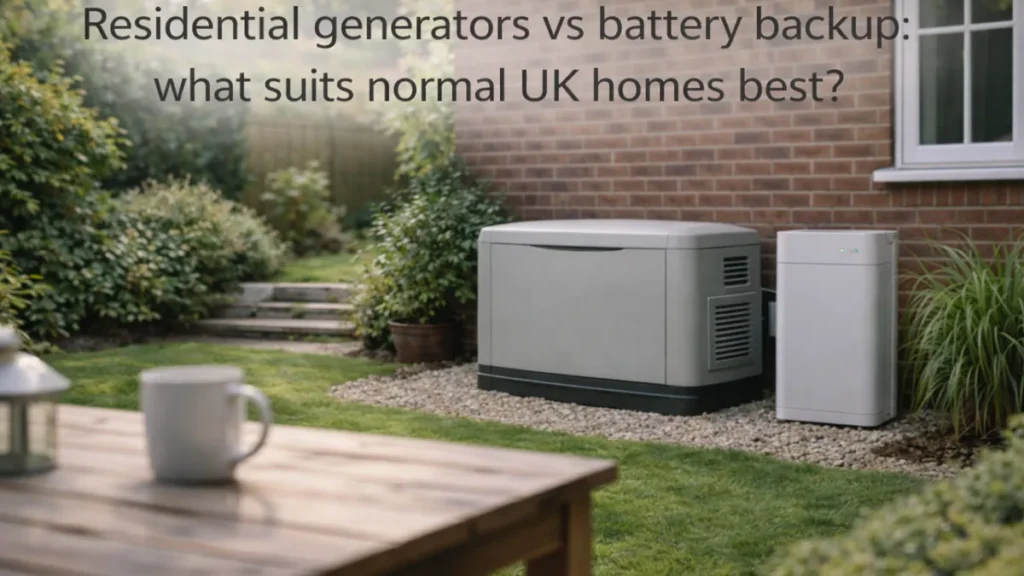
Residential generators vs battery backup, what suits normal UK homes best?
A lot of “generator shopping” starts because people want:
- phone charging
- lights
- Wi-Fi
- maybe a fridge
For that, a battery power station can be the calmer choice: quiet, no fumes, and usable indoors.
Residential generators come into their own when:
- you need longer runtime than a battery can provide
- you need higher power (or you can’t keep batteries topped up)
- you want a backup that’s independent of the grid for longer spells
A sensible UK approach for many households is a hybrid plan:
- Battery power station for night-time, quiet hours, indoor use
- Residential generator for daytime top-ups and running heavier loads (outdoors, safely)
[Portable power stations for UK power cuts]
Residential generators for renters and flats

If you rent or live in a flat, residential generators can be awkward:
- Safe outdoor placement can be difficult
- Noise and neighbour impact matters
- Fuel storage may be impractical
For many renters, the best “backup power” route is:
- battery power station
- power banks
- rechargeable lanterns
- a small UPS for the router (if needed)
If you do consider residential generators in a rental, keep it simple and portable, and be strict about outdoor use and carbon monoxide safety.
Maintenance checklist for residential generators
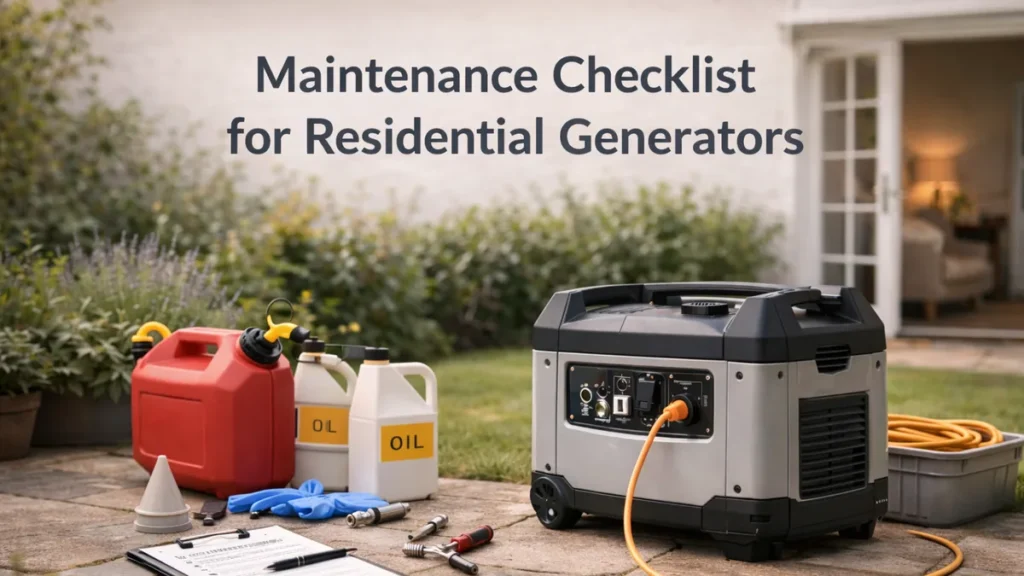
A generator that “should work” is not the same as a generator that will work.
Monthly quick check
- Start it and let it run briefly (follow the manual)
- Check oil level
- Inspect leads and plugs for damage
- Confirm you can find everything in one place (generator, leads, funnel, gloves)
Every 3–6 months
- Rotate fuel sensibly (don’t hoard)
- Replace/clean filters if required
- Check spark plug condition (petrol units)
Once a year
- Full service (or pay for one)
- Re-check your essentials list and watt needs
- Review where you’ll place it outdoors safely
FAQs
Are residential generators worth it in the UK?
They can be — if you have repeat outages, higher power needs, or want longer runtime than batteries offer. For many households, a smaller inverter-style residential generator (essentials only) is the sweet spot.
Can I run a residential generator in a garage with the door open?
No. Safety guidance warns against using generators indoors or in partially enclosed spaces, and warns that opening windows/using fans doesn’t prevent carbon monoxide build-up.
Do I need an electrician to use residential generators?
If you’re powering appliances via extension leads, not necessarily (but you must follow safety guidance). If you want to feed house circuits, yes — and domestic electrical work is covered under Building Regulations including Part P.
How much petrol can I store at home for a generator?
The HSE states you can store up to 30 litres of petrol at home (non-workplace premises) without informing your local Petroleum Enforcement Authority.
What should I look for when buying residential generators?
Prioritise: correct sizing, quieter operation (if needed), stable power (inverter style for electronics), reputable supplier support, and proper product compliance marking guidance (UKCA rules apply depending on the product).
Next step: build your calm backup power plan
Do this today:
- Write your “essentials list” and estimate watts
- Decide if your home is better suited to a battery setup, residential generators, or a hybrid
- Set up the safety basics first (outdoor placement plan + CO alarm)